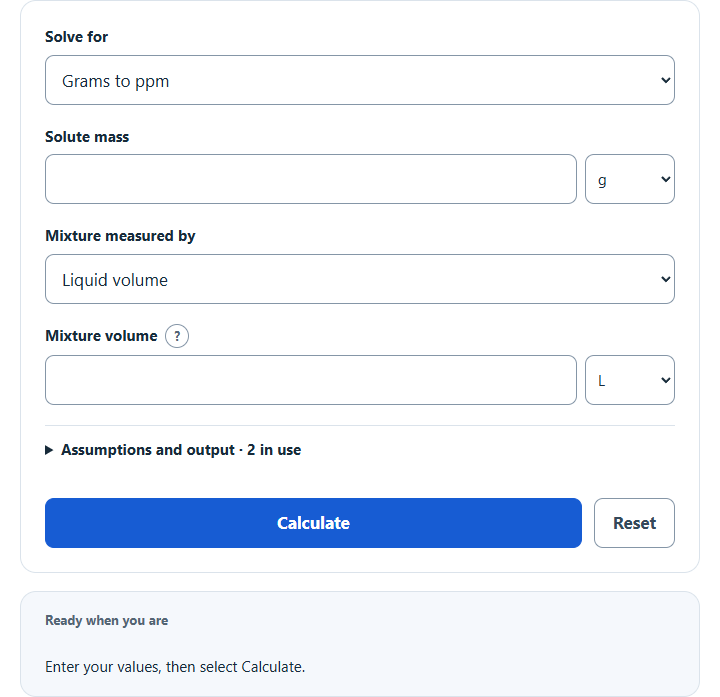
Convert grams to ppm from solute mass and mixture volume or mass, find the grams needed for a target ppm, or convert g/L, % and mg/g to ppm.
Calculator Functions
| Function | What it does | What it requires |
|---|---|---|
| Grams to ppm | Finds the concentration of a mixture in ppm by mass from the mass of solute in it | Requires the solute mass, plus the volume or total mass of the finished mixture |
| ppm to grams (solute needed) | Finds the mass of solute contained in a finished mixture of a set size at a target concentration | Requires the target ppm, plus the volume or total mass of the finished mixture |
| Add solute to an existing mix | Finds the mass of pure solute to add to a mixture that already exists, allowing for the mass the addition itself contributes | Requires the target ppm, the volume or total mass of the starting mixture, and its current ppm (blank counts as 0) |
| Convert g/L, %, mg/g or g/mL to ppm | Converts a concentration stated in another unit to ppm by mass | Requires the concentration value and its unit: mg/L, g/L, g/mL, mg/mL, µg/mL, mg/g, g/kg, percent by mass or ppb |
The first three functions take the mixture as a liquid volume (L, mL, US fl oz or US gal) or as a total mass (g, kg, lb or oz). A volume is converted to mass with the solution density, which is 1 kg/L unless changed. Every result also shows the concentration as mg/kg, percent by mass and ppb, and liquid results other than Add solute to an existing mix add mg/L, g/L and percent w/v. Optional settings set the output mass unit and the number of decimal places.
Grams to ppm Formulas
| ppm | Concentration in parts per million by mass, the same number as mg/kg [1] |
| m | Mass of solute (g) |
| M | Total mass of the mixture, including the solute (g) |
The ratio m ÷ M is the mass fraction of the solute [2]. Each function below applies this relationship in a different direction.
Grams to ppm
The solute mass is divided by the total mixture mass and multiplied by one million. When the mixture is measured as a liquid, its mass comes from volume and density:
V is the mixture volume in liters and ρ is the solution density in kg/L. Amounts entered in lb, oz, US gal or US fl oz are converted to grams and liters first, using the NIST factors [3]. A solute mass larger than the mixture mass is rejected.
Grams per liter to ppm
One liter of a water-based mixture at 1 kg/L has a mass of 1,000 g, so ppm = grams × 1,000 and grams = ppm ÷ 1,000. The same figures apply per liter of a larger batch: 2 g in 10 L is 0.2 g per liter, or 200 ppm.
| Solute in 1 L of mixture | ppm by mass at 1 kg/L |
|---|---|
| 0.001 g (1 mg) | 1 ppm |
| 0.005 g | 5 ppm |
| 0.01 g | 10 ppm |
| 0.05 g | 50 ppm |
| 0.1 g | 100 ppm |
| 0.25 g | 250 ppm |
| 0.5 g | 500 ppm |
| 1 g | 1,000 ppm |
| 2 g | 2,000 ppm |
| 5 g | 5,000 ppm |
| 10 g | 10,000 ppm (1%) |
ppm to grams (solute needed)
This is the main formula rearranged. M is the finished mixture, so the solute is part of that amount and is not added on top of it. A 10 L batch at 1 kg/L and 200 ppm contains 10,000 × 200 ÷ 1,000,000 = 2 g of solute.
Add solute to an existing mix
(1,000,000 − T)
x is the mass of pure solute to add, M₀ is the mass of the mixture before the addition, T is the target ppm and C is the current ppm. The addition raises the total mass as well as the solute mass, which is why the divisor is 1,000,000 − T. Raising 10 L at 1 kg/L from 200 ppm to 500 ppm takes 10,000 × 300 ÷ 999,500 = 3.0015 g. A target below the current concentration is rejected, because adding solute cannot lower it.
Convert g/L, %, mg/g or g/mL to ppm
A unit that is already a mass per mass converts by a fixed factor. A unit that is a mass per volume also depends on the solution density:
ρ is the solution density in kg/L. At 1 kg/L, 1 mg/L equals 1 ppm, which is the usual assumption for water samples [1].
| 1 unit of | ppm by mass | Basis |
|---|---|---|
| mg/kg, or g/t (gram per tonne) | 1 | Mass per mass |
| ppb by mass (µg/kg) | 0.001 | Mass per mass |
| mg/g, or g/kg | 1,000 | Mass per mass |
| Percent by mass (g/100 g) | 10,000 | Mass per mass |
| g/g | 1,000,000 | Mass per mass |
| mg/L, or µg/mL | 1 | At 1 kg/L |
| g/L, or mg/mL | 1,000 | At 1 kg/L |
| g/mL | 1,000,000 | At 1 kg/L |
For a liquid of another density, the mass per volume figures are divided by that density: 1 g/L at 1.2 kg/L is 833.33 ppm. A value in g/t goes in as ppm by mass (mg/kg), since the two are the same.
Limits of This Estimate
- The result is ppm by mass. It is not the ppm by volume used for gases, and it is not a mole fraction.
- A density of 1 kg/L suits dilute water-based mixtures, where a liter weighs about 1 kg [1]. Brines, syrups, acids, oils and solvents need their measured density, or a mixture measured by mass.
- Add solute to an existing mix assumes pure solute that mixes completely, with no reaction or loss. It gives the final mass and does not predict the final volume.
Sources
- U.S. EPA, Test Methods, Data Reporting Questions: 1 ppm equals 1 mg/kg, and 1 mg/L for water samples
- NIST, Guide for the Use of the International System of Units (SP 811), Section 8.6.10: mass fraction as the mass of a substance divided by the mass of the mixture
- NIST, Guide for the Use of the International System of Units (SP 811), Appendix B.8: factors for pounds, ounces, US gallons and US fluid ounces