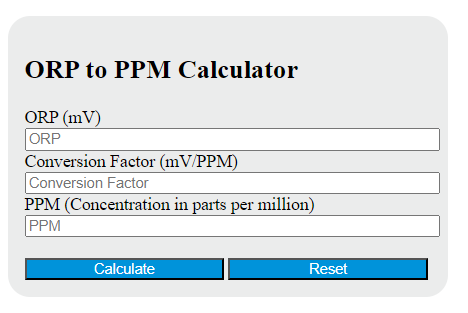
Calculate free chlorine ppm from an ORP reading in mV using your pool’s pH, cyanuric acid and water temperature, or solve for the ORP or ppm you need.
- All Chemistry Calculators
- ORP to Chlorine Calculator
- PPM Calculator
- PPM to mg/L Calculator
- mg/L to PPM Converter
- PPM to Molarity Calculator
- CO2 PPM Calculator
ORP To ppm Formula
The following formula can be used only when you have established an appropriate, application-specific linear calibration between ORP and a particular concentration (ppm) over a limited range (for example, via lab testing in the same water chemistry, pH, temperature, and sensor/reference setup). ORP itself is an electrochemical potential (mV) and does not have a universal conversion to ppm.
Variables:
- PPM is the concentration (parts per million) of the specific substance you calibrated for
- ORP is the oxidation-reduction potential (typically measured in mV versus a reference electrode)
- K is the conversion factor (slope) from your calibration (mV/ppm)
To estimate the concentration in parts per million using this simplified model, divide the ORP by the calibrated conversion factor. Note: many real ORP-to-concentration relationships are not linear and may include an offset (intercept). If your calibration has an offset, you may need to subtract the baseline ORP (at 0 ppm) before using this formula.
| ORP (mV) | PPM |
|---|---|
| 400 | 1.333 |
| 425 | 1.417 |
| 450 | 1.500 |
| 475 | 1.583 |
| 500 | 1.667 |
| 525 | 1.750 |
| 550 | 1.833 |
| 575 | 1.917 |
| 600 | 2.000 |
| 625 | 2.083 |
| 650 | 2.167 |
| 675 | 2.250 |
| 700 | 2.333 |
| 725 | 2.417 |
| 750 | 2.500 |
| 775 | 2.583 |
| 800 | 2.667 |
| 825 | 2.750 |
| 850 | 2.833 |
| 875 | 2.917 |
| * Rounded to 3 decimals. Assumes linear model ORP = K × PPM with K = 300 mV/ppm as an example only. Actual ORP–PPM relationships depend on the redox chemistry, pH, temperature, and sensor/reference conditions. | |
What is ORP To ppm?
ORP (oxidation-reduction potential, also called redox potential) is a millivolt (mV) measurement that indicates how strongly a solution tends to oxidize or reduce other substances. PPM (parts per million) is a concentration unit for a specific chemical in water (for example, free chlorine, dissolved oxygen, or another analyte). There is no universal, chemistry-independent conversion from ORP to ppm; at best, ORP can sometimes be empirically correlated to the ppm of a particular oxidant/disinfectant residual under fixed conditions. Higher ORP often indicates more oxidizing conditions, but it does not uniquely determine “contaminant ppm,” and the direction/magnitude of any correlation depends on the system.
How to Calculate ORP To ppm?
The following steps outline how to estimate ppm from ORP using the simplified formula: PPM = ORP / K (where K is a calibration factor for your specific application).
- First, measure the ORP (oxidation-reduction potential) value (mV) with your ORP probe/meter.
- Next, determine the conversion factor (K) value (mV/ppm) from your own calibration data for the specific substance and conditions.
- Next, gather the formula from above: PPM = ORP / K.
- Finally, calculate the estimated concentration in parts per million (ppm).
- After inserting the variables and calculating the result, check your answer with the calculator above.
Example Problem:
Use the following variables as an example problem to test your knowledge (assumes you have calibrated a linear relationship for your specific system).
ORP (oxidation-reduction potential) = 600 mV
Conversion factor (K) = 300 mV/ppm