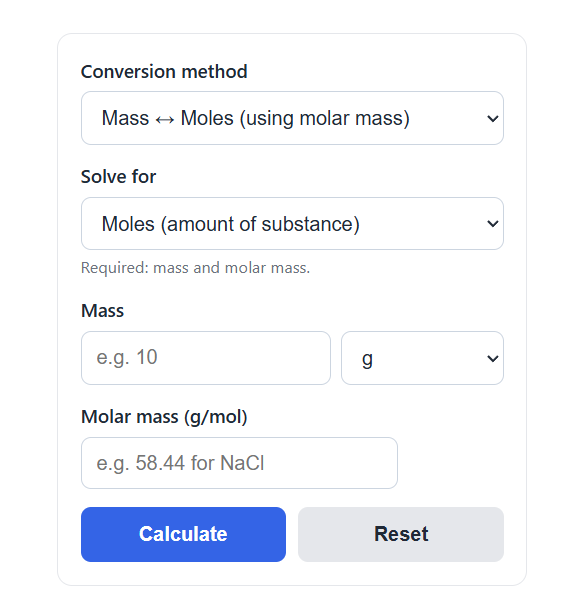
Calculate moles from mass and molar mass, a particle count, or molarity and volume, and solve in reverse for mass, molarity, or volume.
Mole Formula
This calculator works in three modes. Each mode uses a different relationship to find the amount of substance in moles.
Mass and moles (using molar mass):
n = m / M
Particles and moles (using Avogadro's number):
n = N / Na
Solution and moles (using molarity and volume):
n = M * V
- n = amount of substance (mol)
- m = mass of the sample (g)
- M = molar mass of the substance (g/mol)
- N = number of particles (atoms, molecules, or ions)
- Na = Avogadro's number, 6.022 x 10^23 particles per mole
- V = volume of solution (L)
In mass mode you divide the mass by the molar mass to get moles, and you can rearrange the same equation to solve for mass (m = n * M) or molar mass (M = m / n). In particles mode you divide the particle count by Avogadro's number to get moles, or multiply moles by Avogadro's number to get the particle count. In solution mode you multiply molarity by volume to get moles, and the same relationship solves for molarity (M = n / V) or volume (V = n / M). The "Solve for" selector controls which variable the calculator returns, and only the inputs needed for that choice stay visible.
Common Molar Masses and Conversion Values
The molar mass you enter is the sum of the atomic masses in the chemical formula, in grams per mole. The table below lists molar masses for common substances so you can check your input.
| Substance | Formula | Molar mass (g/mol) |
|---|---|---|
| Water | H2O | 18.02 |
| Table salt | NaCl | 58.44 |
| Carbon dioxide | CO2 | 44.01 |
| Glucose | C6H12O6 | 180.16 |
| Sulfuric acid | H2SO4 | 98.08 |
The constants below are the fixed values the calculator uses when you convert between particles, moles, and solutions.
| Quantity | Value |
|---|---|
| Avogadro's number | 6.022 x 10^23 particles/mol |
| 1 mole of any gas at STP | 22.4 L |
| Molarity (M) | moles per liter of solution |
Example Problems
Example 1. You have 10 g of sodium chloride (NaCl), which has a molar mass of 58.44 g/mol. To find the moles, divide the mass by the molar mass: n = 10 / 58.44 = 0.171 mol. Set the calculator to mass mode and solve for moles to check this result.
Example 2. You have 0.5 mol of a compound dissolved in 2 L of solution. To find the molarity, divide moles by volume: M = 0.5 / 2 = 0.25 mol/L. Set the calculator to solution mode and solve for molarity to confirm.
FAQ
What is a mole in chemistry?
A mole is a counting unit for particles. One mole contains 6.022 x 10^23 particles, which is Avogadro's number. It links the mass of a sample you can weigh to the number of atoms or molecules it contains.
How do you find molar mass?
Add the atomic masses of every atom in the chemical formula, using the values from the periodic table. For water (H2O) you add two hydrogen atoms (about 1.008 each) and one oxygen atom (about 16.00) to get 18.02 g/mol. Enter that value in the molar mass field.
Can this calculator convert moles back to mass or particles?
Yes. Each mode has a "Solve for" selector. In mass mode you can solve for moles, mass, or molar mass. In particles mode you can solve for moles or the number of particles. In solution mode you can solve for moles, molarity, or volume.