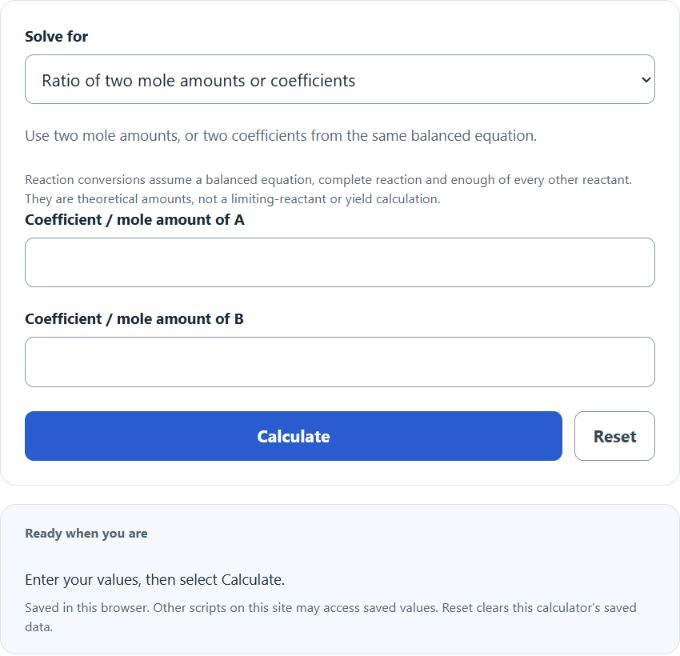
Calculate mole ratios and stoichiometric conversions from balanced equations, finding moles or grams of B from A's amount with coefficients.
Related Calculators
- Volume To Moles Calculator
- Density To Moles Calculator
- Molar Volume Calculator
- Molecules To Gram Calculator
- All Chemistry Calculators
Mole-to-Mole Ratio Formula
The mole ratio compares one mole amount to another. In composition problems, the standard approach is to divide the moles of each element or substance by the smallest mole value in the set. This expresses the composition in the simplest relative form and is especially useful when finding empirical formulas.
Where:
- MMR = mole-to-mole ratio
- ne = moles of the selected element or substance
- nmin = smallest mole value among the substances being compared
Although the ratio is often written as mol/mol, it is fundamentally a relative comparison. Once every amount is expressed in moles, the units cancel and only the numerical relationship remains.
How to Calculate a Mole Ratio
- Convert each quantity to moles if the data is given in grams, particles, or volume-based chemical units.
- Identify the smallest mole value in the full set.
- Divide each mole amount by that smallest value.
- Round values that are already very close to whole numbers.
- If needed, multiply all ratios by the same small whole number to remove fractions such as 0.5, 0.33, 0.67, 0.25, or 0.75.
This process is what turns raw mole data into a chemically meaningful ratio such as 1:2, 2:3, or 1:1.5 before final simplification.
Example
If a substance has 12 moles and the smallest mole amount in the comparison is 10 moles, the ratio for that substance is:
That means the substance is present at 1.2 times the smallest mole amount. If this value is part of an empirical-formula calculation, you would compare it with the ratios of the other elements and then decide whether all values are already close enough to whole numbers or need to be scaled.
Why the Smallest Mole Value Is Used
Dividing by the smallest mole amount normalizes the entire set. The smallest value becomes 1, and every other value shows how many times larger it is relative to that baseline. This is the fastest way to move from measured amounts to a simplest ratio.
- If the results are near 1, 2, 3, or 4, round carefully.
- If the results cluster around 1.5, multiply all ratios by 2.
- If the results cluster around 1.33 or 1.67, multiply all ratios by 3.
- If the results cluster around 1.25 or 1.75, multiply all ratios by 4.
When Mole Ratios Are Used
- Determining empirical formulas from elemental analysis
- Comparing reactants or products in chemistry problems
- Interpreting laboratory composition data
- Checking whether a measured sample matches an expected chemical relationship
- Preparing for stoichiometry calculations based on balanced equations
Mole Ratio vs. Stoichiometric Ratio
A mole ratio can come from measured composition data, but chemistry problems also use mole ratios from balanced chemical equations. In that case, the coefficients in the equation provide the conversion factor between substances.
In this relationship:
- nknown is the known amount in moles
- ndesired is the amount you want to find
- νknown and νdesired are the balanced-equation coefficients
The key distinction is simple: dividing by the smallest mole value is used to simplify composition data, while coefficient ratios are used to convert between substances in a balanced reaction.
Quick Reference
| Situation | What You Do | Result |
|---|---|---|
| Composition or empirical-formula problem | Divide each mole amount by the smallest mole amount | Simplest relative ratio |
| Balanced chemical equation | Use coefficient ratios between known and desired substances | Converted moles of reactant or product |
| Ratio contains decimals | Multiply all ratios by the same small whole number | Whole-number subscripts or cleaner ratio values |
Common Mistakes
- Using grams directly instead of converting to moles first
- Dividing by the wrong reference value instead of the smallest mole amount
- Rounding too early and changing the intended chemical relationship
- For reaction problems, using an unbalanced equation
- Forgetting that similar decimals may indicate a multiplier is needed rather than simple rounding
Frequently Asked Questions
Is mole ratio the same as mass ratio?
No. Mass ratio compares masses, while mole ratio compares amounts of substance on a particle-count basis. Because different substances have different molar masses, the two ratios are not usually the same.
Do mole ratios always become whole numbers immediately?
Not always. Experimental data often produces decimals first. After dividing by the smallest mole value, you may need to multiply all ratios by 2, 3, or 4 to reveal the simplest whole-number relationship.
Can this be used for empirical formulas?
Yes. This is one of the main uses of a mole ratio calculation. Once each element’s mole value is divided by the smallest one, the resulting ratio can be translated into empirical-formula subscripts.
Why is the ratio sometimes written as mol/mol if the units cancel?
Writing mol/mol helps show that the comparison started with mole quantities, but mathematically the ratio is dimensionless because the same unit appears in both the numerator and denominator.