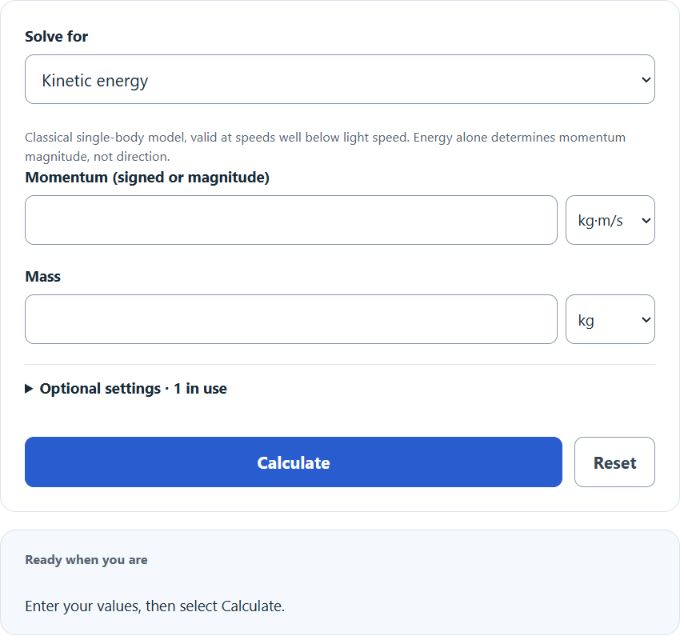
Select kinetic energy, momentum magnitude, or mass, enter the two known values, and convert between kg·m/s, lbm·ft/s, kg, lbm, J, and BTU (International Table).
- Mechanics and Physics Unit Converters
- All Energy Calculators
- All Physics Calculators
- Momentum to Force Calculator
Kinetic Energy From Momentum Formula
The following classical equation gives the kinetic energy of a single body with positive mass at speeds well below light speed.
Variables:
- Where KE is the Kinetic Energy From Momentum (joules)
- p is the total momentum (kg-m/s)
- m is the mass (kg)
To calculate the kinetic energy from momentum, square the momentum, then divide by 2 times the mass.
| Momentum (kg·m/s) | Mass (kg) | Kinetic Energy (J) | Kinetic Energy (BTU) |
|---|---|---|---|
| 0.5 | 1.00 | 0.125 | 0.000118 |
| 1 | 1.00 | 0.500 | 0.000474 |
| 1.5 | 1.00 | 1.125 | 0.001066 |
| 2 | 1.00 | 2.000 | 0.001896 |
| 2.5 | 1.00 | 3.125 | 0.002962 |
| 3 | 1.00 | 4.500 | 0.004265 |
| 4 | 1.00 | 8.000 | 0.007583 |
| 5 | 1.00 | 12.500 | 0.011848 |
| 6 | 1.00 | 18.000 | 0.017061 |
| 7.5 | 1.00 | 28.125 | 0.026657 |
| 8 | 1.00 | 32.000 | 0.030330 |
| 10 | 1.00 | 50.000 | 0.047391 |
| 12 | 1.00 | 72.000 | 0.068243 |
| 15 | 1.00 | 112.500 | 0.106629 |
| 20 | 1.00 | 200.000 | 0.189563 |
| 25 | 1.00 | 312.500 | 0.296193 |
| 30 | 1.00 | 450.000 | 0.426518 |
| 40 | 1.00 | 800.000 | 0.758254 |
| 50 | 1.00 | 1250.000 | 1.184771 |
| 60 | 1.00 | 1800.000 | 1.706071 |
| Assumes constant mass m = 1.00 kg. Relation: KE = p² / (2m). Energy conversion: 1 J ≈ 0.000947817 BTU (1 BTU ≈ 1055.06 J). | |||
How to Calculate Kinetic Energy From Momentum?
The following worked example outlines the steps and information needed to calculate kinetic energy from momentum.
Example Problem #1:
- First, determine the total momentum (kg-m/s). In this example, the total momentum (kg-m/s) is measured to be 5.
- Next, determine the mass (kg). For this problem, the mass (kg) is calculated to be 3.
- Finally, calculate the Kinetic Energy From Momentum using the formula above:
KE = p^2 / (2*m)
Inserting the values from above and solving the equation with the imputed values gives:
KE = 5^2 / (2*3) ≈ 4.1667 J
FAQ
What is kinetic energy and how is it different from potential energy?
Kinetic energy is the energy that an object possesses due to its motion. It depends on the mass of the object and its velocity. Potential energy, on the other hand, is the stored energy in an object due to its position, shape, or state. While kinetic energy is associated with movement, potential energy relates to the potential of an object to move or change.
How does the conservation of momentum relate to kinetic energy?
The principle of conservation of momentum states that the total momentum of a closed system remains constant if no external forces are acting on it. In elastic collisions, both momentum and kinetic energy are conserved. However, in inelastic collisions, while momentum is conserved, kinetic energy is not because some of it is transformed into other forms of energy, such as heat or sound. For a single body in the classical regime, KE = p²/(2m). A system’s total momentum alone does not determine its total kinetic energy because internal relative motion can also contribute.