Calculate monitor bandwidth from resolution, refresh rate, color depth, chroma, and screen count. Estimate active data rate and link bandwidth.
Monitor Bandwidth Formula
The basic monitor bandwidth calculation multiplies the number of pixels sent per frame by the number of bits used for each pixel, the refresh rate, and the number of screens.
The calculator uses width and height directly and counts ideal active samples from per-channel color depth and chroma subsampling. This sample count does not reproduce every interface’s packing rules.
- BW_MBps = bandwidth in megabytes per second
- DataRate_Gbps = active-video data rate in gigabits per second
- P = total pixels per frame, such as 1920 × 1080 = 2,073,600 pixels
- W = screen width in pixels
- H = screen height in pixels
- B = bit depth per pixel, such as 24 bits for 8-bit RGB 4:4:4
- BPC = bits per color channel, such as 8-bit, 10-bit, or 12-bit
- CF = chroma factor: 3 for 4:4:4, 2 for 4:2:2, and 1.5 for 4:2:0
- R = refresh rate in hertz
- N = number of screens
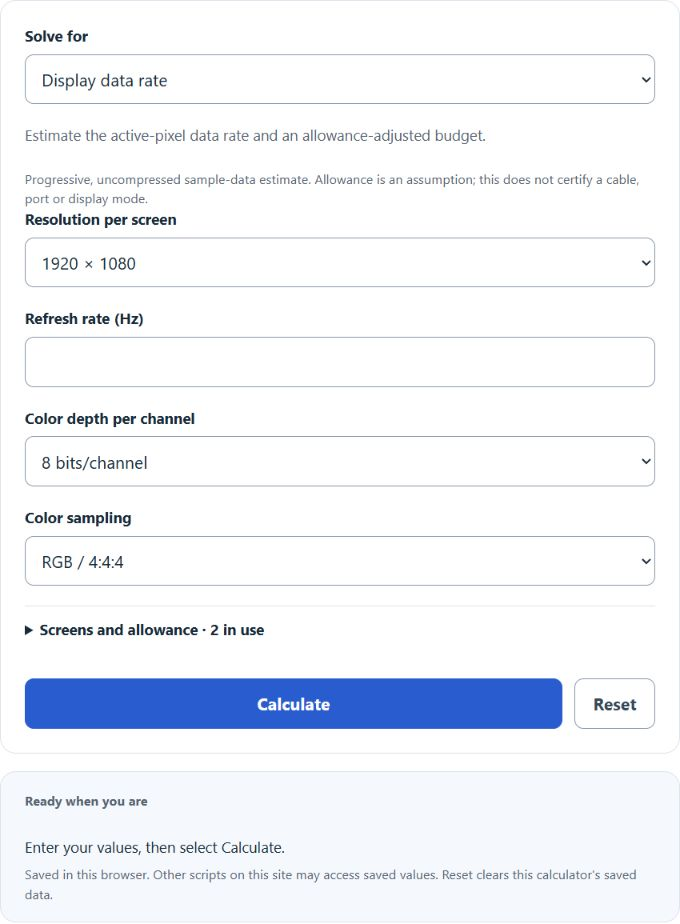
Choose Display data rate or Refresh rate from a data budget. Select a resolution, or choose Custom and enter both pixel dimensions. Enter the refresh rate or effective payload budget, then choose color depth and sampling. Screens and allowance contains a default of one screen and an adjustable 20% allowance; the allowance is an assumption, not a timing or interface standard.
Active-pixel rate excludes blanking, protocol and link-encoding overhead, audio and compression such as DSC. The second result applies your chosen allowance. The inverse refresh result is a continuous mathematical estimate, not a guarantee that a display, cable, source or port supports a particular mode.
Common Monitor Resolution and Pixel Counts
| Resolution | Name | Pixels per Frame | Megapixels |
|---|---|---|---|
| 1280 × 720 | HD | 921,600 | 0.92 MP |
| 1920 × 1080 | Full HD | 2,073,600 | 2.07 MP |
| 2560 × 1440 | QHD | 3,686,400 | 3.69 MP |
| 3840 × 2160 | 4K UHD | 8,294,400 | 8.29 MP |
| 7680 × 4320 | 8K UHD | 33,177,600 | 33.18 MP |
Approximate Video Interface Payload Limits
These are peak payload ceilings for the named link modes, not universal capacities of every port with that version label. Lane count, negotiated link rate, timing, packing and device support matter. Do not treat the allowance estimate as a compatibility test.
| Interface | Approximate Ceiling | Use in the Calculator |
|---|---|---|
| HDMI 1.4 | 8.16 Gbit/s | Older 1080p and some limited 4K modes |
| HDMI 2.0 | 14.4 Gbit/s | Common for 4K 60 Hz 8-bit with suitable settings |
| HDMI 2.1 FRL | 42.67 Gbit/s before FEC and packet overhead | Higher refresh 4K and some 8K modes |
| DisplayPort 1.2 | 17.28 Gbit/s | Common for QHD high refresh and 4K 60 Hz |
| DisplayPort 1.4 | 25.92 Gbit/s | Higher bandwidth modes, often with DSC for demanding settings |
| DisplayPort 2.1 UHBR20 | 77.37 Gbit/s | Very high refresh, high resolution, and multi-monitor use |
Example Calculations
Example 1: 4K at 60 Hz, 24 bits per pixel
You want the bandwidth for one 3840 × 2160 monitor at 60 Hz using 24 bits per pixel.
- Resolution: 3840 × 2160 = 8,294,400 pixels
- Bit depth: 24 bits per pixel
- Refresh rate: 60 Hz
- Number of screens: 1
The result is 1492.992 MB/s, which is about 11.94 Gbit/s.
Example 2: 1440p at 144 Hz, 10-bit 4:4:4
You want the interface data rate for one 2560 × 1440 monitor at 144 Hz, 10-bit per channel, using 4:4:4 chroma.
- Width: 2560 pixels
- Height: 1440 pixels
- Bits per color channel: 10
- Chroma factor for 4:4:4: 3
- Refresh rate: 144 Hz
- Number of screens: 1
The result is 15.93 Gbit/s before blanking and overhead.
FAQs
Why is the calculated bandwidth lower than what a video cable specification lists?
Display data rate reports active samples and a separate allowance-adjusted estimate. Real video links often need more bandwidth because of blanking intervals, link encoding, packet overhead, and timing standards. Cable and port specifications usually describe link capacity, not only the visible pixel data.
What bit depth should you enter for a normal monitor?
Choose 8 bits/channel and RGB / 4:4:4 for an ideal 24-bit-per-pixel sample model. 10 bits/channel with RGB / 4:4:4 gives 30 bits per pixel. Always choose per-channel depth in this calculator; do not enter 24 as a channel depth.
Does chroma subsampling reduce monitor bandwidth?
Yes. Chroma subsampling sends less color detail than full 4:4:4 color, so it reduces the required data rate. In this ideal sample model, 4:4:4 uses a sampling factor of 3, 4:2:2 uses 2, and 4:2:0 uses 1.5. Real interface packing may differ from this average sample count. For desktop text and general computer use, 4:4:4 usually gives the clearest result. HDMI 4:2:2 transport can use a fixed 24 bits per pixel even when the source has fewer than 12 bits per channel; the ideal sample estimate is not that transport rate. See Intel’s HDMI guide. The four-lane UHBR20 payload ceiling follows the official DisplayPort FAQ.