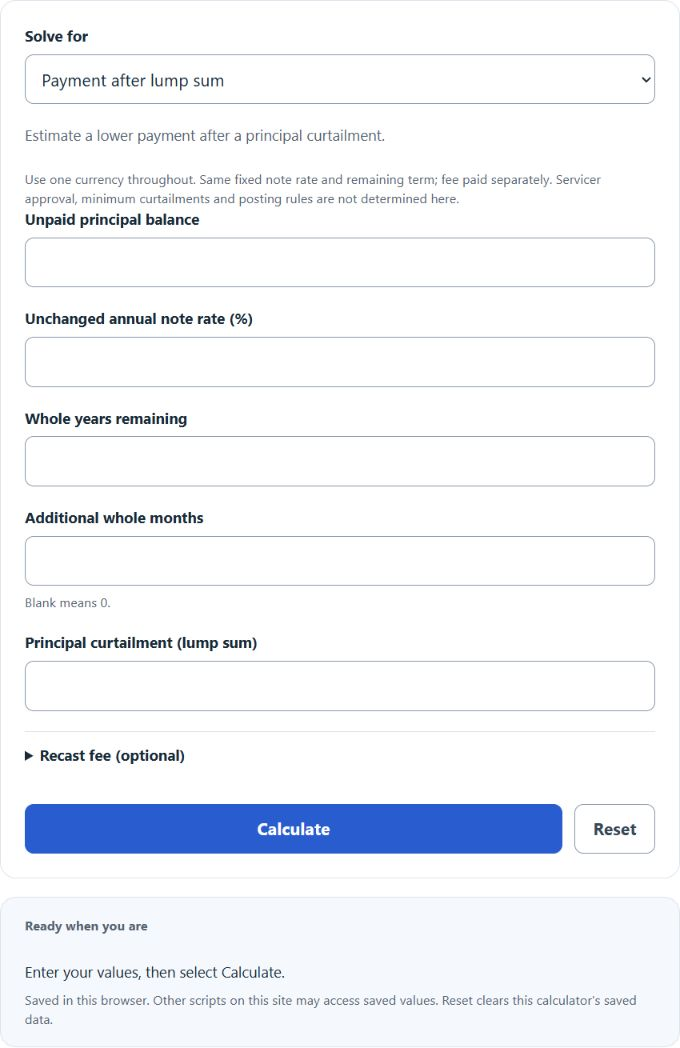
Estimate a mortgage recast after a principal curtailment or reverse-solve the lump sum for a target payment, including fee recovery and payoff-at-old-payment analysis.
Mortgage Recast Formula
The following equation is used to calculate the new monthly mortgage payment after recasting.
- Where MRP is the new monthly recast payment ($)
- OB is the outstanding balance ($)
- LSP is the lump-sum payment ($)
- i is the monthly decimal note interest rate (annual percentage / 1200)
- n is the number of months remaining in the loan term
To calculate the new monthly mortgage payment (MRP), subtract the lump-sum payment (LSP) from the outstanding balance (OB), then apply the standard mortgage payment formula using the updated principal over the remaining loan term.
What is a Mortgage Recast?
Definition:
With an approved mortgage recast, a principal curtailment reduces the balance and the servicer recalculates principal-and-interest payments at the same note rate over the remaining term. Eligibility, minimum curtailments, documents and fees depend on the loan and servicer. A curtailment alone does not guarantee a lower required payment.
How to Calculate Mortgage Recast?
Example Problem:
The following example outlines the steps and information needed to calculate the new monthly mortgage payment after recasting.
First, determine the current outstanding balance on the mortgage. In this example, the outstanding balance (OB) is $200,000.
Next, identify the amount of lump-sum payment. In this case, the lump-sum payment (LSP) is $20,000.
Assume the monthly interest rate (i) is 0.004, from a 4.8% annual note rate divided by 1200, and the remaining term is 300 months. APR may include fees and is not the note rate used here.
Finally, calculate the new monthly payment using the formula above:
MRP = (OB – LSP) × [ i × (1 + i)^n ] / [ (1 + i)^n – 1 ]
MRP = ($200,000 – $20,000) × [0.004 × (1.004)^300] / [(1.004)^300 – 1]
The recast payment is approximately $1,031.39, compared with $1,145.99 before curtailment, a reduction of $114.60 per month. Scheduled interest savings are $14,379.82 before any fee. If the old mathematical payment continues after curtailment, monthly simulation gives 248 payments, $104,086.49 of interest and an adjusted final payment of $1,025.99. Amounts use unrounded calculations.
FAQ
Is recasting different from refinancing?
Yes. While both can potentially lower monthly payments, refinancing replaces the existing mortgage with an entirely new loan (typically with different terms and interest rates), whereas recasting keeps the original loan and simply recalculates payments after a one-time lump-sum principal reduction.
Does recasting save interest overall?
By reducing the principal, you pay interest on a smaller balance, which can lead to significant interest savings over the life of the loan. However, the exact amount saved depends on factors like the size of the lump-sum payment, interest rate, and time remaining on the mortgage.
Can all mortgages be recast?
Not all loans or servicers allow recasting. Ask the servicer about eligibility, minimum principal curtailment, timing, required documents and fees. The calculator does not determine eligibility. Fee recovery is a simple cash-flow comparison and excludes the opportunity cost of the lump sum.
Change-log:
- 6/5/25 – Added functionality to calculate the monthly payment reduction, interest saved, and break even time.
- 6/5/25 – Historical comparison-feature note. The current tool compares recasting with continuing the old mathematical payment after the same curtailment; use the Mortgage Refinance Calculator for a refinance analysis.