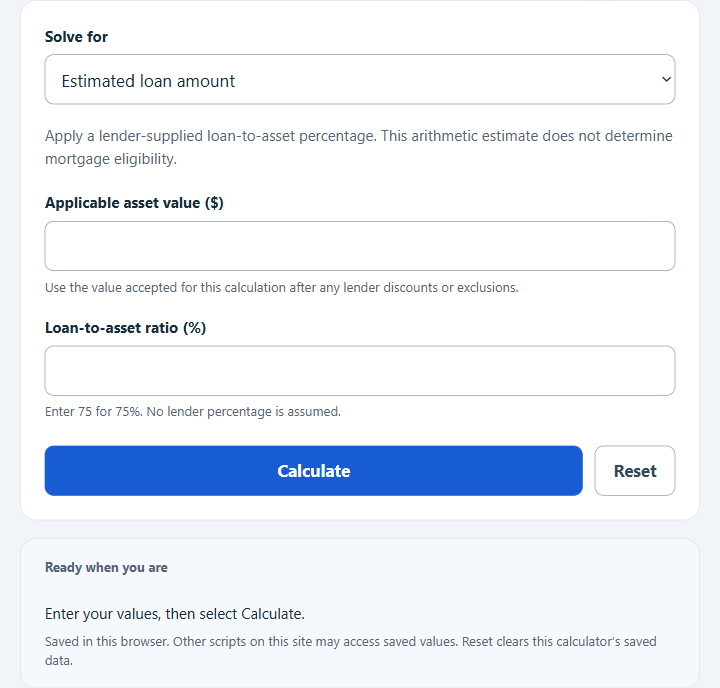
Choose an estimated loan amount, loan-to-asset ratio, or applicable asset value to calculate from the other two figures. This simplified arithmetic model does not determine mortgage eligibility.
Asset-Based Mortgage Calculator Formula
The following equation applies a stated loan-to-asset percentage to applicable asset value. Mortgage loan-to-value (LTV) normally uses property value, rather than the total value of an investment portfolio.
- Where ABM is the estimated asset-based mortgage amount ($)
- ΣA is the sum of all applicable assets ($)
- LR is the loan ratio (expressed as a decimal)
To estimate the mortgage amount, sum all of the relevant assets you’re including and multiply by the loan ratio your lender applies for asset-based loans.
What is an Asset-Based Mortgage Calculator?
Definition:
This calculator multiplies an applicable asset value by a user-supplied loan ratio, or solves the inverse relationship. It does not estimate qualification, payment terms, or qualifying income. Asset-depletion mortgage programs may instead convert eligible assets into monthly income under program-specific rules.
How to Calculate an Asset-Based Mortgage?
Example Problem:
The following example outlines the steps and information needed to calculate an estimated Asset-Based Mortgage.
First, determine the value and types of assets you wish to include. In this example, let’s say you have $150,000 in real estate equity, $100,000 in stocks, and $50,000 in bonds, for a total asset value of $300,000.
Next, determine the loan-to-asset ratio (LR) applicable to the same asset base. This arithmetic illustration uses 75% (0.75 as a decimal); it is not a statement that these assets or this ratio qualify with a lender.
Finally, calculate the mortgage estimate using the formula above:
ABM = (ΣA) × LR
ABM = $300,000 × 0.75
ABM = $225,000
FAQ
Why would someone choose an asset-based mortgage over a traditional mortgage?
Asset-based mortgages can be ideal for individuals whose income might not clearly reflect their ability to repay a loan — for instance, retirees, seasonal workers, or high-net-worth individuals with the majority of their funds in investments rather than earned income. By focusing on the value of assets, lenders can gauge a borrower’s financial standing even if their traditional income is less stable.
What types of assets can typically be used for qualification?
Lenders often consider a range of assets, including cash, stocks, bonds, mutual funds, retirement accounts, and real estate equity. The exact list depends on the lender’s requirements, and some assets might be discounted or excluded based on their liquidity and stability of value.
Does a higher loan ratio always mean a higher mortgage amount?
Yes, generally speaking, a higher loan ratio (LR) will increase the estimated mortgage amount, assuming the total asset value (ΣA) remains constant. However, a higher LR can also come with stricter terms or higher interest rates, so it’s important to weigh the benefits against the potential added costs.