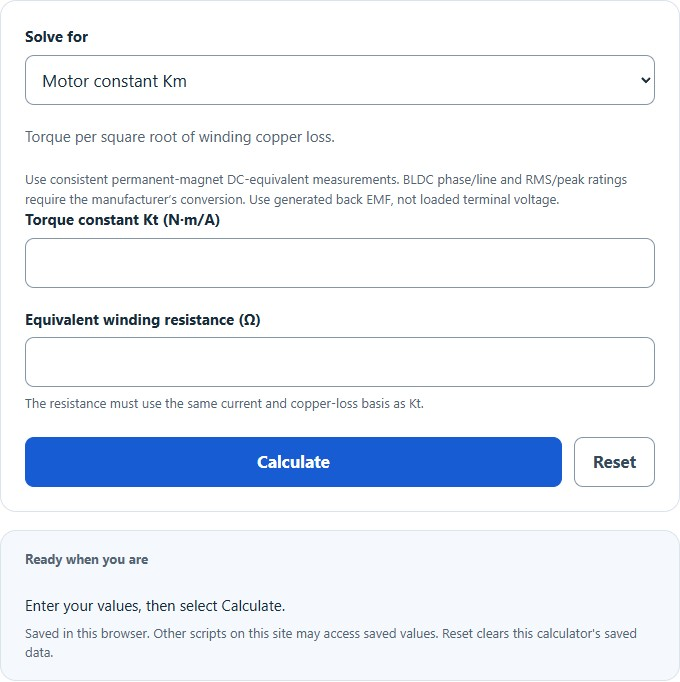
Calculate Km from torque constant and equivalent winding resistance, Kt from torque/current, or Ke and Kv from generated back EMF and speed. Use consistent permanent-magnet DC-equivalent measurements.
Motor Constant Formula
The following formula is used to calculate the motor constant (also called a motor “figure of merit” based on copper loss).
Variables:
- Km is the motor constant (Nm/√W)
- Kt is the torque constant (Nm/A)
- R is the equivalent winding resistance (Ω), using the same current and copper-loss basis as Kt
- Pcu is the copper (I2R) loss in the windings (W)
- T is torque (N·m), and I is current (A)
To calculate the motor constant, divide the torque constant by the square root of the winding resistance. Equivalently, if you know the copper loss at a given operating point, you can compute Km = T / √Pcu. Note: This definition uses copper loss (I2R), not mechanical output power (Tω). BLDC phase/line and RMS/peak conventions can require manufacturer-specific conversion; raw line-to-line resistance cannot always be inserted directly.
What is a Motor Constant?
The motor constant (Km) is a value that represents how much torque a motor can produce per square root of copper loss in the windings. A higher motor constant means the motor can produce more torque for the same I2R heating, assuming similar operating conditions. This figure of merit does not include other losses (iron/core loss, windage, friction, controller losses), so it is not a complete measure of overall system efficiency.
How to Calculate Motor Constant?
The following steps outline how to calculate the Motor Constant.
- Determine the torque constant (Kt) of the motor (for example, from a datasheet or from torque/current measurements using Kt = T/I).
- Determine equivalent winding resistance R in ohms (Ω), matching the datasheet current convention used for Kt. For Ke/Kv modes, enter generated back EMF, not uncorrected loaded terminal voltage.
- Calculate the motor constant using Km = Kt / √R.
- After inserting the variables and calculating the result, check your answer with the calculator above.
Example Problem :
Use the following variables as an example problem to test your knowledge.
Torque Constant (Kt) = 0.10 Nm/A
Winding Resistance (R) = 0.50 Ω
With a consistent current basis, Km = 0.10 / √0.50 ≈ 0.1414 N·m/√W. The ideal DC-equivalent relation Kt = Ke = 60/(2πKv) requires compatible SI definitions; it is not a universal BLDC conversion.