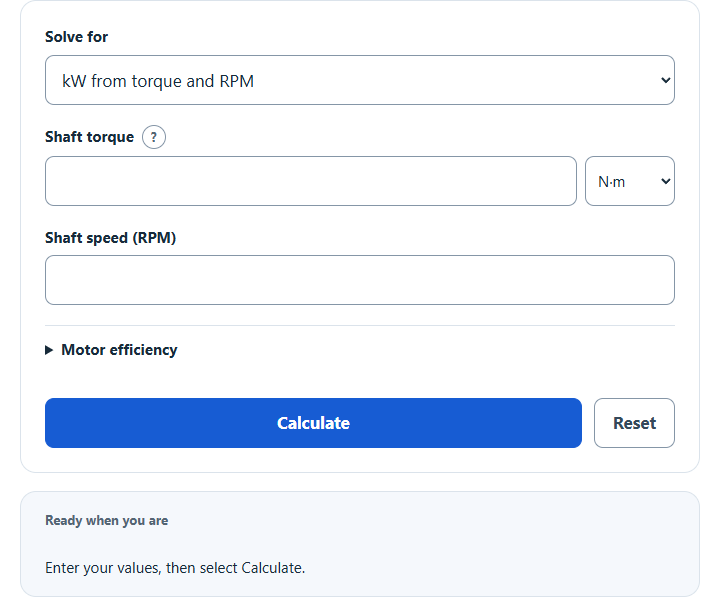
Convert RPM and torque to kW, or work from kW back to RPM or torque, with N·m or lb·ft and hp shown; RPM alone cannot give power without torque.
- All Physics Calculators
- Mechanics and Physics Unit Converters
- RPM To Feet Per Minute Calculator
- RPM to Horsepower Calculator
- RPM to Flow Rate Calculator
RPM to kW Formula
Mechanical power equals torque multiplied by angular velocity. The constant 9549.3 consolidates two unit conversions: RPM to rad/s (multiply by 2π/60) and watts to kilowatts (divide by 1000). Combined: 60,000 / (2π) ≈ 9549.296586. The calculator retains full π rather than the rounded divisor.
Variables:
- P = power in kilowatts (kW)
- T = torque in newton-meters (Nm)
- RPM = rotational speed in revolutions per minute
| RPM | 50 Nm | 100 Nm | 200 Nm | 500 Nm | 1,000 Nm |
|---|---|---|---|---|---|
| 500 | 2.62 | 5.24 | 10.47 | 26.18 | 52.36 |
| 750 | 3.93 | 7.85 | 15.71 | 39.27 | 78.54 |
| 1,000 | 5.24 | 10.47 | 20.94 | 52.36 | 104.72 |
| 1,500 | 7.85 | 15.71 | 31.42 | 78.54 | 157.08 |
| 2,000 | 10.47 | 20.94 | 41.89 | 104.72 | 209.44 |
| 3,000 | 15.71 | 31.42 | 62.83 | 157.08 | 314.16 |
| 5,000 | 26.18 | 52.36 | 104.72 | 261.80 | 523.60 |
| * P(kW) = T(N·m) × RPM × 2π / 60,000. Values rounded to 2 decimal places. | |||||
Power by Application
Power depends on torque and speed measured at the same shaft and operating point. Gear ratios, loading and control change the available combinations. Use manufacturer operating data instead of assuming a universal speed, torque or power range for a machine type.
How to Calculate Power from RPM and Torque
- First, determine the torque (T) in newton-meters.
- Next, determine the rotational speed (RPM).
- Multiply torque in N·m by RPM and by 2π/60,000 to get shaft power in kilowatts. Dividing by 9549.3 is a rounded approximation.
- Check your result with the calculator above.
Example Problem:
Torque (T) = 500 newton-meters, RPM = 1500 revolutions per minute
P = 500 × 1500 × 2π / 60,000 ≈ 78.54 kW