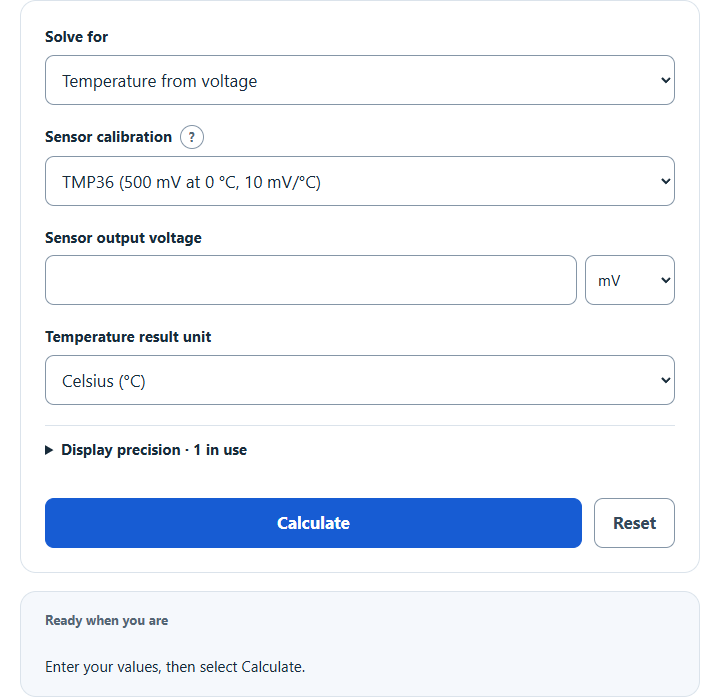
Convert mV to temperature for a TMP36 or any linear analog sensor: enter millivolts or volts to get °C, °F and K, or convert a temperature back to mV.
Calculator Functions
| Function | What it does | What it requires |
|---|---|---|
| Temperature from voltage | Converts the output voltage of a linear temperature sensor to a temperature | Requires the sensor calibration and the sensor output voltage in mV or V |
| Voltage from temperature | Finds the voltage a linear temperature sensor puts out at a temperature | Requires the sensor calibration and the temperature in °C, °F or K |
The sensor calibration is either the TMP36 (500 mV at 0 °C and 10 mV per °C) or a custom linear sensor, which adds two inputs: the output at 0 °C in mV and the sensitivity in mV per °C. Temperature results can be shown in °C, °F or K and voltage results in mV or V, with 1 to 4 decimal places. Every result lists the temperature in all three units and the voltage in both.
mV to Temperature Formulas
| T | Temperature (°C) |
| mV | Sensor output voltage in millivolts |
| 500 | TMP36 output at 0 °C (mV) |
| 10 | TMP36 scale factor (mV per °C) |
The TMP36 has a scale factor of 10 mV/°C and puts out 750 mV at 25 °C, which places 0 °C at 500 mV [1]. Each 1 mV change in its output is therefore 0.1 °C. A reading of 1 mV by itself is not a valid TMP36 output: it would mean −49.9 °C, below the −40 °C the sensor is specified for [1].
Temperature from voltage
The formula above applies directly. 750 mV is (750 − 500) ÷ 10 = 25 °C, or 77 °F. 1,200 mV is 70 °C. A reading in volts is multiplied by 1,000 first, so 0.75 V is also 25 °C.
A custom linear sensor uses its own offset and sensitivity. A sensor with no offset and 10 mV/°C, such as the TMP35 with its 250 mV output at 25 °C [1], reads (250 − 0) ÷ 10 = 25 °C.
Voltage from temperature
A TMP36 at 30 °C puts out 500 + 10 × 30 = 800 mV. A temperature in °F or K is converted to °C first: 98.6 °F is 37 °C, which gives 870 mV.
Thermocouple mV to Temperature
A thermocouple millivolt reading cannot be converted with these formulas. Its voltage does not rise in a straight line with temperature, and it depends on the thermocouple type. NIST publishes voltage against temperature tables for types B, E, J, K, N, R, S and T, with the coefficients of their reference functions [2]. Use the table for the thermocouple type in question.
TMP36 mV to Temperature Table
| Output (mV) | °C | °F |
|---|---|---|
| 100 | -40 | -40 |
| 300 | -20 | -4 |
| 400 | -10 | 14 |
| 500 | 0 | 32 |
| 600 | 10 | 50 |
| 700 | 20 | 68 |
| 750 | 25 | 77 |
| 800 | 30 | 86 |
| 900 | 40 | 104 |
| 1,000 | 50 | 122 |
| 1,250 | 75 | 167 |
| 1,500 | 100 | 212 |
| 1,750 | 125 | 257 |
Limits of This Estimate
- The TMP36 conversion is the nominal one. The sensor’s typical accuracy is ±2 °C over its temperature range [1], so decimals in the result are not real precision.
- TMP36 results outside −40 °C to 125 °C, the range the sensor is specified for [1], are rejected.
- The custom sensor function assumes a straight-line output and does not check the range of the sensor. It cannot be used for thermistors, RTDs or thermocouples, which are not linear.
- A noisy supply or analog-to-digital reference changes the measured voltage, and the error carries straight into the temperature.
Sources
- Analog Devices, TMP35/TMP36/TMP37 Low Voltage Temperature Sensors data sheet, Rev. F: the TMP36 scale factor, output at 25 °C, specified range and typical accuracy
- NIST, Temperature Scale Database (SRD 60), ITS-90 thermocouple tables: thermocouple voltage tables by type