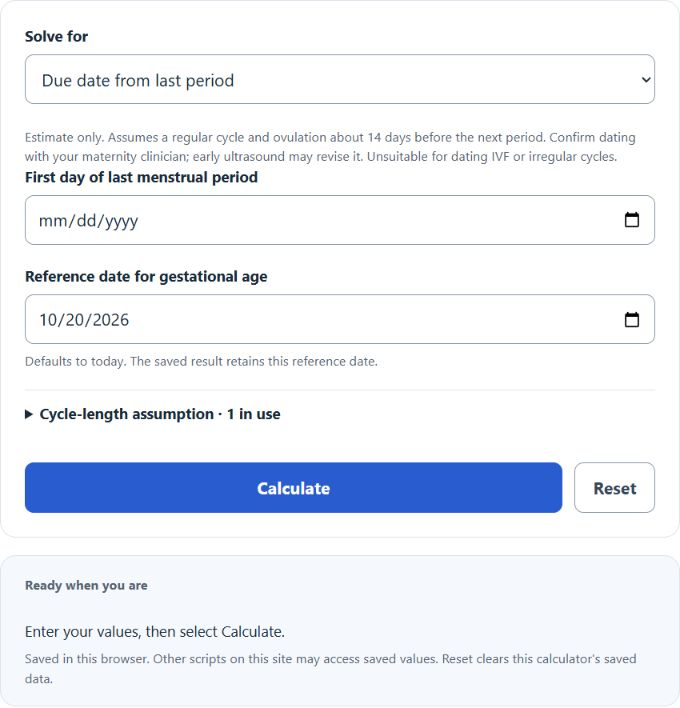
Estimate a due date from the first day of the last period, or estimate the last period from a due date. Optional cycle length adjusts the estimate; gestational age and trimester use an explicit reference date.
Medical note: This calculator provides an estimate and is not medical advice. Confirm pregnancy dating and due date with your obstetric provider; early ultrasound dating may be more accurate than last-menstrual-period dating.
- Estimates may be less accurate with irregular/long/short cycles, uncertain LMP, recent pregnancy (including miscarriage) or postpartum/breastfeeding, hormonal contraception, PCOS, or fertility treatment (e.g., IVF/embryo transfer).
- Conception/ovulation dates are often uncertain unless you have ovulation tracking or fertility treatment dates.
- Most births do not occur on the exact due date; delivery commonly occurs within a range around the estimated date.
- All Health and Medical Calculators
- Amniotic Fluid Index Calculator
- HCG to Weeks Calculator
- CRL to Weeks Calculator
- Fundal Height Calculator
Naegele’s Rule Formula
The following formula is used to calculate the expected date of delivery using Naegele’s Rule.
Variables:
- EDD is the expected date of delivery
- LMP is the first day of the last menstrual period
This calculator adds exactly 280 calendar days to LMP for a 28-day cycle, then adds or subtracts the difference between cycle length and 28 days. The traditional calendar-month shorthand can differ by a few days. Ovulation timing and pregnancy length vary; this is an estimate, not an exact delivery date.
What is Naegele’s Rule?
Naegele’s Rule is a standard method used by obstetricians to estimate a pregnant woman’s due date. The rule calculates the expected date of delivery by adding one year, subtracting three months, and adding seven days to the first day of a woman’s last menstrual period. It is based on an average 28-day cycle with ovulation around day 14; if cycle length or ovulation timing differs, results can vary.
How to Calculate Naegele’s Rule?
The following steps outline how to use Naegele’s Rule to calculate the expected date of delivery (EDD).
- First, determine the first day of the last menstrual period (LMP).
- Next, add 280 calendar days to LMP.
- Then, add cycle length minus 28 days if adjusting for a regular cycle.
- Finally, treat the resulting EDD as an estimate and confirm pregnancy dating with your maternity clinician.
Example Problem:
Use the following variables as an example problem to test your knowledge.
LMP: January 15, 2022
For a 28-day cycle: January 15, 2022 + 280 days = October 22, 2022.