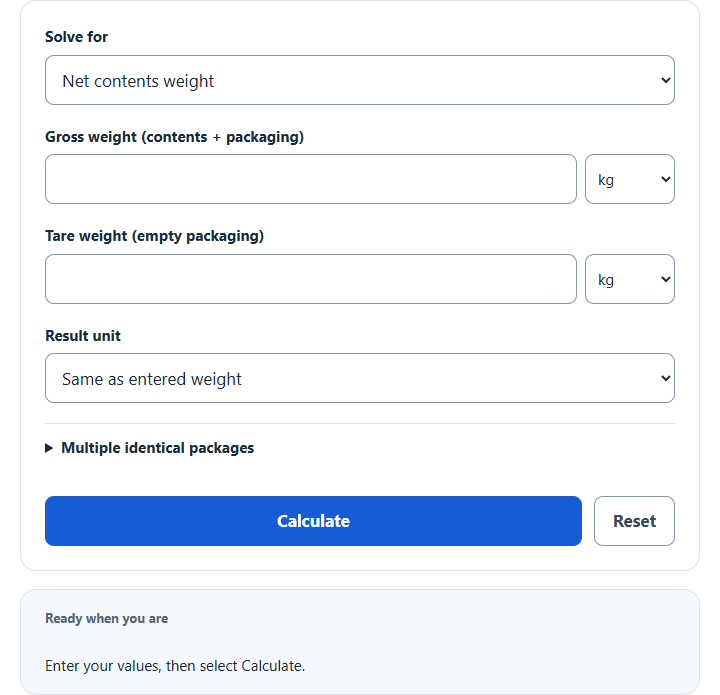
Calculate net weight from gross and tare weight in kg or lb, solve missing gross or tare, and total net weight for multiple packages.
Related Calculators
- Net Mass Calculator
- Item Weight Calculator
- Weight to Mass Calculator
- Mass to Weight Calculator
- Dimension to Weight Calculator
- Weight Per Volume Calculator
- All Everyday Life and Education Calculators
Calculator Functions
| Function | What it does | What it requires |
|---|---|---|
| Net contents weight | Converts a gross weight to the net weight of the contents alone | Requires the gross weight and the tare weight of the empty packaging |
| Gross weight with packaging | Converts a net weight to the gross weight of the packed item | Requires the net weight and the tare weight of the empty packaging |
| Tare packaging weight | Finds the weight of the packaging from a filled package and its contents | Requires the gross weight and the net weight |
Each weight has its own unit list of kilograms, grams, pounds, ounces and metric tonnes, so the two entries do not have to match. The result unit follows the entered weight unless another is picked. An optional number of identical packages adds the total net, gross and tare weight for the whole lot.
Net Weight Formulas
| NW | Net weight: the product that remains after the tare is deducted [1] |
| GW | Gross weight: the package with its contents, packing material and labels [1] |
| TW | Tare weight: the container, wrapper or other material deducted from the gross weight [1] |
Mixed units are converted to kilograms before the subtraction, at 0.45359237 kg per pound and 0.028349523125 kg per ounce [3]. A tonne here is a metric tonne of 1,000 kg.
Net contents weight
The main formula applies directly. A drum that weighs 250 kg full and 20 kg empty holds 250 − 20 = 230 kg. A 5 lb parcel in an 8 oz box holds 4.5 lb. A gross weight cannot be turned into a net weight by itself: the tare has to be weighed or taken from the packaging specification. A tare larger than the gross weight is rejected.
Gross weight with packaging
A carton with 12 kg of product in 0.6 kg of packaging weighs 12.6 kg. For 40 identical cartons the totals are 480 kg net, 504 kg gross and 24 kg tare.
Tare packaging weight
A jar that weighs 510 g on the scale and is labeled 454 g net has 510 − 454 = 56 g of glass, lid and label. A net weight larger than the gross weight is rejected.
How to Calculate Net Weight from Gross Weight
Weigh the filled package to get the gross weight. Empty it, then weigh everything that is not product, including the container, lid, wrapper, labels and ties, to get the tare [1]. Subtract the tare from the gross weight, package by package [2]. When many packages use the same packaging, the tare of a few emptied ones can be averaged and used for the rest, as long as the packaging weights are close to each other [2].
Limits of This Estimate
- The result is only as good as the two weighings. Use the same scale and conditions for both, and a scale fine enough for the packaging, since a small tare read on a coarse scale carries a large error.
- Packaging that soaks up liquid weighs more used than new. Official package checks state whether the tare is dried or wet, and the choice changes the net figure [1].
- This does not certify a label’s net weight claim or a scale’s accuracy. Package inspections follow sampling and tolerance rules that a single subtraction does not cover [2].
- Totals for several packages assume each one has exactly the gross, net and tare weight entered.
Sources
- NIST, Handbook 133 (2026), Checking the Net Contents of Packaged Goods, Appendix F Glossary: definitions of gross weight, tare weight, net quantity, and dried and wet tare
- NIST, Handbook 133 (2026), Chapter 2, Test Procedures for Packages Labeled by Weight: net weight as gross weight minus tare weight, the use of an average tare, and the sampling rules for inspections
- NIST, Guide for the Use of the International System of Units (SP 811), Appendix B.8: factors for pounds and ounces