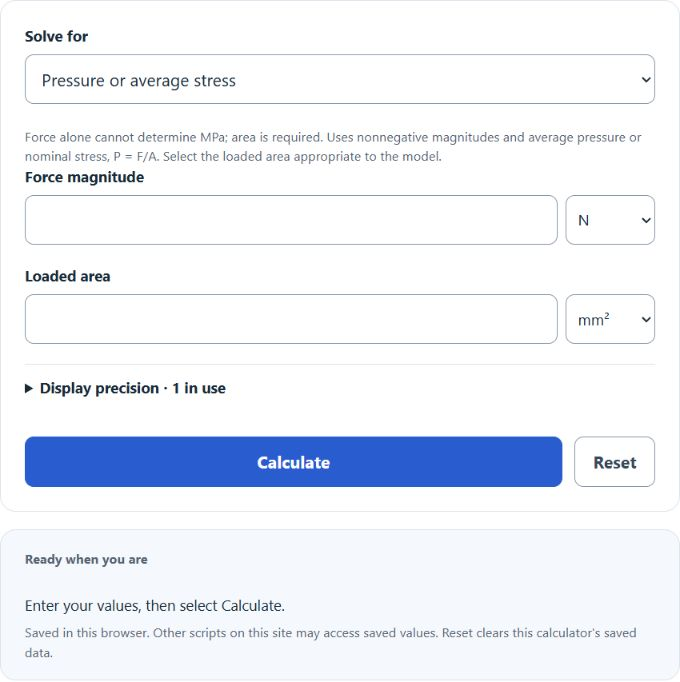
Calculate force, area or pressure in MPa, or convert between N/mm², Pa, kPa, bar and psi with this Newton to MPa calculator for pressure units.
| MPa to psi | psi to MPa |
|---|---|
| 1 MPa = 145.038 psi | 14.7 psi = 0.101 MPa |
| 5 MPa = 725.189 psi | 30 psi = 0.207 MPa |
| 10 MPa = 1450.377 psi | 50 psi = 0.345 MPa |
| 20 MPa = 2900.754 psi | 100 psi = 0.690 MPa |
| 25 MPa = 3625.943 psi | 145 psi = 1.000 MPa |
| 30 MPa = 4351.131 psi | 200 psi = 1.379 MPa |
| 50 MPa = 7251.886 psi | 500 psi = 3.447 MPa |
| 100 MPa = 14503.770 psi | 1000 psi = 6.895 MPa |
| 200 MPa = 29007.540 psi | 1500 psi = 10.342 MPa |
| 300 MPa = 43511.310 psi | 3000 psi = 20.685 MPa |
| Formulas: psi = MPa x 145.0377; MPa = psi / 145.0377. | |
- All Unit Converters
- Newton To hp Calculator
- Newton To Joules Calculator
- Air Watts To Pa Calculator
- Newton to kg
Newton to MPa Formula
Pressure (and stress) is force distributed over area. The core formula is:
Where N is force in newtons and m² is the cross-sectional area in square meters. The 10⁻⁶ factor converts pascals to megapascals (1 MPa = 1,000,000 Pa). When the area is given in mm² instead of m², the formula simplifies to a direct 1:1 identity: 1 N/mm² = 1 MPa. This shortcut is standard in structural and mechanical engineering because cross-sections are almost always reported in mm².
Why Area Changes Everything: Force Concentration
Force alone tells you nothing about pressure. A 1,000 N force (about 102 kgf) produces different average pressures over the illustrative contact areas below. These are ideal uniform-contact calculations; real contact and deformation can change the effective area:
| Area | Real-world analogy | Pressure (MPa) | Pressure (psi) |
|---|---|---|---|
| 1,000,000 mm² (1 m²) | Mattress surface | 0.001 MPa | 0.145038 psi |
| 50,000 mm² (500 cm²) | Human footprint | 0.02 MPa | 2.900755 psi |
| 10,000 mm² (100 cm²) | Brick face | 0.1 MPa | 14.503774 psi |
| 100 mm² (1 cm²) | Fingertip | 10 MPa | 1,450.377377 psi |
| 10 mm² | Ballpoint pen tip | 100 MPa | 14,503.773773 psi |
| 1 mm² | Mechanical pencil tip | 1,000 MPa | 145,037.737730 psi |
| 0.1 mm² | Fine sewing needle | 10,000 MPa | 1,450,377.377302 psi |
| Force held constant at 1,000 N (approx 102 kgf) throughout. | |||
Material Strength Reference (MPa)
The following illustrative material values depend on product form, specification, diameter, condition and test basis. They are not allowable stresses or a basis for fastener sizing or safe-load certification. The force column simply multiplies the stated reference stress by 100 mm²; concrete uses compressive strength, not yield or tensile strength.
| Material | Yield (MPa) | UTS or stated compressive strength (MPa) | Force at listed reference stress on 100 mm² |
|---|---|---|---|
| Concrete C25 (compressive) | N/A | 25 | 2.5 kN |
| Concrete C50 (compressive) | N/A | 50 | 5 kN |
| Aluminum 1100-H14 | 110 | 125 | 11 kN |
| Structural steel ASTM A36 | 250 | 400 to 550 | 25 kN |
| Aluminum 6061-T6 | 276 | 310 | 27.6 kN |
| High-strength steel A572 Gr.50 | 345 | 450 | 34.5 kN |
| Grade 60 rebar (ASTM A615) | 420 | 620 | 42 kN |
| Stainless steel 304 | 215 | 505 | 21.5 kN |
| Grade 8.8 bolt steel, illustrative d > 16 mm band; verify product standard | 660 | 830 | 66 kN |
| Titanium 6Al-4V (Grade 5) | 880 | 950 | 88 kN |
| UTS = Ultimate Tensile Strength. Concrete uses listed compressive strength; metals use listed illustrative yield stress. Force = reference MPa × 100 mm². Verify the applicable product specification and design factors. | |||
Pressure Scale: Everyday to Industrial
MPa spans an enormous range in practice. This table places common systems on that scale so a calculated result can be quickly sanity-checked against real-world contexts:
| System | Pressure (MPa) |
|---|---|
| Atmosphere at sea level | 0.101 |
| Car tire | 0.20 to 0.35 |
| Road bicycle tire | 0.60 to 0.90 |
| City water main | 0.30 to 1.0 |
| Hydraulic system (light industrial) | 7 to 14 |
| Hydraulic system (heavy equipment) | 20 to 35 |
| High-pressure hydraulic press | 35 to 70 |
| Ocean at 1,000 m depth | 10 |
| Mariana Trench (approx 11,000 m) | 110 |
| Mild steel yield point | 250 |
| High-strength bolt preload stress | 500 to 700 |
Pressure vs. Stress: Same Formula, Different Context
MPa describes both fluid pressure and solid material stress. Fluid pressure acts equally in all directions at a point in a liquid or gas. Stress in a solid is directional: axial (tension or compression along one axis), shear (acting across a plane), or multi-axial in complex loading. In both cases the calculation is identical (force divided by area), but the area you use differs. The bore cross-section relates fluid pressure to end thrust. Pipe-wall stress requires wall geometry and an appropriate pressure-vessel model; dividing force by bore area does not give hoop stress. For a structural column, use the column cross-section. For a bolt in tension, use the tensile stress area (slightly smaller than the nominal shank area, defined by thread geometry per ASME standards). Using the wrong area is the most common error in Newton-to-MPa calculations.
How to Calculate Newton to MPa
- Identify the force in newtons (N).
- Identify the relevant cross-sectional area. Use m² or mm² depending on which is more convenient.
- Apply the formula: MPa = N / m² x 10⁻⁶, or equivalently MPa = N / mm² (direct 1:1 when using mm²).
- Check the force, loaded area, units and arithmetic. A material or pressure comparison does not establish an allowable load or safe design.
Example Problem:
A hydraulic cylinder piston has a 250 mm bore diameter. At a system pressure of 20 MPa (typical for a medium-duty excavator), what force does it generate?
Bore area = pi x (125 mm)² = 49,087 mm²
Using the unrounded bore area: force = 20 MPa × π × (125 mm)² ≈ 981,748 N = approximately 982 kN (100 tonnes-force)
This is theoretical cylinder extension force, assuming negligible opposing pressure and friction. It does not establish an excavator’s rated lifting capacity, which depends on geometry, stability and the manufacturer’s load chart. Under this ideal model, doubling bore diameter quadruples piston force at the same pressure.