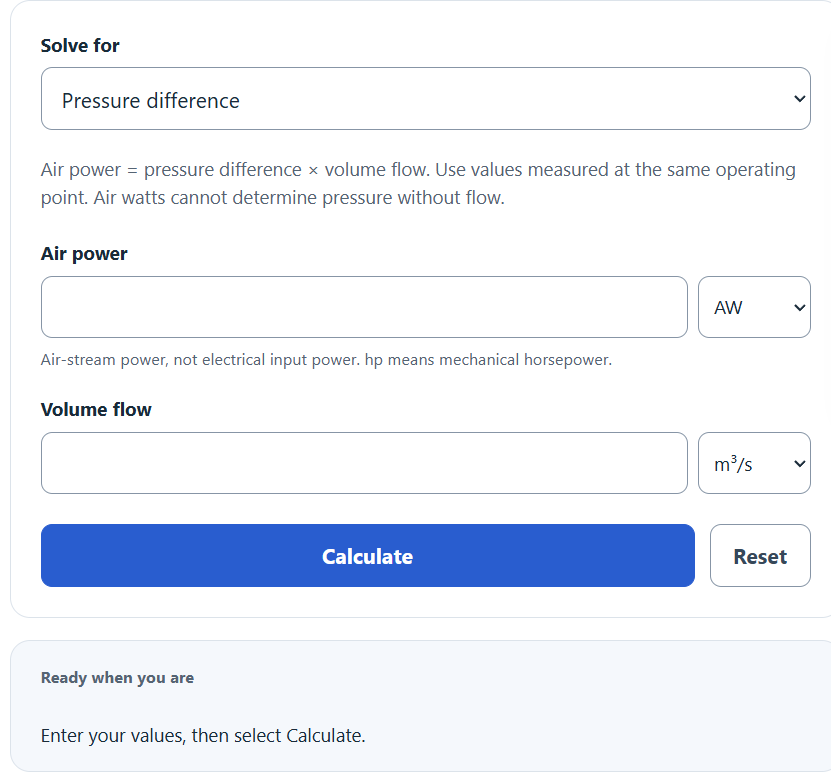
Calculate air watts, pressure, or flow rate from any two values using P = pressure × flow, with units like AW, Pa, psi, m³/s, L/s, and CFM.
Watch the full air-watts-to-pascals video explanation
Air Watts To Pa Formula
The following relation calculates pressure difference from air power and volume flow measured at the same operating point. Select Solve for, enter the two displayed inputs, then select Calculate.
Variables:
- p is the pressure difference in pascals (Pa)
- AW is the power in Air Watts (AW)
- Q is the volumetric flow rate in m³/s
| Pressure (kPa) | Flow (L/s) | Air Watts (AW) |
|---|---|---|
| 2 | 10 | 20 |
| 2 | 15 | 30 |
| 3 | 15 | 45 |
| 3 | 20 | 60 |
| 4 | 20 | 80 |
| 4 | 25 | 100 |
| 5 | 25 | 125 |
| 5 | 30 | 150 |
| 6 | 30 | 180 |
| 6 | 35 | 210 |
| 7 | 35 | 245 |
| 7 | 40 | 280 |
| 8 | 40 | 320 |
| 8 | 45 | 360 |
| 9 | 45 | 405 |
| 9 | 50 | 450 |
| 10 | 50 | 500 |
| 10 | 60 | 600 |
| 12 | 60 | 720 |
| 12 | 70 | 840 |
| * AW rounded to 0 decimals. Uses P = p × Q with consistent units. Note: 1 kPa × 1 L/s = 1 W = 1 Air Watt. 1 kPa = 1000 Pa, 1 L/s = 0.001 m³/s. | ||
What is Air Watts To Pa?
Air watts measure air-stream power; pascals measure pressure difference. There is no fixed conversion between them: pressure in Pa equals air watts divided by volume flow in m³/s. One air watt is one watt of air-stream power, not one watt of electrical motor input. Use pressure and flow from the same operating point; maximum sealed suction and maximum free airflow occur under different conditions.