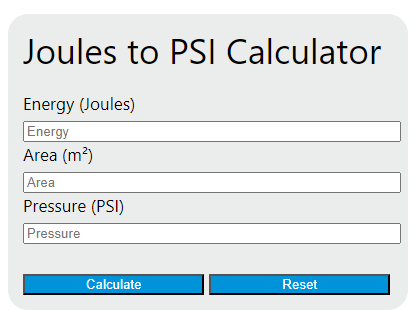
Calculate an equivalent or average pressure from energy using a physically defined work geometry: a volume change, an area plus stopping distance, or a projectile diameter plus stopping depth. Results are shown in PSI, bar, MPa, and Pa.
| Energy to PSI | PSI to Work |
|---|---|
| 1 J = 0.145 PSI | 1 PSI = 6.895 J |
| 5 J = 0.725 PSI | 5 PSI = 34.474 J |
| 10 J = 1.450 PSI | 10 PSI = 68.948 J |
| 25 J = 3.626 PSI | 14.7 PSI = 101.353 J |
| 50 J = 7.252 PSI | 30 PSI = 206.843 J |
| 100 J = 14.504 PSI | 50 PSI = 344.738 J |
| 250 J = 36.259 PSI | 75 PSI = 517.107 J |
| 500 J = 72.519 PSI | 100 PSI = 689.476 J |
| 1000 J = 145.038 PSI | 150 PSI = 1034.214 J |
| 2000 J = 290.075 PSI | 300 PSI = 2068.427 J |
| 5000 J = 725.189 PSI | 500 PSI = 3447.379 J |
| 10000 J = 1450.377 PSI | 1000 PSI = 6894.757 J |
| For a 1 L volume change, using E = pΔV: PSI = J × 0.145037738 and J = PSI × 6.894757293. | |
| Energy to PSI | PSI to Work |
|---|---|
| 0.1 J = 0.885 PSI | 1 PSI = 0.113 J |
| 0.25 J = 2.213 PSI | 5 PSI = 0.565 J |
| 0.5 J = 4.425 PSI | 10 PSI = 1.130 J |
| 1 J = 8.851 PSI | 14.7 PSI = 1.661 J |
| 2 J = 17.701 PSI | 30 PSI = 3.390 J |
| 5 J = 44.254 PSI | 50 PSI = 5.649 J |
| 10 J = 88.507 PSI | 100 PSI = 11.298 J |
| 20 J = 177.015 PSI | 150 PSI = 16.948 J |
| 50 J = 442.537 PSI | 300 PSI = 33.895 J |
| 100 J = 885.075 PSI | 500 PSI = 56.492 J |
| 250 J = 2212.686 PSI | 1000 PSI = 112.985 J |
| 500 J = 4425.373 PSI | 3000 PSI = 338.954 J |
| For a 1 in³ volume change, using E = pΔV: PSI = J × 8.850745791 and J = PSI × 0.112984829. | |
- All Unit Converters
- Mechanics and Physics Unit Converters
- Joules To Tnt Calculator
- Joules To Amp Hours Calculator
Joules to PSI Formula
Joules and PSI are units of different physical quantities, so there is no direct one-step conversion from joules to PSI. A joule is energy (N·m), while pressure is force per area (N/m²). To obtain pressure from energy, the calculation must include enough geometry to convert work into force per area.
Energy and Volume Change
This relation follows from constant-pressure work, E = PΔV. Here, ΔV must be the volume change or swept volume through which the pressure does work. It should not automatically be replaced by the total internal volume of a tank or container.
Energy, Area, and Stopping Distance
This is an average-pressure model. If energy E is dissipated as work over stopping distance s, then the average force is F_avg = E/s. Dividing that force by contact area A gives P_avg = E/(A × s). Energy divided by area alone is not pressure.
Projectile Diameter and Stopping Depth
For a circular projectile face, A = πD²/4. Substituting that area into P_avg = E/(A × s) gives the projectile formula above. It estimates average pressure only; real impact pressure can vary strongly with time, deformation, contact area, material response, and energy losses.
Variables:
- P or P_avg is pressure in pascals (Pa)
- E is energy or work in joules (J)
- ΔV is volume change or swept volume in cubic meters (m³)
- A is contact area in square meters (m²)
- s is stopping distance in meters (m)
- D is projectile diameter in meters (m)
- 1 PSI = 6,894.757293168 Pa
What is Joules to PSI?
A joule measures energy, while PSI measures pressure, so a joules-to-PSI calculation is always model-dependent. The unit identity 1 Pa = 1 J/m³ is exact because 1 Pa = 1 N/m² and 1 J = 1 N·m. However, that dimensional identity does not mean that the total energy stored in any system can simply be divided by its container volume to obtain its actual pressure.
For mechanical work at constant or average pressure, E = PΔV is the appropriate relationship. For an impact or stopping problem, E = F_avg s can be combined with P_avg = F_avg/A, giving P_avg = E/(A s). For compressed gases, the relationship between pressure and stored or recoverable energy depends on the thermodynamic process and the gas properties, so a simple E/V calculation should be treated only as an equivalent pressure or constant-pressure-work model.
Pressure and Equivalent Work per Volume Change
The table below shows the mechanical work associated with a 1-liter volume change at several pressures using E = PΔV. These are work-equivalent values, not claims about the total stored energy of a real pressurized system.
| Pressure (PSI) | Pressure (Pa) | Work for ΔV = 1 L (J) |
|---|---|---|
| 1 | 6,894.757 | 6.895 |
| 14.6959 | 101,325 | 101.325 |
| 35 | 241,316.505 | 241.317 |
| 90 | 620,528.156 | 620.528 |
| 100 | 689,475.729 | 689.476 |
| 1,000 | 6,894,757.293 | 6,894.757 |
| 3,000 | 20,684,271.880 | 20,684.272 |
| 5,000 | 34,473,786.466 | 34,473.786 |
| 60,000 | 413,685,437.590 | 413,685.438 |
| E = PΔV. For ΔV = 1 L = 0.001 m³, E (J) = PSI × 6.894757293. | ||
How to Calculate Joules to PSI
Choose the model that matches the physical information you actually know.
Volume-Change Method
- Determine the energy or work E in joules.
- Determine the volume change ΔV in cubic meters.
- Calculate average pressure in pascals: P = E / ΔV.
- Convert pascals to PSI by dividing by 6,894.757293168.
Example: If 5,000 J of work is done through a volume change of 0.002 m³, P = 5,000 / 0.002 = 2,500,000 Pa. Converting to PSI gives 2,500,000 / 6,894.757293168 = 362.59 PSI.
Area and Stopping-Distance Method
- Determine the energy E in joules.
- Determine the contact area A in square meters.
- Determine the stopping distance s in meters.
- Calculate average pressure: P_avg = E / (A × s).
Example: If 500 J is dissipated over a 0.01 m² contact area through a stopping distance of 0.05 m, P_avg = 500 / (0.01 × 0.05) = 1,000,000 Pa = 145.04 PSI.
Projectile-Diameter Method
- Determine the impact energy E in joules.
- Determine projectile diameter D and stopping depth s in meters.
- Calculate the circular area: A = πD²/4.
- Calculate average pressure: P_avg = 4E / (πD²s).
Example: For 500 J, a 10 mm diameter, and a 50 mm stopping depth, the circular area is 7.85398 × 10⁻⁵ m². The average-pressure estimate is about 127.324 MPa, or 18,466.78 PSI.