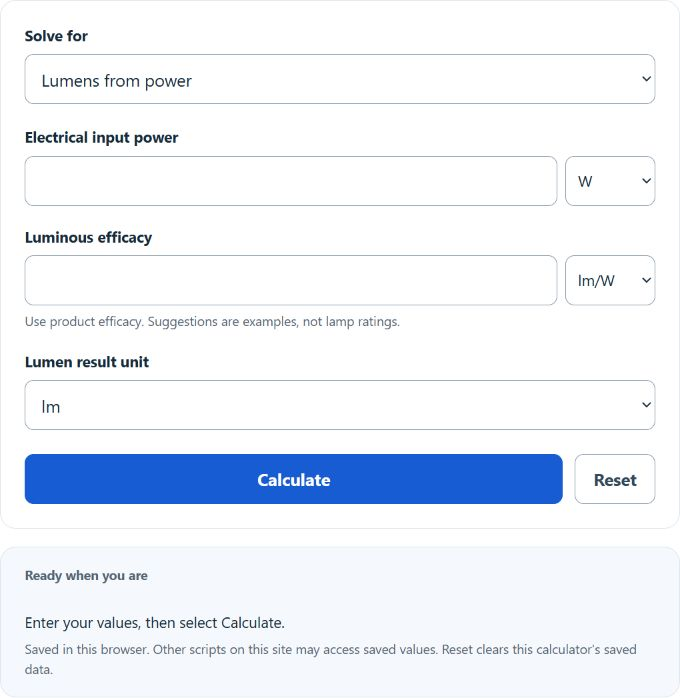
Select the value to calculate: lumens, watts, luminous efficacy, average lux, surface lumens, area, or fixture count. Use matching lamp or fixture ratings; fixture estimates expose utilization and light-loss factors.
- All Unit Converters
- Watts to Lux Calculator
- Volts to Lumens Calculator
- Lumens to Lux Distance Calculator
- Lumens to Nits Calculator
- Light Intensity Calculator
Watts To Lumens Formula
This calculator connects electrical power, luminous efficacy, and total light output. It is useful for estimating how bright a lamp or fixture will be, comparing lighting technologies, or solving for lumens per watt when you already know wattage and lumen output.
- L = total light output in lumens
- W = electrical power in watts
- η = luminous efficacy in lumens per watt
If you need to solve for a different variable, rearrange the same relationship:
A higher lumens-per-watt value means the source produces more visible light for the same electrical input. That is why LED lamps usually deliver more light than older incandescent lamps at the same wattage.
What Lumens Per Watt Means
Lumens per watt measures luminous efficacy, or how effectively a light source turns electrical power into visible light. Watts tell you how much power is consumed. Lumens tell you how much light is produced. Lumens per watt tells you how efficiently the source does it.
This is important when:
- choosing an energy-efficient bulb replacement
- comparing LED, fluorescent, halogen, and incandescent lighting
- estimating battery or generator runtime for portable lighting
- checking whether a retrofit fixture will meet a target brightness
- calculating power needed to reach a required lumen output
How to Calculate Watts to Lumens
- Find the device power draw in watts.
- Find the luminous efficacy in lumens per watt.
- Multiply wattage by efficacy.
- The result is the estimated total lumen output.
If instead you know lumens and watts, divide lumens by watts to find the source efficacy. If you know the target lumens and expected efficacy, divide lumens by efficacy to estimate required wattage.
Example Calculations
If a lamp uses 12 watts and delivers 110 lumens per watt, the light output is:
If a fixture produces 1,600 lumens while consuming 14 watts, the luminous efficacy is:
If you need 2,400 lumens and expect an efficacy of 120 lumens per watt, the estimated power draw is:
Illustrative Lumens Per Watt Assumptions
The retained ranges below are illustrative assumptions, not verified product ratings or guaranteed technology limits. Actual performance depends on the complete product and operating conditions. Use measured or manufacturer fixture lumens and electrical input power for calculations.
| Lighting Technology | Illustrative Efficacy Range | General Performance |
|---|---|---|
| Incandescent | 10 to 18 lumens per watt | Low efficiency, high heat output |
| Halogen | 15 to 25 lumens per watt | Slightly better than incandescent, still power intensive |
| Compact fluorescent (CFL) | 50 to 70 lumens per watt | Moderate efficiency for general lighting |
| Fluorescent tube | 70 to 100 lumens per watt | Common for offices, shops, and utility spaces |
| Standard LED | 80 to 130 lumens per watt | High efficiency with broad residential and commercial use |
| High-efficiency LED | 130 to 200+ lumens per watt | Very efficient products designed for lower energy use |
Quick Watts to Lumens Reference
This table shows how strongly efficacy affects total light output. The same wattage can produce very different lumen levels depending on the lamp technology.
| Power | At 15 lumens per watt | At 100 lumens per watt | At 150 lumens per watt |
|---|---|---|---|
| 5 watts | 75 lumens | 500 lumens | 750 lumens |
| 10 watts | 150 lumens | 1,000 lumens | 1,500 lumens |
| 15 watts | 225 lumens | 1,500 lumens | 2,250 lumens |
| 20 watts | 300 lumens | 2,000 lumens | 3,000 lumens |
| 40 watts | 600 lumens | 4,000 lumens | 6,000 lumens |
| 60 watts | 900 lumens | 6,000 lumens | 9,000 lumens |
What Affects Real-World Light Output?
- Fixture losses: lenses, reflectors, diffusers, and housings can reduce delivered lumens.
- Heat: many light sources become less effective as operating temperature rises.
- Driver quality: electrical losses in the driver affect system-level efficacy.
- Color quality: high-CRI products may trade some efficacy for better color rendering.
- Dimming: some lamps do not maintain the same efficacy across all dimming levels.
- Aging: lamp output usually declines over time due to lumen depreciation.
Watts, Lumens, and Lux
Lumens describe total emitted light, but they do not tell you how bright a surface or room will appear by themselves. For room lighting, light distribution and area matter too. Surface illuminance is often expressed in lux, which depends on how many lumens are spread across the target area.
- lux = illumination on a surface
- L = total lumens reaching the surface
- A = area in square meters
Fixture count is rounded up from area × target average lux ÷ (fixture lumens × utilization factor × light-loss factor). Default factors of 1 assume all lumens reach the area with no loss. Enter assessed factors for the installation; this arithmetic estimate does not evaluate distribution, spacing, glare, or required lighting standards.
FAQ
- Is there a single universal watts-to-lumens conversion?
- No. You need the luminous efficacy, because different lamp technologies can produce very different lumen output from the same wattage.
- Why can two 10-watt bulbs have different brightness?
- Because wattage measures power use, not light output. The bulb with the higher lumens-per-watt rating will produce more lumens from the same 10 watts.
- What is a good lumens-per-watt value?
- A useful value comes from the selected product’s tested lumen output divided by its electrical input power. Compare complete fixtures under consistent conditions; the illustrative ranges above do not establish a universal rating or quality threshold.
- Can this calculator solve for lumens per watt?
- Yes. If you know lumens and watts, divide lumens by watts to calculate luminous efficacy.
- Should I use bulb lumens or fixture lumens?
- Use fixture lumens when you want the most realistic delivered-light estimate for a complete luminaire. Bare bulb or chip ratings can be higher than the light that actually leaves the fixture.
- Does higher efficacy always mean better lighting?
- Not always. Efficiency matters, but so do beam spread, glare control, color temperature, color rendering, dimming performance, and application fit.