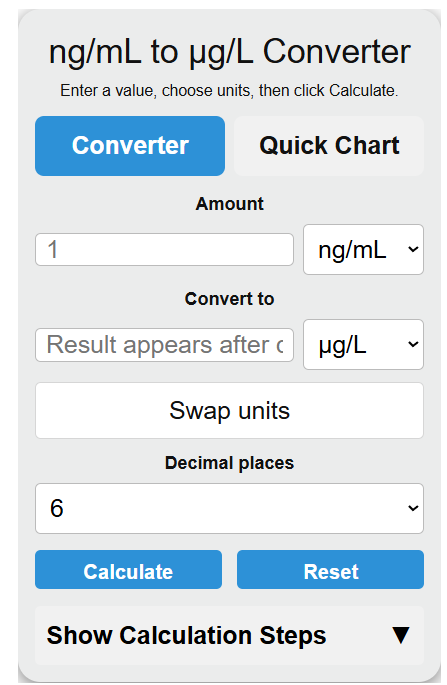
ng/ml to mcg/l Converter performs the exact 1-to-1 conversion, supports reverse and related metric concentration units, and finds analyte mass in a sample volume.
Quick Overview: ng/mL to mcg/L
Nanograms per milliliter and micrograms per liter are equivalent concentration units. This means the conversion is direct:
- 1 ng/mL = 1 mcg/L
- 5 ng/mL = 5 mcg/L
- 10 ng/mL = 10 mcg/L
- 50 ng/mL = 50 mcg/L
The calculator simply keeps the same number and changes the unit label from ng/mL to mcg/L.
- ng/ml to ug/ml Converter
- mg/l to ng/l Converter
- ng/g to ppb Converter
- ug/kg to ppb Converter
- All Unit Converters
ng/mL to mcg/L Formula
The following formula is used to convert nanograms per milliliter to micrograms per liter.
Variables:
- mcg/L is the concentration in micrograms per liter
- ng/mL is the concentration in nanograms per milliliter
To convert ng/mL to mcg/L, keep the same numeric value and change only the unit label.
What is ng/mL to mcg/L Conversion?
Converting ng/mL to mcg/L is a concentration unit conversion used in laboratory testing, medical reports, chemistry, toxicology, and environmental measurements. These two units are equivalent because a microgram is 1,000 nanograms and a liter is 1,000 milliliters. Since both sides scale by the same factor, the numerical value remains unchanged. For example, 25 ng/mL is exactly the same as 25 mcg/L.
How to Convert ng/mL to mcg/L?
The following steps outline how to convert ng/mL to mcg/L.
- First, determine the concentration in nanograms per milliliter (ng/mL).
- Next, apply the relationship 1 ng/mL = 1 mcg/L.
- Finally, rewrite the value using micrograms per liter (mcg/L).
- After converting the value, check your answer with the calculator above.
Example Problem:
Use the following variable as an example problem to test your knowledge.
Value in ng/mL = 25
Equivalent in mcg/L = 25
ng/mL to mcg/L Conversion Table
The table below lists example concentrations in ng/mL and their equivalent values in mcg/L.
| Example Description | Value in ng/mL | Equivalent in mcg/L |
|---|---|---|
| Low analyte level | 1 | 1 mcg/L |
| Mildly elevated level | 5 | 5 mcg/L |
| Common reference value | 10 | 10 mcg/L |
| Moderate concentration | 25 | 25 mcg/L |
| Higher concentration | 50 | 50 mcg/L |
| Very high level | 100 | 100 mcg/L |
| Extremely high level | 250 | 250 mcg/L |
In practice, labs and references may use either ng/mL or mcg/L depending on formatting preferences. Since the values are numerically identical, it is easy to compare results between reports that use one unit or the other.