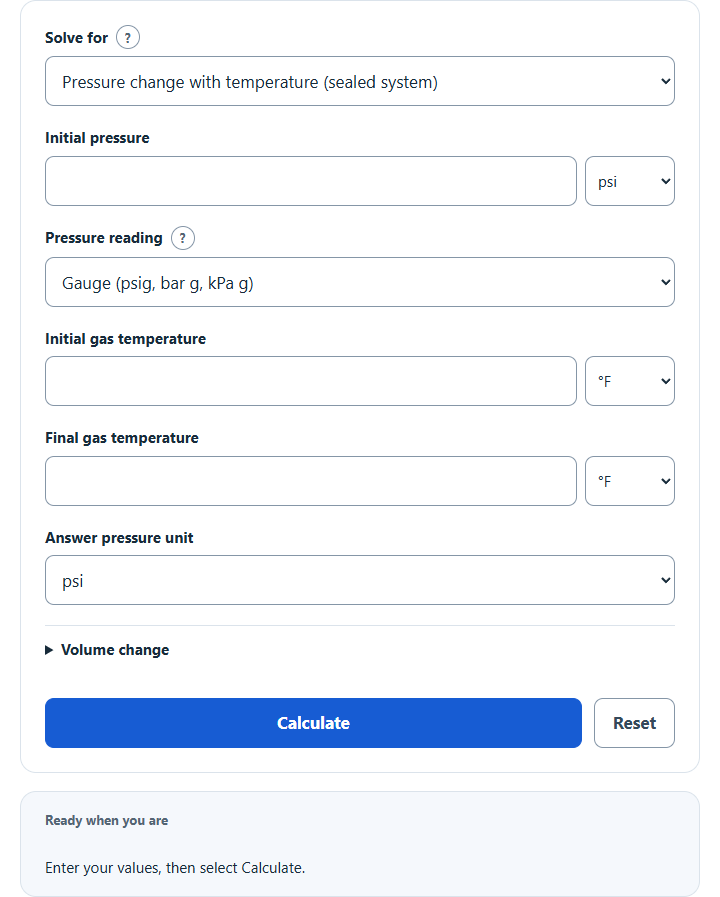
Calculate how nitrogen pressure changes with temperature in a sealed system from a gauge or absolute reading, or solve P, V, n or T with PV = nRT.
Related Calculators
- Volume To Moles Calculator
- Moles to Mass Calculator
- mmol to Grams Calculator
- Clausius-Clapeyron Equation Calculator
- All Chemistry Calculators
Nitrogen Volume for a Pipe or Vessel
Select Pipe/vessel gas to use a straight pipe’s internal diameter and length, or a known internal vessel volume. Enter the final gauge pressure and settled gas temperature. Final contents assumes an evacuated start; Additional nitrogen subtracts existing nitrogen at the same temperature and prescribed compressibility factor Z. It does not estimate nitrogen for displacing air or achieving a purge purity.
Pipe volume V = π(D/2)2L. Absolute pressure = gauge pressure + local atmosphere. The reference-volume estimate is Vref = V × (Pfinal,abs − Pinitial,abs) / (ZPref) × Tref/T. For final contents, Pinitial,abs = 0. Temperatures are in kelvin. Both reference outputs assume Zref = 1: Nm³ at 0 °C and 101.325 kPa absolute; scf at 60 °F and the same pressure. Always match the gas supplier’s reference conditions before comparing a capacity.
Example: a 1 m³ vessel at 0 °C and 101.325 kPa gauge, with local atmosphere 101.325 kPa and Z = 1, contains 2 Nm³. Raising existing nitrogen from 0 to 101.325 kPa gauge at that same temperature requires 1 additional Nm³. These are gas-law estimates, excluding purge cycles, leakage, delivery losses and reserve.
If you enter usable gas per cylinder in scf on this tool’s stated basis, the calculator rounds required scf ÷ usable scf per cylinder upward. It does not infer usable delivery capacity from cylinder pressure or water volume. A supplied Z must suit the gas state; high-density nitrogen requires validated property data. This quantity estimate does not approve a pressure test or prescribe safe filling conditions.
Nitrogen Pressure Formula
The following ideal-gas formula calculates absolute nitrogen pressure when Z = 1. The more general relation is P = ZnRT/V with a prescribed compressibility factor appropriate to the solved state. A guessed fixed Z does not replace a validated nitrogen equation of state at high density or near phase boundaries.
Variables:
- P is absolute nitrogen pressure in pascals (Pa), not gauge pressure; absolute pressure equals gauge pressure plus local atmospheric pressure
- n is the number of moles of nitrogen gas
- R is the molar gas constant, 8.31446261815324 J/(mol·K), equivalent to Pa·m³/(mol·K)
- T is absolute temperature in kelvin, greater than 0 K
- V is the volume of the container in cubic meters
For the ideal model, multiply the independently known nitrogen amount by R and absolute temperature, then divide by vessel volume in cubic meters. For the prescribed-Z model, also multiply by a state-appropriate Z. The calculator does not determine Z, phase stability, allowable pressure or a safe fill level.
What is a Nitrogen Pressure?
Nitrogen pressure is the normal force per unit area exerted by the gas. Nitrogen is relatively unreactive under many ordinary conditions, but this does not make a pressurized system safe. Nitrogen can displace oxygen and cause asphyxiation, and compressed gas stores hazardous energy. Use equipment ratings, gas-supplier guidance and an approved procedure for the actual application; this gas-law estimate does not approve cylinder filling or pressure testing.
How to Calculate Nitrogen Pressure?
The following steps outline how to calculate the Nitrogen Pressure:
- First, determine gas or vessel volume V and convert it to cubic meters for the SI formula; 1 liter = 0.001 m³.
- Next, determine the temperature of the nitrogen gas (T) in kelvin.
- Next, obtain nitrogen amount n independently, for example from a known amount or nitrogen mass and an appropriate molar mass. Do not use an unknown pressure to infer n and then claim to solve that same pressure.
- Finally, calculate absolute pressure P = nRT/V for Z = 1, or P = ZnRT/V with a validated state-appropriate Z, using coherent SI units.
- After inserting the variables and calculating the result, check your answer with the calculator above.
Example Problem:
Use the following variables as an example problem to test your knowledge.
Volume of nitrogen gas (V) = 5 liters
Temperature of nitrogen gas (T) = 300 kelvin
Number of moles of nitrogen gas (n) = 2 moles
For the ideal-gas assumption Z = 1, V = 5 L = 0.005 m³, n = 2 mol and T = 300 K give P = 2 × 8.31446261815324 × 300 / 0.005 ≈ 997,735.514 Pa ≈ 997.735514 kPa absolute.