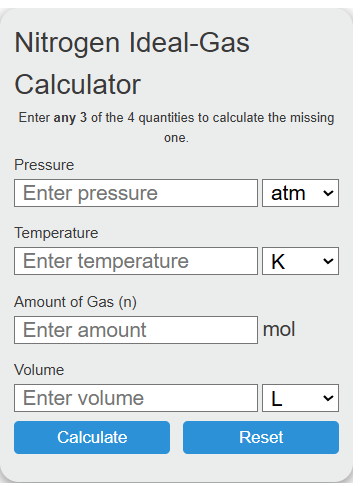
Calculate nitrogen gas volume or mass from pressure and temperature, or convert liquid nitrogen to gas volume, with SI and US unit options.
Related Calculators
- Liters To Moles Calculator
- Volume To Moles Calculator
- Moles To mL Calculator
- Z Factor Calculator
- All Chemistry Calculators
Nitrogen Volume Formula
Nitrogen volume is calculated using the ideal gas law:
| Variable | Symbol | SI Unit | Common Alt. |
|---|---|---|---|
| Volume | V | m³ | L, ft³ |
| Amount (moles) | n | mol | |
| Gas constant | R | 8.31446 J/(mol·K) | 0.082057 L·atm/(mol·K) |
| Temperature | T | K | °C + 273.15 |
| Pressure | P | Pa | atm, psi, bar |
Nitrogen Physical Properties
Nitrogen (N2) is a diatomic gas that behaves very close to an ideal gas under most ambient conditions. The properties below are reference values used in volume and density calculations.
| Property | Value |
|---|---|
| Molar mass | 28.014 g/mol |
| Density at STP (0°C, 1 atm) | 1.2506 g/L |
| Density at NTP (20°C, 1 atm) | 1.165 g/L |
| Molar volume at STP | 22.414 L/mol |
| Critical temperature (Tc) | 126.2 K (-147°C) |
| Critical pressure (Pc) | 33.9 atm (498 psi) |
| Van der Waals constant a | 1.390 L²·atm/mol² |
| Van der Waals constant b | 0.0391 L/mol |
Ideal Gas Accuracy for Nitrogen
The ideal gas law gives excellent results for nitrogen at pressures below 100 atm and temperatures well above its critical point (126.2 K). The compressibility factor Z (ratio of actual molar volume to ideal molar volume) quantifies how much the real gas deviates. For nitrogen at 300 K, Z stays within 1% of 1.0 up to roughly 150 atm, making the ideal law suitable for most industrial applications. Significant deviation occurs near the critical region or at cryogenic temperatures.
| Pressure (atm) | Z at 300 K | Ideal Law Error |
|---|---|---|
| 1 | 1.0000 | <0.01% |
| 10 | 0.9990 | 0.1% |
| 50 | 0.9950 | 0.5% |
| 100 | 0.9950 | ~1% |
| 200 | 1.032 | 3.2% (over-predicts volume) |
| 500 | 1.20 | ~20% |
At very high pressures, repulsive intermolecular forces dominate and Z rises above 1, meaning nitrogen occupies more volume than the ideal law predicts. For high-pressure applications such as nitrogen cylinders stored at 2,200 psi (150 atm), the ideal law introduces only about 1% error at room temperature, which is acceptable for most engineering purposes.
Example Calculations
Example 1: Basic volume calculation
Given: P = 100 psi (6.805 atm), T = 300 K, n = 1 mol
V = nRT / P = (1 × 0.082057 × 300) / 6.805 = 3.617 L (0.1278 ft³)
Example 2: Industrial nitrogen cylinder
A standard K-cylinder has an internal water volume of 49.9 L and is filled to 2,200 psi (149.7 atm) at 20°C (293 K). Using the ideal gas law to find how many moles are stored:
n = PV / RT = (149.7 × 49.9) / (0.082057 × 293) = 310.7 mol
At atmospheric pressure (1 atm) and 20°C, that gas expands to: V = nRT / P = (310.7 × 0.082057 × 293) / 1 = 7,474 L = 263.9 ft³. Standard K-cylinders are rated at 230 to 300 ft³, consistent with this calculation.