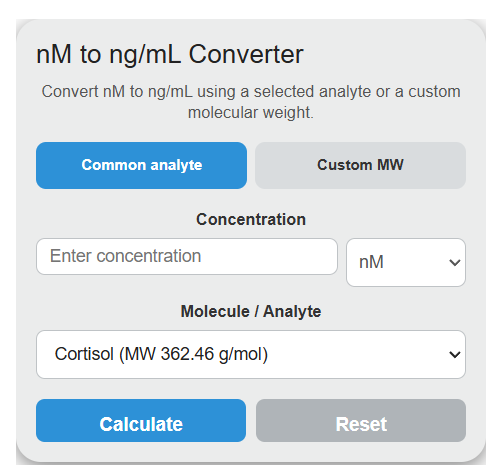
Convert nM, µM, or mM to ng/mL and reverse the conversion using molecular weight presets or custom MW, with mass units, assay-volume mass, dilution, and formula steps.
- Ng/Ml To Nm Calculator
- mcg/l to ng/ml Converter
- mg/l to percent Converter
- mol/L To kg/m3 Calculator
- All Unit Converters
nM to ng/mL Formula
The following formula is used to convert a concentration from nanomolar to nanograms per milliliter.
Variables:
- ng/mL is the mass concentration in nanograms per milliliter
- nM is the molar concentration in nanomoles per liter
- MW is the molecular weight of the compound in grams per mole
To calculate ng/mL, multiply the concentration in nM by the molecular weight of the compound and divide by 1000. If you need to reverse the calculation, use nM = ng/mL × 1000 ÷ MW.
What is nM to ng/mL Conversion?
A value in nM describes how many nanomoles of a substance are present per liter, while ng/mL describes the mass of that substance per milliliter. These units measure concentration in different ways, so the molecular weight of the compound is required to convert between them. Heavier molecules produce a larger ng/mL value at the same nM concentration.
This type of conversion is common in laboratory testing, pharmacology, endocrinology, and biomedical research because assay results may be reported in either molar units or mass-per-volume units depending on the method used.
How to Convert nM to ng/mL?
The following steps outline how to convert nM to ng/mL.
- First, determine the concentration in nanomolar (nM).
- Next, determine the molecular weight (MW) of the molecule in grams per mole.
- Multiply the nM value by the molecular weight.
- Divide the result by 1000 to convert the value to ng/mL.
- Check your answer using the calculator above.
Example Problem:
Use the following values as an example problem to test your knowledge.
Concentration = 10 nM
Molecule = Cortisol
Molecular Weight = 362.46 g/mol
ng/mL = 10 × 362.46 ÷ 1000 = 3.6246 ng/mL
Common Molecular Weights
Some approximate molecular weights often used in clinical and research settings are listed below.
- Cortisol: 362.46 g/mol
- Estradiol: 272.38 g/mol
- Testosterone: 288.42 g/mol
- Thyroxine (T4): 776.87 g/mol
- Vitamin D3: 384.64 g/mol
- Progesterone: 314.46 g/mol
- Insulin: 5808 g/mol
For example, 10 nM of cortisol is about 3.62 ng/mL, while 10 nM of insulin is about 58.08 ng/mL. The difference exists because insulin has a much higher molecular weight, so the same molar amount represents more mass.
nM to ng/mL Conversion Table
The table below shows how a 10 nM concentration converts to ng/mL for several common molecules using the formula ng/mL = nM × MW ÷ 1000.
| Molecule | Molecular Weight (g/mol) | 10 nM in ng/mL |
|---|---|---|
| Cortisol | 362.46 | 3.62 ng/mL |
| Estradiol | 272.38 | 2.72 ng/mL |
| Testosterone | 288.42 | 2.88 ng/mL |
| Thyroxine (T4) | 776.87 | 7.77 ng/mL |
| Vitamin D3 | 384.64 | 3.85 ng/mL |
| Progesterone | 314.46 | 3.14 ng/mL |
| Insulin | 5808 | 58.08 ng/mL |
Different assays and publications may report the same analyte in either nM or ng/mL. Understanding how molecular weight connects these units makes it possible to compare values accurately across labs, references, and instruments.