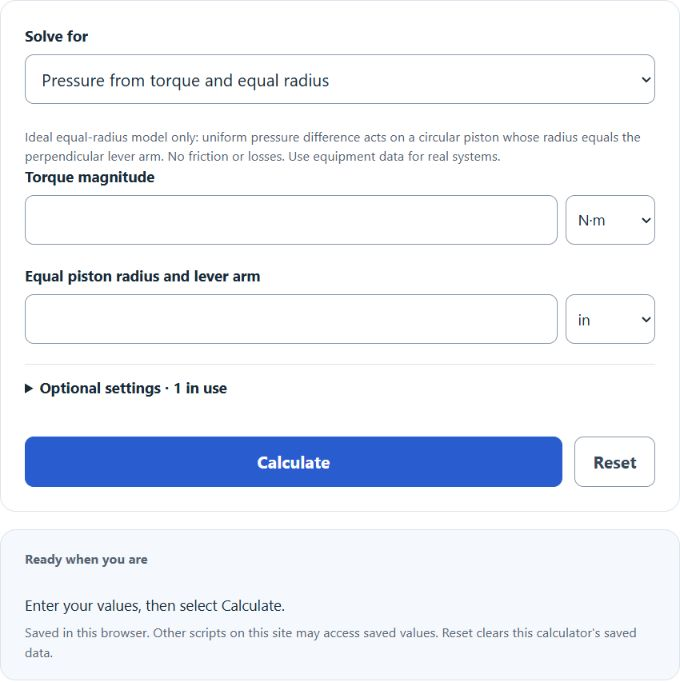
Calculate ideal torque, equal radius, or pressure difference using a circular piston whose radius also equals the perpendicular lever arm, or convert pressure units directly. Real equipment requires its own geometry and performance data.
| Torque to Pressure | Pressure to Torque |
|---|---|
| 5 ft·lbf = 19.10 psi | 25 psi = 6.54 ft·lbf |
| 10 ft·lbf = 38.20 psi | 50 psi = 13.09 ft·lbf |
| 15 ft·lbf = 57.30 psi | 75 psi = 19.63 ft·lbf |
| 20 ft·lbf = 76.39 psi | 100 psi = 26.18 ft·lbf |
| 25 ft·lbf = 95.49 psi | 150 psi = 39.27 ft·lbf |
| 30 ft·lbf = 114.59 psi | 200 psi = 52.36 ft·lbf |
| 40 ft·lbf = 152.79 psi | 250 psi = 65.45 ft·lbf |
| 50 ft·lbf = 190.99 psi | 300 psi = 78.54 ft·lbf |
| 75 ft·lbf = 286.48 psi | 500 psi = 130.90 ft·lbf |
| 100 ft·lbf = 381.97 psi | 1000 psi = 261.80 ft·lbf |
| Ideal equal-radius model: T(in·lbf) = P(psi) x pi x r(in)³. Divide T(in·lbf) by 12 for ft·lbf. Radius and perpendicular lever arm both 1 inch. | |
| Torque to Pressure | Pressure to Torque |
|---|---|
| 10 ft·lbf = 4.77 psi | 10 psi = 20.94 ft·lbf |
| 20 ft·lbf = 9.55 psi | 25 psi = 52.36 ft·lbf |
| 30 ft·lbf = 14.32 psi | 50 psi = 104.72 ft·lbf |
| 40 ft·lbf = 19.10 psi | 75 psi = 157.08 ft·lbf |
| 50 ft·lbf = 23.87 psi | 100 psi = 209.44 ft·lbf |
| 75 ft·lbf = 35.81 psi | 150 psi = 314.16 ft·lbf |
| 100 ft·lbf = 47.75 psi | 200 psi = 418.88 ft·lbf |
| 150 ft·lbf = 71.62 psi | 300 psi = 628.32 ft·lbf |
| 200 ft·lbf = 95.49 psi | 500 psi = 1047.20 ft·lbf |
| 300 ft·lbf = 143.24 psi | 1000 psi = 2094.40 ft·lbf |
| Ideal equal-radius model: T(in·lbf) = P(psi) x pi x r(in)³. Divide T(in·lbf) by 12 for ft·lbf. Radius and perpendicular lever arm both 2 inches. | |
Nm to psi Conversion Formula
For an ideal circular piston with uniform pressure difference and a perpendicular lever arm equal to the piston radius, the relationship is:
Variables:
- PSI – pressure in pounds per square inch
- T – torque in newton-meters (N·m)
- 8.85075 – conversion factor from N·m to in·lbf (1 N·m = 8.85074579 in·lbf)
- r – radius in inches; represents both the piston radius and the moment arm
Radius has a cubic effect on pressure: doubling r reduces the required pressure by a factor of 8. The table below shows PSI per 1 N·m of torque at common radii:
| Radius (in) | PSI per 1 N·m | PSI for 100 N·m | PSI for 500 N·m |
|---|---|---|---|
| 0.5 | 22.538 | 2,254 | 11,269 |
| 1.0 | 2.817 | 281.728 | 1,409 |
| 1.5 | 0.835 | 83.475 | 417.375 |
| 2.0 | 0.352 | 35.216 | 176.08 |
| 3.0 | 0.104 | 10.434 | 52.172 |
Why This Conversion Requires a Radius
Torque (N·m) and pressure (PSI) measure fundamentally different physical quantities: torque is rotational force times distance, while pressure is force per unit area. No single conversion factor exists between them. A geometric parameter is always required.
The formula above uses an ideal equal-radius circular-piston model: uniform pressure difference P acts over a piston area pi x r^2, and the transmitted force acts at a perpendicular moment arm also equal to r. Thus T = P x (pi x r^2) x r. A general piston/crank requires its actual area and instantaneous perpendicular moment arm; equal piston and crank radii alone are insufficient. Rotary vane actuators have different geometry and require manufacturer data.
For a hydraulic motor with known displacement, use a different relationship: T(N·m) = Δp(bar) x D(cm³/rev) x mechanical efficiency / (20 x pi). Here Δp is inlet minus outlet pressure. The table below uses the exact listed PSI pressure differences and 100% mechanical efficiency; actual motor torque requires manufacturer efficiency data.
| Displacement (cc/rev) | 1,000 PSI (69 bar) | 2,000 PSI (138 bar) | 3,000 PSI (207 bar) |
|---|---|---|---|
| 50 | 55 N·m | 110 N·m | 165 N·m |
| 100 | 110 N·m | 219 N·m | 329 N·m |
| 250 | 274 N·m | 549 N·m | 823 N·m |
| 500 | 549 N·m | 1,097 N·m | 1,646 N·m |
| 1000 | 1,097 N·m | 2,195 N·m | 3,292 N·m |
| Formula: T(N·m) = Δp(bar) x D(cm³/rev) x mechanical efficiency / (20 x pi). Values shown assume efficiency = 1. Use manufacturer data for actual efficiency and allowable pressure difference. | |||
How to Calculate Pressure from Torque (Nm)
- Determine the torque in newton-meters (N·m).
- Confirm the ideal model applies: the circular piston radius and perpendicular moment arm must be equal. Enter this common radius in inches. Do not use a rotary vane radius or an arbitrary crank radius.
- Apply the formula: PSI = (Torque x 8.85075) / (pi x Radius^3). Note the exponent is 3, not 2 — radius appears cubed because it accounts for both the piston area (r^2) and the moment arm (r).
- The result is the ideal pressure difference across the piston in pounds per square inch. Friction, angle changes, losses and equipment limits are not included.
- Verify your result with the calculator above. For a different system geometry (hydraulic motor with known displacement), use the displacement formula instead.
Example Problem:
An ideal circular piston with a 2-inch radius transmits force through a perpendicular moment arm of 2 inches to produce 50 N·m of torque. What pressure difference is required?
PSI = (50 x 8.85074579) / (pi x 2^3) ≈ 17.61 PSI (using unrounded intermediate values).