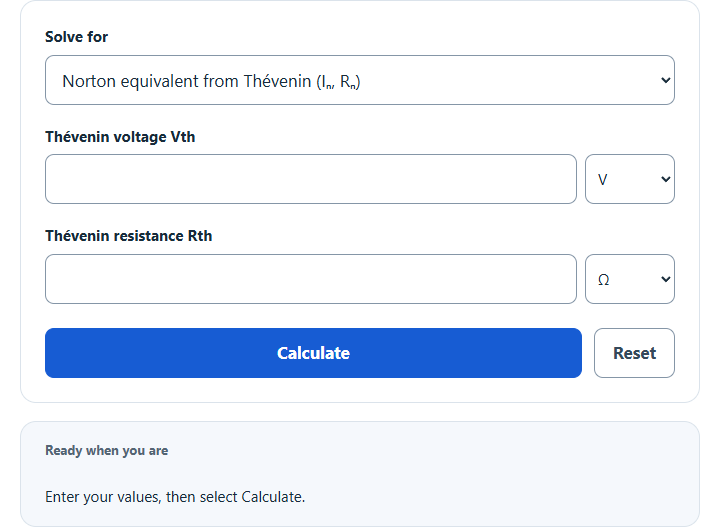
Find the Norton equivalent current and resistance from a Thévenin source or a simple circuit, calculate load current, or convert Norton to Thévenin.
- All Physics Calculators
- Thevenin Voltage Calculator
- Norton Current Calculator
- All Electrical Calculators
Norton's Theorem Formula
The following formula is used to calculate the load current according to Norton's Theorem.
Variables:
- IL is the load current (amps)
- ISC is the short circuit current (amps)
- RTH is the Thévenin equivalent resistance (ohms)
- RL is the load resistance (ohms)
To calculate the load current using Norton's Theorem, use current division: multiply the short circuit (Norton) current by the ratio of the equivalent resistance to the total parallel resistance, RTH/(RTH+RL).
What is Norton's Theorem?
Norton's Theorem is a simplification technique used in circuit analysis. According to the theorem, any linear two-terminal electrical network (including independent/dependent sources) can be replaced at terminals A-B by an equivalent current source (ISC) in parallel with an equivalent resistance (RTH). (For AC analysis, the same idea applies using impedances instead of resistances.) This theorem is used to simplify the analysis of circuits by reducing them to a basic equivalent circuit, making calculations easier to manage.
How to Calculate Load Current using Norton's Theorem?
The following steps outline how to calculate the load current using Norton's Theorem.
- First, determine the short circuit current (ISC) in amps.
- Next, determine the Thévenin equivalent resistance (RTH) in ohms.
- Next, determine the load resistance (RL) in ohms.
- Next, gather the formula from above: IL = ISC × RTH/(RTH+RL).
- Finally, calculate the load current (IL) in amps.
- After inserting the variables and calculating the result, check your answer with the calculator above.
Example Problem :
Use the following variables as an example problem to test your knowledge.
Short circuit current (ISC) = 5 amps
Thévenin equivalent resistance (RTH) = 10 ohms
Load resistance (RL) = 20 ohms