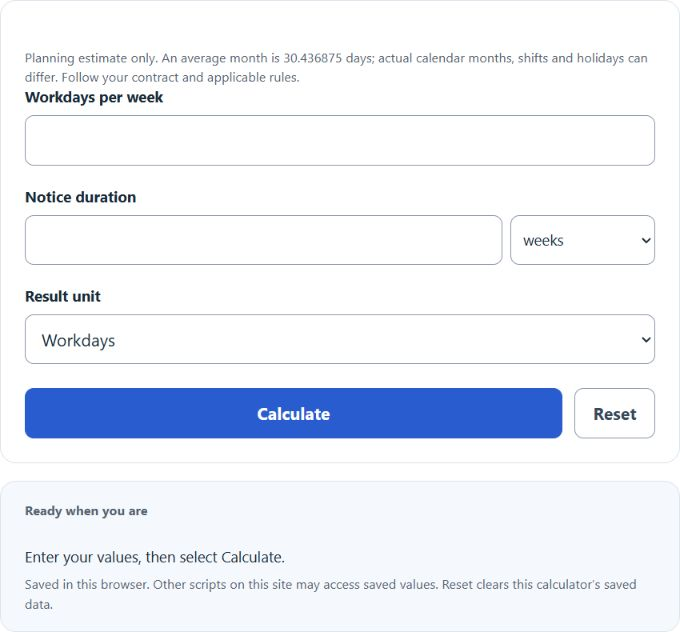
Estimate notice period workdays from working days per week and duration in days, weeks, or months, with results in workdays, workweeks, or workmonths.
Related Calculators
- Length of Employment Calculator
- Employment Duration Calculator
- Length of Service Calculator
- Contract End Date Calculator
- Weeks to Working Days Calculator
- All Everyday Life and Education Calculators
Notice Period Formula
A notice period is the amount of time between giving notice and the final working day. This calculator converts that time into estimated workdays based on how many days you normally work each week. It is especially useful when a contract gives notice in weeks, calendar days, or months, but you want to know the practical impact on your work schedule.
When notice is stated in weeks, the estimate is straightforward:
If notice is entered in calendar days, the calculator estimates the workday portion of those days using a 7-day week:
If notice is entered in months, the calculator uses an average Gregorian month length of 30.436875 days (about 30.44):
Variable Definitions
- NP: estimated notice period in workdays
- WD: number of working days in a typical week
- W: notice duration in weeks
- CD: notice duration in calendar days
- M: notice duration in months
How the Calculator Interprets Each Unit
| Input Unit | Use Case | Estimate Applied |
|---|---|---|
| Weeks | Best when the contract says “2 weeks,” “4 weeks,” or similar. | NP = WD × W |
| Days | Useful when notice is written as calendar days rather than working days. | NP = (WD) / (7) × CD |
| Months | Useful for contracts that state notice as a number of months. | NP = (WD) / (7) × 30.436875 × M |
How to Use the Notice Period Calculator
- Enter the number of days you usually work in a week.
- Enter the length of the notice period.
- Select whether the duration is in weeks, calendar days, or average months, choose the result unit, then select Calculate.
- Review the estimated result in workdays, and use it as a planning figure for handover, payroll, and final scheduling.
Examples
Example 1: 5 workdays per week and 4 weeks of notice
This gives an estimated notice period of 20 workdays.
Example 2: 5 workdays per week and 30 calendar days of notice
This is about 21.43 estimated workdays, which should be interpreted according to the actual schedule and applicable agreement.
Example 3: 3 workdays per week and 2 months of notice
This produces an estimate of about 26.09 workdays.
What Affects the Final Notice Period in Practice?
The calculator gives a clean estimate, but the exact final schedule may differ depending on contract language and workplace rules. Common factors include:
- Calendar days vs. working days: some contracts count every day, while others count only scheduled working days.
- Part-time schedules: working 2, 3, or 4 days per week changes the total significantly.
- Public holidays and company closures: these may or may not count depending on policy.
- Garden leave or pay in lieu of notice: you may remain employed without working normally.
- Rounding: estimated outputs can include decimals, while real schedules are usually handled in whole days or actual shifts.
Working Days, Business Days, and Calendar Days
These terms are often confused, but they are not identical:
- Working days are the days you are normally scheduled to work.
- Business days usually mean weekdays and may exclude weekends and holidays.
- Calendar days include every day on the calendar, including weekends.
If your agreement uses one specific term, follow that wording first and use the calculator as an estimate to translate the notice into practical work time.
When This Calculator Is Most Helpful
- Estimating how many workdays remain after resigning
- Planning project handover and transition timelines
- Comparing notice clauses across employment offers
- Understanding the impact of part-time or non-standard workweeks
- Converting monthly or daily notice requirements into expected scheduled workdays
Important Note
This calculator is best used as a planning tool. The enforceable notice period is determined by the wording of the employment contract, handbook, policy documents, or any applicable legal requirements. If the contract specifies how weekends, holidays, or partial weeks are treated, that wording should control the final interpretation.