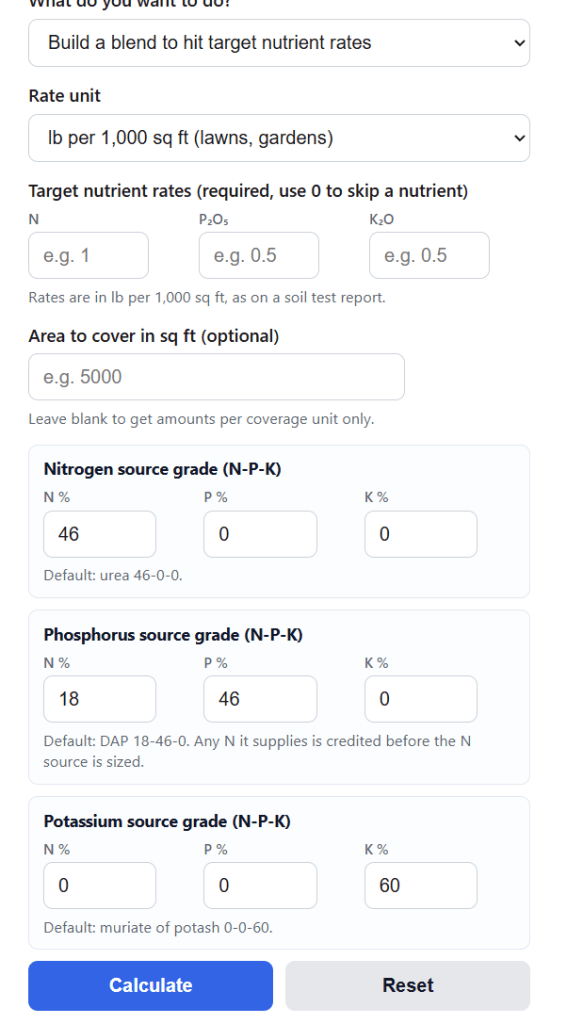
Calculate a custom NPK fertilizer blend, including the exact product weights needed to hit target nutrient rates and the final N-P-K grade and ratio of any mix.
NPK Fertilizer Blend Formula
PW = TR / (G / 100)
Blend % = 100 * NW / BW
- PW is the product weight of one fertilizer needed per coverage unit (lb per 1,000 sq ft, lb per acre, or kg per hectare)
- TR is the target rate for one nutrient in the same coverage unit
- G is the grade percentage of that nutrient from the product's guaranteed analysis (the 46 in 46-0-0)
- NW is the total weight of one nutrient contained in a mix
- BW is the total weight of the whole blend
The blend-building mode applies the first formula one product at a time, in an order that prevents double-applying nitrogen. The potassium source is sized first against the K₂O target. The phosphorus source is sized next against whatever P₂O₅ remains. Then the nitrogen supplied by those two products is subtracted from the N target before the nitrogen source is sized, which matters whenever the phosphorus source is DAP (18-46-0) or MAP (11-52-0), since both carry meaningful nitrogen. The result is the weight of each product per coverage unit, the totals for your full area, and the grade and N : P₂O₅ : K₂O ratio of the finished blend.
The mix-analysis mode applies the second formula to up to four products. Enter each product's weight in any single unit along with its grade, and the calculator returns the combined grade of the mixture, the weight of each nutrient it contains, and the equivalent elemental phosphorus and potassium.
Common Blending Products and Their Grades
These are the straight fertilizers most custom blends are built from. The last column shows how many pounds of product deliver one pound of the nutrient it is used for.
| Product | Grade | Primary use | Lb product per lb nutrient |
|---|---|---|---|
| Urea | 46-0-0 | Nitrogen | 2.17 |
| Ammonium sulfate | 21-0-0 | Nitrogen plus sulfur | 4.76 |
| DAP (diammonium phosphate) | 18-46-0 | Phosphorus (also 18% N) | 2.17 |
| MAP (monoammonium phosphate) | 11-52-0 | Phosphorus (also 11% N) | 1.92 |
| Triple superphosphate | 0-46-0 | Phosphorus, no N | 2.17 |
| Muriate of potash (MOP) | 0-0-60 | Potassium | 1.67 |
| Sulfate of potash (SOP) | 0-0-50 | Potassium, chloride-free | 2.00 |
Custom blends do not have to be synthetic. The table below gives typical guaranteed analyses for organic amendments so you can run them through either mode of the calculator. Organic grades vary somewhat by supplier, so check the bag; the values shown are common label analyses.
| Organic amendment | Typical grade | Notes |
|---|---|---|
| Blood meal | 12-0-0 | Fast organic N source |
| Feather meal | 13-0-0 | Slow-release N over 2 to 4 months |
| Bone meal | 3-15-0 | P source, works best in soil below pH 7 |
| Alfalfa meal | 2-1-2 | Balanced, adds organic matter |
| Kelp meal | 1-0-2 | K plus micronutrients |
| Langbeinite (Sul-Po-Mag) | 0-0-22 | K plus magnesium and sulfur, mined mineral |
| Wood ash | 0-1-3 | Raises soil pH, use sparingly |
Grade numbers use the oxide convention, not elemental amounts. To convert, multiply P₂O₅ by 0.44 to get elemental phosphorus and K₂O by 0.83 to get elemental potassium. DAP at 46% P₂O₅ therefore contains about 20% elemental P. The calculator reports both forms so results line up with either labeling style.
Example Problems
Example 1: build a blend to hit target rates. A soil test calls for 1.0 lb N, 0.5 lb P₂O₅, and 0.5 lb K₂O per 1,000 sq ft on a 5,000 sq ft garden, using urea (46-0-0), DAP (18-46-0), and muriate of potash (0-0-60).
MOP first: 0.5 / 0.60 = 0.83 lb. DAP next: 0.5 / 0.46 = 1.09 lb, which also delivers 1.09 × 0.18 = 0.20 lb of N. Urea covers the remaining N: (1.0 − 0.20) / 0.46 = 1.75 lb. Total product is 3.67 lb per 1,000 sq ft, a finished grade of about 27.3-13.6-13.6 and a 2 : 1 : 1 ratio. For the full 5,000 sq ft, buy 8.74 lb urea, 5.43 lb DAP, and 4.17 lb MOP, about 18.3 lb of product in total. Skipping the DAP nitrogen credit would have oversized the urea by roughly 11 percent.
Example 2: find the grade of a custom mix. You mix 3 lb blood meal (12-0-0), 6 lb bone meal (3-15-0), and 3 lb langbeinite (0-0-22), 12 lb in total.
N = 3 × 0.12 + 6 × 0.03 = 0.54 lb (4.5%). P₂O₅ = 6 × 0.15 = 0.90 lb (7.5%). K₂O = 3 × 0.22 = 0.66 lb (5.5%). The mix works out to a 4.5-7.5-5.5 grade with a 1 : 1.7 : 1.2 ratio, containing about 0.39 lb elemental P and 0.55 lb elemental K.
Frequently Asked Questions
Why do the phosphorus and potassium numbers not mean elemental P and K?
Fertilizer labeling law in North America and most other markets expresses phosphorus as phosphate (P₂O₅) and potassium as potash (K₂O), a convention left over from early oxide-based chemistry analysis. A 10-10-10 bag contains 10% N, 10% P₂O₅, and 10% K₂O by weight, which is only about 4.4% elemental P and 8.3% elemental K. Soil test recommendations use the same oxide convention, so you can enter them directly; the elemental line in the results is there for comparing against sources that report elemental values, such as hydroponic nutrient analyses.
Can any two fertilizers be blended together?
Not always. Urea mixed with ammonium nitrate turns wet and cakes quickly, and urea blended with ordinary superphosphate can release moisture and clump in storage. Blends of chemically compatible products can still separate in the bag or spreader if granule sizes differ, which puts nutrients down unevenly. The practical rules are to blend close to the time of application, match granule sizes where you can, and store blends dry and briefly.
How do I convert a recommendation in lb per acre to lb per 1,000 sq ft?
Divide by 43.56, since an acre is 43,560 sq ft. A recommendation of 130 lb N per acre equals about 3.0 lb N per 1,000 sq ft. Going the other way, multiply by 43.56. The calculator also accepts rates directly in lb per acre or kg per hectare, so conversion is only needed when your recommendation and your preferred working unit differ.