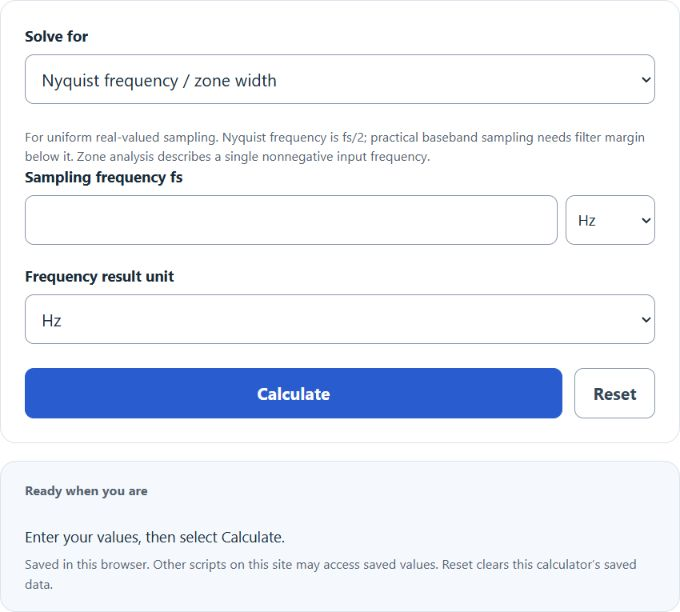
Calculate sampling frequency or Nyquist frequency from the other, with results in Hz, kHz, MHz, or GHz for signal sampling and unit conversion.
Nyquist Zone Frequency Formula
This calculator finds the Nyquist frequency from a known sampling frequency, or the sampling frequency from a known Nyquist frequency. In signal processing, the Nyquist frequency is one-half of the sampling rate, and it also represents the width of each Nyquist zone.
Where:
- fN = Nyquist frequency
- fs = sampling frequency
If you already know the Nyquist frequency and need to solve for the sampling frequency, rearrange the equation as follows:
How to Use the Calculator
- Choose the calculation and enter the required frequency values.
- Select the correct unit: Hz, kHz, MHz, or GHz.
- Click calculate to solve for the missing value.
- Interpret the result as the highest baseband frequency limit for standard real-valued sampling.
Choose the result unit independently; the calculator converts Hz, kHz, MHz and GHz consistently.
What a Nyquist Zone Means
Nyquist zones divide the frequency axis into equal bands, each with a width equal to the Nyquist frequency. This is useful in ADC, DSP, RF sampling, and aliasing analysis.
The Nyquist-frequency mode returns the width of every zone. The signal-zone mode also identifies the zone and folded alias. It uses lower-inclusive, upper-exclusive intervals; a frequency exactly on a boundary is flagged.
Finding the Nyquist Zone Number
For a positive input frequency, the zone number can be estimated with:
Where:
- z = Nyquist zone number
- f = input signal frequency
- fs = sampling frequency
Examples
If the sampling frequency is 150 Hz, the Nyquist frequency is:
If the desired Nyquist frequency is 12 MHz, the required sampling frequency is:
If the sampling frequency is 100 MHz, the zone boundaries are:
So the first three zones are 0 to 50 MHz, 50 to 100 MHz, and 100 to 150 MHz.
Nyquist Frequency vs. Nyquist Rate
These terms are related, but they are not the same:
- Nyquist frequency is half of an actual sampling rate.
- Nyquist rate is the minimum sampling rate needed to capture a signal with a highest frequency component.
For arbitrary baseband signals, avoid equality at the Nyquist edge and leave practical anti-alias filter margin. Use the calculator on this page when you need to convert directly between sampling frequency and Nyquist frequency.
Why This Calculation Matters
- It defines the frequency limit before standard aliasing begins in baseband sampling.
- It helps size anti-aliasing filters ahead of an ADC.
- It is essential when choosing sample rates for data acquisition, oscilloscopes, RF receivers, and digital audio systems.
- It provides the bandwidth of each Nyquist zone when analyzing undersampling or bandpass sampling systems.
Practical Notes
- Always keep your units consistent when entering values.
- A higher sampling frequency increases the Nyquist frequency and expands the first usable zone.
- Signals above the first zone can still be intentionally sampled in some applications, but their aliased position must be controlled carefully.
- Even-numbered zones often appear spectrally inverted after sampling, which matters in RF and communication system design.
Common Mistakes
- Confusing the sampling frequency with the Nyquist frequency.
- Using mixed units across Hz, kHz, MHz, and GHz.
- Assuming the Nyquist frequency is the same as the Nyquist rate.
- Ignoring aliasing when the input signal contains frequency content above the first zone.