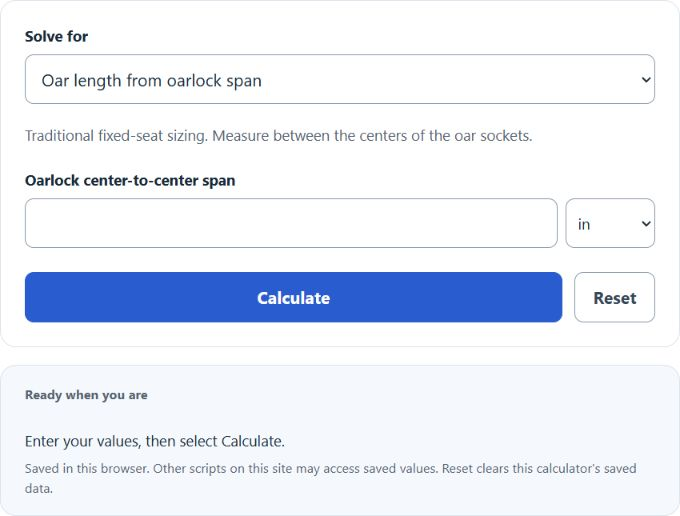
Enter the span between oarlocks (center-to-center) and select the unit into the Oar Length Calculator. The calculator will estimate the oar length using the rule-of-thumb formula shown below (actual oar length depends on boat/rigging style and manufacturer recommendations).
Related Calculators
- Crank Length Calculator
- Lap Distance Calculator
- Velocity Loss Calculator
- Heart Rate Zone Calculator
- All Sports and Fitness Calculators
Oar Length Formula and Sizing Guide
The oar length calculator estimates overall oar length from the span between the oarlocks. Measure the span from the center of one oarlock to the center of the other, enter that value in inches, feet, centimeters, or meters, and the calculator returns the estimated oar length in the unit you select.
Rule-of-Thumb Formula
OL = \left(\frac{S}{2} + 2\right)\frac{25}{7}OL = estimated oar length
S = span between oarlocks, measured center-to-center
For direct use of the equation, both values are in inches. The calculator handles the unit conversions automatically.
Inverse Formula
S = \frac{14}{25}OL - 4Use the inverse form when you already know the oar length and want to estimate the oarlock span that matches it.
How to Use the Oar Length Calculator
- Measure the span between the oarlocks from center to center.
- Choose the correct unit for the span measurement.
- Enter the value into the calculator.
- Read the estimated total oar length in inches, feet, centimeters, or meters.
- Use the result as a starting size, then compare it with available commercial oar lengths and your rigging setup.
Examples
If the span between oarlocks is 63 inches, the estimated oar length is:
OL = \left(\frac{63}{2} + 2\right)\frac{25}{7} = 119.64 \text{ in}That is approximately 9.97 ft, 303.89 cm, or 3.04 m.
If you already have a 10 ft oar and want to estimate the matching span, first convert 10 ft to 120 in, then solve for span:
S = \frac{14}{25}(120) - 4 = 63.2 \text{ in}Quick Reference Table
| Span (in) | Span (cm) | Estimated Oar Length (in) | Estimated Oar Length (ft) | Estimated Oar Length (cm) | Estimated Oar Length (m) |
|---|---|---|---|---|---|
| 58.00 | 147.32 | 110.71 | 9.23 | 281.21 | 2.81 |
| 60.00 | 152.40 | 114.29 | 9.52 | 290.29 | 2.90 |
| 62.00 | 157.48 | 117.86 | 9.82 | 299.36 | 2.99 |
| 63.00 | 160.02 | 119.64 | 9.97 | 303.89 | 3.04 |
| 64.00 | 162.56 | 121.43 | 10.12 | 308.43 | 3.08 |
| 66.00 | 167.64 | 125.00 | 10.42 | 317.50 | 3.18 |
What the Estimate Tells You
This formula gives a fast, practical starting point for sizing an oar from the rig width of the boat. Because the equation is linear, every additional inch of oarlock span increases the estimated oar length by about 1.79 inches. That makes it useful for quick comparisons when you are adjusting rigging or evaluating different setups.
What Can Change the Final Oar Size
- Boat width and rigging: Wider setups generally need longer oars.
- Handle overlap and gearing: Small length changes affect leverage, comfort, and clearance.
- Blade style: Different blade shapes and designs can change how a given length feels in the water.
- Rower preference: Strength, stroke rate, and personal feel matter.
- Available stock sizes: Real-world oars are sold in set lengths, so the nearest available size is often the practical choice.
Measurement Tips
- Measure the span with the boat set up exactly as it will be rowed.
- Use the center of each oarlock, not the outer hull width or gunwale width.
- Re-measure after moving hardware, outriggers, or collars.
- If the result falls between two sizes, start with the nearest length and fine-tune the rig if your setup allows it.
Common Questions
- Is the result exact?
- No. It is a rule-of-thumb estimate designed to give a strong starting point, not a fixed universal standard.
- Can I use metric units?
- Yes. You can enter the span in centimeters or meters, and the calculator will convert the measurement before applying the formula.
- Does the calculator estimate total oar length or just part of the oar?
- It estimates the overall oar length.
- What if I know the oar length but not the span?
- Use the inverse equation above to estimate the matching span between oarlocks.