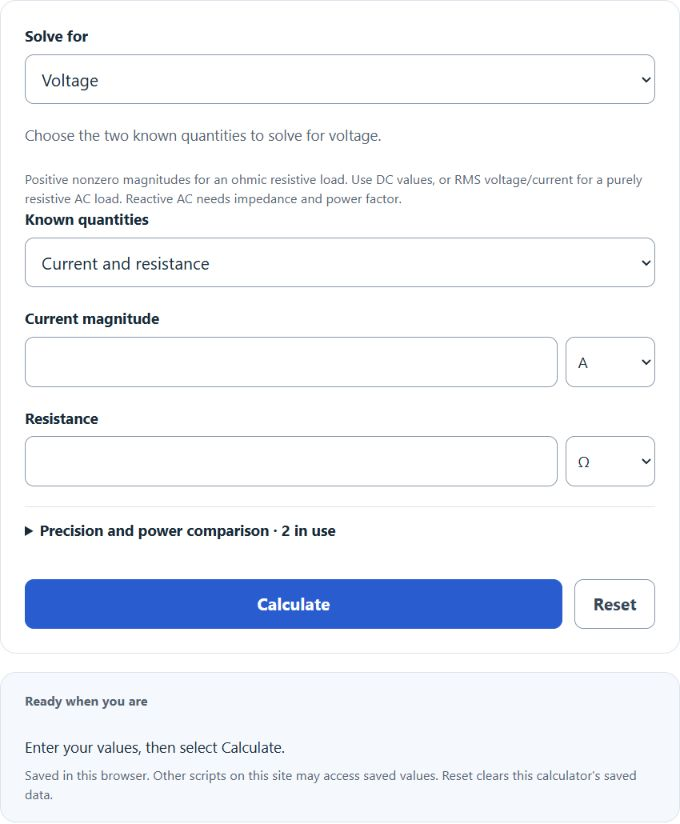
Calculate voltage, current, resistance and dissipated power from two positive nonzero magnitudes for an ohmic resistive load. Use DC values or RMS voltage/current for a purely resistive AC load.
Ohm’s Law Formula
Ohm’s law relates voltage, current, and resistance in a resistive circuit. The calculator rearranges this relationship to solve for whichever quantity you choose, and it adds the power equations so you can also find watts. Pick a quantity in the “Solve for” menu, choose which pair of values you know, and the matching formula below is the one applied.
V = I * R
I = V / R
R = V / I
P = V * I
P = I^2 * R
P = V^2 / R
- V = voltage in volts (V)
- I = current in amperes (A)
- R = resistance in ohms
- P = power in watts (W)
When you solve for voltage, the calculator uses V = I * R if you enter current and resistance, or one of the power forms if you enter power with another value. Solving for current uses I = V / R, and solving for resistance uses R = V / I. Power is found with P = V * I when voltage and current are known, P = I^2 * R when current and resistance are known, and P = V^2 / R when voltage and resistance are known. The unit menus convert prefixes such as milliamps or kilohms to base units before the math runs, and the advanced options control the number of significant digits and an optional resistor power-rating margin.
Common Values for Everyday Circuits
These are illustrative nominal values, not universal source capabilities or safe operating limits. Actual current depends on the load and supply specification. LEDs are nonlinear devices, so a forward-voltage example does not make them ohmic resistors.
| Source or device | Typical voltage | Typical current |
|---|---|---|
| AA battery | 1.5 V nominal example | Load- and battery-dependent |
| USB port | 5 V legacy example | Check the port and negotiated specification |
| Car electrical system | 12 V nominal example | Depends on the circuit and operating load |
| US wall outlet | 120 V nominal example | Depends on the load; circuit rating is separate |
| Standard LED | 2 to 3 V | 0.01 to 0.02 A |
The next table shows the four quantities and the unit prefixes the calculator accepts for each.
| Quantity | Symbol | Base unit | Prefixes supported |
|---|---|---|---|
| Voltage | V | volt (V) | uV, mV, V, kV |
| Current | I | amp (A) | uA, mA, A, kA |
| Resistance | R | ohm | mohm, ohm, kohm, Mohm |
| Power | P | watt (W) | uW, mW, W, kW, MW |
Example Problems
Example 1. A resistor carries a current of 2 A and has a resistance of 10 ohms. Solve for voltage. Using V = I * R, you get V = 2 * 10 = 20 V. The calculator also reports the power as P = V * I = 20 * 2 = 40 W.
Example 2. A purely resistive device runs on 120 V and draws 0.5 A. Solve for resistance. Using R = V / I, you get R = 120 / 0.5 = 240 ohms. Its power use is P = V * I = 120 * 0.5 = 60 W.
Frequently Asked Questions
Does Ohm’s law work for any circuit? Ohm’s law applies to resistive circuits, meaning circuits whose elements behave as resistors. It gives accurate results for resistors, heating elements, and most wiring. It does not directly describe capacitors, inductors, or components like diodes whose resistance changes with voltage, so treat those cases separately.
Why does the calculator also show power? Power tells you how much energy a component dissipates as heat, which determines the rating you need. Once any two of voltage, current, and resistance are known, power follows from P = V * I, P = I^2 * R, or P = V^2 / R. The optional power allowance shows a mathematical comparison above calculated dissipation. It does not establish a safe resistor rating or temperature; check the specific datasheet, ambient temperature, mounting, voltage and pulse limits.
What units should I enter? Enter positive magnitudes and pick the matching prefix from each unit menu. The calculator converts everything to volts, amps, ohms, and watts before solving, so you can mix prefixes such as milliamps and kilohms without converting by hand.