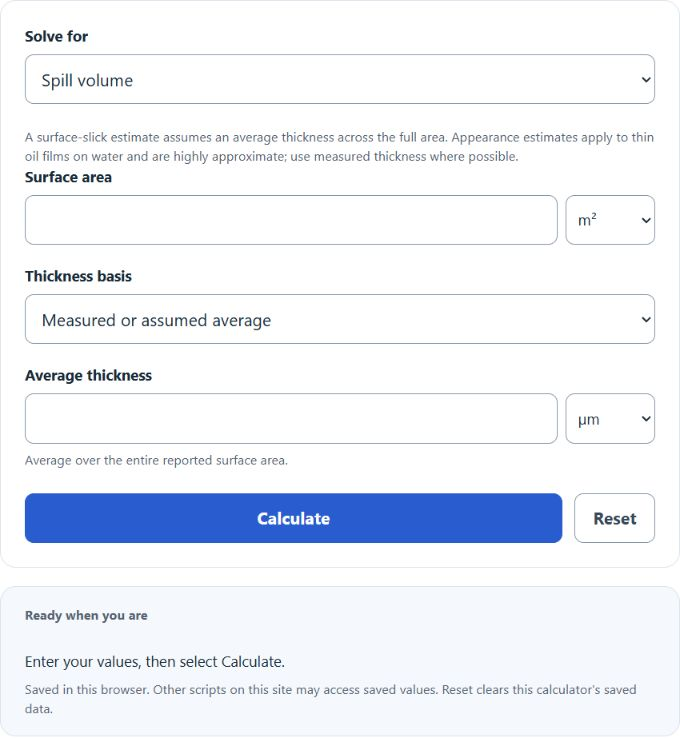
Estimate oil spill volume from slick surface area and average thickness, use an oil-film appearance estimate, or solve for spill area or average thickness.
- All Physics Calculators
- All Volume Calculators
- Oil to Gas Ratio Calculator
- Oil Shrinkage Factor Calculator
Oil Spill Volume Formula
This calculator estimates a surface slick. It does not model pipe rupture, pressure-driven leakage or tank drainage.
Use m² for area and meters for thickness to obtain volume in m³. One m³ is 1,000 L, one US gallon is exactly 0.003785411784 m³, and one oil barrel is 42 US gallons. Thickness must be an average over the reported area.
Thin Oil-Film Appearance References
NOAA’s oil-film glossary gives the following appearance estimates for thin oil films on water below 0.0001 inch thick. They are rough reference estimates, not measured thicknesses or a guarantee of accuracy.
| Appearance | US gallons per mi² | Derived nominal thickness (µm) |
|---|---|---|
| Barely visible | 25 | 0.03654 |
| Silvery sheen | 50 | 0.07308 |
| Trace of color | 100 | 0.14616 |
| Bright bands of color | 200 | 0.29231 |
| Dull brown | 666 | 0.97340 |
| Darker brown | 1,332 | 1.94679 |
The equivalent thickness is derived from the listed US gallons per square mile; it is not an independent measurement. Use the area actually covered by that appearance. Estimate unlike patches separately and add their volumes. The NOAA Trajectory Analysis Handbook explains that lighting, glare, sea state and viewing angle affect observations. Thick dark patches can conceal very different depths, so these thin-film estimates should not be applied to them or to oil on land.
Worked Examples
Measured average thickness: A slick covering 1,000 m² with average thickness 1 mm (0.001 m) has estimated volume 1,000 × 0.001 = 1 m³ = 1,000 L.
Appearance estimate on water: Bright bands of color covering 1 mi² correspond to roughly 200 US gallons under the NOAA reference. This is a surface-oil estimate, not necessarily the original amount released.
FAQ
How accurate are sheen-based estimates? They are rough estimates. Real slicks vary in thickness and coverage, and observation conditions affect color. Use measured average thickness where possible; do not assume a fixed error bound.
Can this solve for area or thickness? Yes. Select Surface area and supply volume plus thickness, or select Average thickness and supply volume plus area. All required quantities must be greater than zero.
Does this replace spill response or reporting? No. It is planning arithmetic and does not replace field measurements, spill response procedures or required reporting.