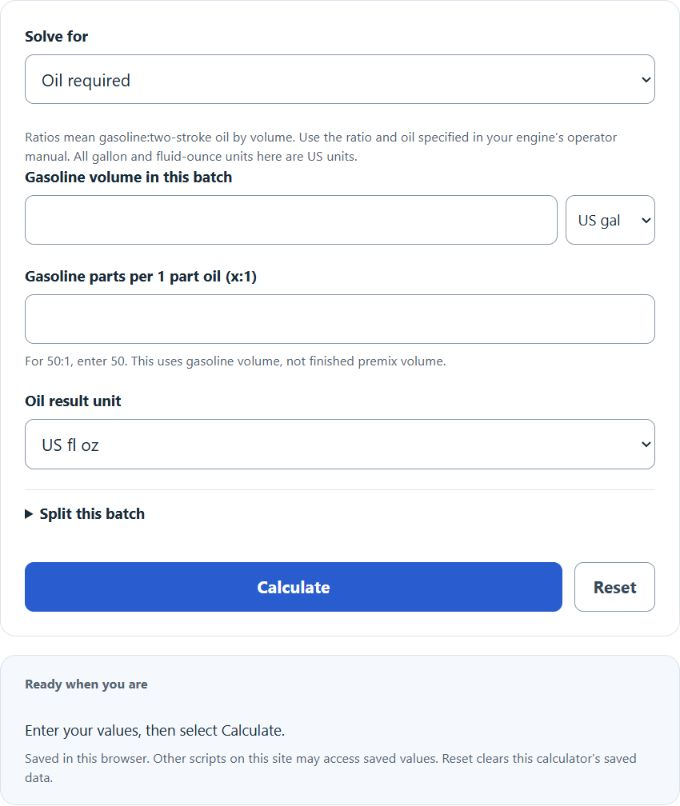
Calculate two-stroke oil needed, gas-to-oil ratio, or gasoline capacity in gallons, liters, fluid ounces, and milliliters with batch scaling and total-mixture checks.
- Automotive Calculators
- Air to Fuel Ratio (AFR) Calculator
- Compression Ratio to PSI Calculator
- Gas Purge Calculator
- Gasoline Weight Calculator
- Oil Spill Volume Calculator
- Oil Water Ratio Calculator
- Oil to Gas Price Calculator
- Condensate Gas Ratio Calculator
Oil to Gas Ratio Formula
This calculator is for two-stroke gasoline and oil premix. It uses a gasoline:oil volume ratio, such as 50 parts gasoline to one part oil. It does not calculate oilfield production ratios or gas volumes at standard conditions.
Oil required = gasoline volume ÷ ratio.
Gasoline amount = oil volume × ratio.
Gasoline:oil ratio = gasoline volume ÷ oil volume.
Convert both liquids to the same volume unit before dividing. “Gasoline volume” means gasoline before oil is added; it is not the final mixture volume.
How to Use the Calculator
- Select Oil required, Gasoline-to-oil ratio, or Gasoline amount.
- Enter the visible quantities and select their units. For a ratio such as 50:1, enter 50.
- For oil or gasoline solves, you may split the whole batch into equal containers. The calculator divides both liquids by the container count; it does not multiply the batch.
- Select Calculate to save the result. Changing inputs marks that result as stale; Calculate updates it, and Reset clears this calculator’s saved data.
Volume Units
All gallons and fluid ounces here are US units: 1 US gallon = 128 US fl oz = 3,785.411784 mL, and 1 US fl oz = 29.5735295625 mL. Fluid ounces measure volume, not oil weight. Imperial gallons/fluid ounces are different and cannot be substituted without conversion. See the NIST conversion tables.
Worked Examples
One US gallon gasoline at an entered 50:1 ratio: 128 US fl oz ÷ 50 = 2.56 US fl oz oil, or 75.70823568 mL. Nominal finished premix volume is 1.02 US gal. Manufacturer charts may round 2.56 to 2.6 fl oz.
One liter gasoline at an entered 50:1 ratio: 1,000 ÷ 50 = 20 mL oil. The nominal finished premix is 1.02 L, of which oil is 100 ÷ 51 ≈ 1.96078%.
Frequently Asked Questions
Which ratio should I use?
Use the ratio and two-stroke oil specified in the exact engine’s operator manual. Ratios such as 50:1, 40:1 and 32:1 are comparison scenarios, not universal recommendations. A Husqvarna operator manual illustrates the gasoline-to-oil volume convention for its specified equipment; other engines can have different requirements.
Is 50:1 the same as 2% oil in the final mixture?
No. Oil is 1/50 of the gasoline volume, but 1/51 of the combined gasoline-plus-oil volume, approximately 1.96078%.
Can I enter final premix volume as gasoline volume?
No. If you need a nominal finished mixture of volume T at ratio x:1, oil = T/(x+1) and gasoline = Tx/(x+1). This calculator’s gasoline input is the gasoline component before adding oil.
Can zero or negative volumes be used?
No. These mixing calculations require positive volumes and a positive ratio. Container count must be a positive whole number.