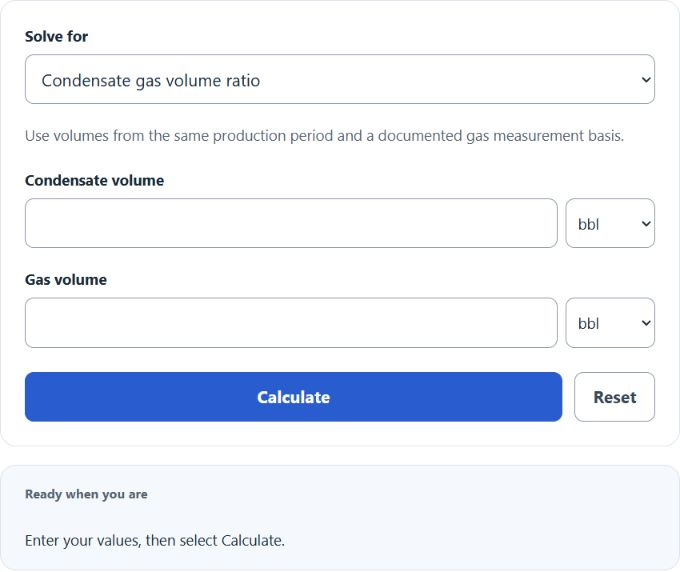
Calculate condensate gas ratio or find condensate and gas volumes from two known values, with bbl, gal, L, m³, and cu ft conversions.
Related Calculators
- Lever Rule Calculator
- Chemistry Volume Calculator
- Water Vapor Pressure Calculator
- Heat of Vaporization Calculator
- All Chemistry Calculators
Condensate Gas Ratio Formula
The calculator uses the condensate volume divided by the gas volume after converting both volumes to liters. Because both values are converted to the same base unit first, the ratio is a volume-to-volume ratio.
To solve for condensate volume:
To solve for gas volume:
- CGR = condensate gas ratio
- Vc = volume of condensate produced, converted to liters for the calculation
- Vg = volume of gas produced, converted to liters for the calculation
Select the value to solve for. The calculator has three functions:
- Calculate condensate gas ratio: enter condensate volume and gas volume. The calculator converts both to liters, then divides condensate volume by gas volume.
- Calculate condensate volume: enter the ratio and gas volume. The calculator converts gas volume to liters, multiplies by the ratio, then converts the result back to your selected condensate unit.
- Calculate gas volume: enter the ratio and condensate volume. The calculator converts condensate volume to liters, divides by the ratio, then converts the result back to your selected gas unit.
Supported Volume Unit Conversions
The calculation uses liters as the internal base unit. Barrels are petroleum barrels of 42 US gallons; gallons are US liquid gallons. These are the conversion factors applied before or after the formula.
| Unit | Abbreviation | Liters | Used For |
|---|---|---|---|
| Barrel | bbl | 158.987294928 L | Condensate and gas |
| Gallon | gal | 3.785411784 L | Condensate |
| Liter | L | 1 L | Condensate and gas |
| Cubic meter | m³ | 1000 L | Condensate and gas |
| Cubic foot | cu ft | 28.316846592 L | Gas |
Reading the Condensate Gas Ratio
The result shows how much condensate volume is produced per one unit of gas volume, using equivalent volume units.
| CGR Result | Meaning |
|---|---|
| 0 | No condensate volume relative to the gas volume entered. |
| Less than 1 | Gas volume is greater than condensate volume. |
| 1 | Condensate and gas volumes are equal after unit conversion. |
| Greater than 1 | Condensate volume is greater than gas volume. |
Example Calculations
Example 1: Calculate condensate gas ratio
You produce 10 barrels of condensate and 2,000 cubic feet of gas.
- Condensate volume: 10 bbl × 158.987294928 ≈ 1,589.8729 L
- Gas volume: 2,000 cu ft × 28.316846592 ≈ 56,633.6932 L
- CGR = 1,589.87294928 / 56,633.693184 ≈ 0.028073
The condensate gas ratio is 0.028073 L/L.
Example 2: Calculate condensate volume
You have a condensate gas ratio of 0.05 and 5,000 cubic feet of gas. You want the condensate result in barrels.
- Gas volume: 5,000 cu ft × 28.316846592 = 141,584.23296 L
- Condensate volume: 0.05 × 141,584.23296 = 7,079.211648 L
- Convert to barrels: 7,079.211648 / 158.987294928 ≈ 44.5269 bbl
The condensate volume is 44.5269 bbl.
FAQ
Is condensate gas ratio the same as barrels per cubic foot?
Not in this calculator. This calculator converts both condensate and gas volumes to liters, then calculates a volume-to-volume ratio. Petroleum reporting often expresses condensate gas ratio in units such as barrels per million standard cubic feet. If you need that type of industry-specific CGR, make sure your required units and standard gas conditions match your reporting basis.
Why does the calculator convert both volumes to liters first?
The formula only works correctly when both volumes are in the same base unit. For example, dividing barrels directly by cubic feet would mix units. Converting both values to liters first makes the ratio consistent.
Can the gas volume be zero?
No. Gas volume cannot be zero when calculating the condensate gas ratio because the formula divides by gas volume. A zero gas volume would make the calculation undefined.