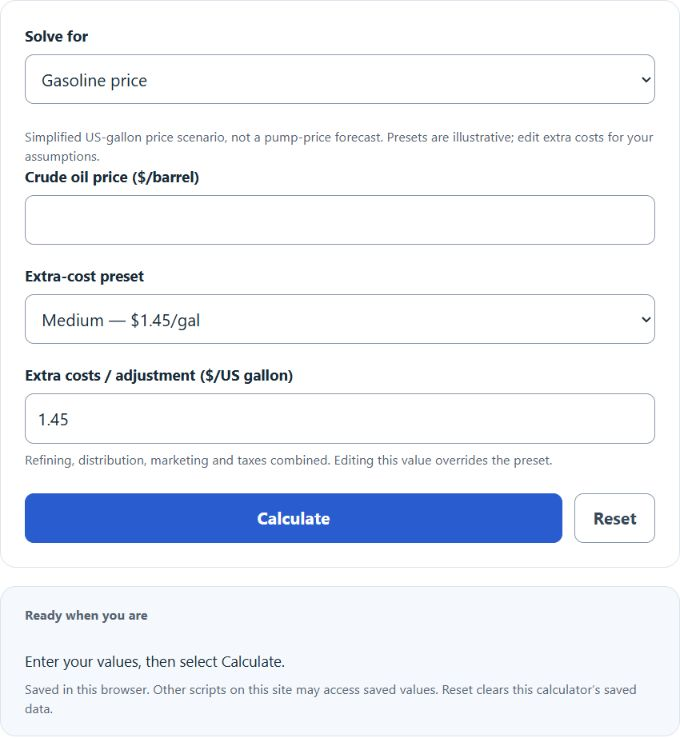
Estimate gas price per gallon from crude oil price per barrel, extra costs, and low, medium, or high state cost profiles.
Related Calculators
- Fuel Price Calculator
- Annual Fuel Cost Calculator
- Cost Per Mile of Driving Calculator
- Miles Per Tank Calculator
- Gallons Per Mile Calculator
- Oil to Gas Ratio Calculator
- All Automotive Calculators
Gas Price From Oil Price Formula
The following formula is used to estimate the gasoline price from crude oil price.
- Where GP is the estimated gasoline price ($/gallon)
- OP is the crude oil price ($/barrel)
- E is the combined extra-cost adjustment for refining, distribution, marketing and taxes ($/US gallon)
With extra costs held fixed, this scenario changes gasoline price by $1/42, or about $0.024 per US gallon, for each $1 per barrel change in crude price. This is a model sensitivity, not a guaranteed market response.
What Makes Up the Price of Gasoline
Retail gasoline prices combine crude oil, refining, distribution and marketing, and taxes. Their shares vary over time and by location. The breakdown below is an illustrative $3.00-per-gallon scenario, not a verified annual EIA observation.
Taxes include federal, state and sometimes local charges. The federal gasoline tax and fee total $0.184 per gallon; state and local rules vary. The dated tax comparison below is a historical illustration, not a current quote.
Distribution and marketing cover transport, terminals and retail operations. Refining is a separate cost component. The illustrative table assigns 22% to distribution and marketing and 14% to refining; these are scenario assumptions.
| Component | Share of Pump Price | Approx. $/Gallon (at $3.00/gal) |
|---|---|---|
| Crude Oil Cost | ~47% | $1.41 |
| Refining Costs & Margin | ~14% | $0.42 |
| Distribution, Marketing & Retail | ~22% | $0.66 |
| Federal Tax | ~6% | $0.184 (fixed) |
| State & Local Taxes | ~11% | $0.326 (illustrative) |
Refinery Yield: What One Barrel Actually Produces
A petroleum barrel contains 42 U.S. gallons. EIA explains that U.S. refineries typically produce about 19 to 20 gallons of motor gasoline, 11 to 13 gallons of distillate fuel and other products from that input. Product volumes vary with refinery operations.
Processing gain increases total product volume because products have different densities. Gasoline is one of several valuable outputs; assigning the entire crude barrel cost only to its gasoline yield would ignore the other products. The calculator uses 42 solely as a barrel-to-US-gallon price benchmark.
The Crack Spread: Measuring Refining Profitability
The crack spread is the difference between the price of refined petroleum products (gasoline and diesel) and the price of crude oil. It represents the gross profit margin a refinery earns from "cracking" crude oil molecules into lighter products. The industry standard metric is the 3:2:1 crack spread, which assumes three barrels of crude oil yield two barrels of gasoline and one barrel of diesel.
Crack spreads vary with market conditions and are indicators of refining margins. They are not fixed costs that can be assumed for every location or date. Use an extra-cost assumption suited to the scenario you want to compare.
Why Gas Prices Do Not Always Track Oil Prices
Crude oil and gasoline prices often move together, but refining and retail conditions can change their relative movements. A fixed extra-cost scenario cannot forecast those changes.
With other costs held fixed, a $10 per barrel change gives $10/42, or about $0.238 per gallon, in this model. Some taxes are fixed per gallon, while others can depend on prices or other rules.
Seasonal fuel requirements, refinery outages, regional supply and demand, and crude benchmarks can all affect pump prices. The calculator combines these effects into your chosen extra-cost adjustment.
State Tax Impact on Pump Prices
State and local fuel taxes affect pump prices. The figures below are retained as illustrative state tax assumptions; they have not been verified as rates for a common effective date. Check current state and local rules before using them.
| State | State Tax + Fees ($/gallon) | Total w/ Federal ($0.184) |
|---|---|---|
| California example | $0.698 | $0.882 |
| Illinois | $0.661 | $0.845 |
| Pennsylvania | $0.587 | $0.771 |
| New York | $0.456 | $0.640 |
| Illustrative average | $0.330 | $0.514 |
| Texas | $0.200 | $0.384 |
| Mississippi | $0.184 | $0.368 |
| Alaska example | $0.090 | $0.274 |
Under these illustrative assumptions, the $0.608-per-gallon difference gives $9.73 for a 16-gallon fill-up, or about $505.86 for 52 such fill-ups. This comparison depends on the assumed rates and is not a current tax quote.
| Crude Oil ($/barrel) | Est. Gasoline ($/gallon) |
|---|---|
| 40 | 2.40 |
| 50 | 2.64 |
| 60 | 2.88 |
| 70 | 3.12 |
| 80 | 3.35 |
| 90 | 3.59 |
| 100 | 3.83 |
| 110 | 4.07 |
| 120 | 4.31 |
| 130 | 4.55 |
| 140 | 4.78 |
| 150 | 5.02 |
| 175 | 5.62 |
| 200 | 6.21 |
| * Rounded to 2 decimals. Formula: Gasoline ($/US gal) = Crude ($/bbl) / 42 + 1.45 | |