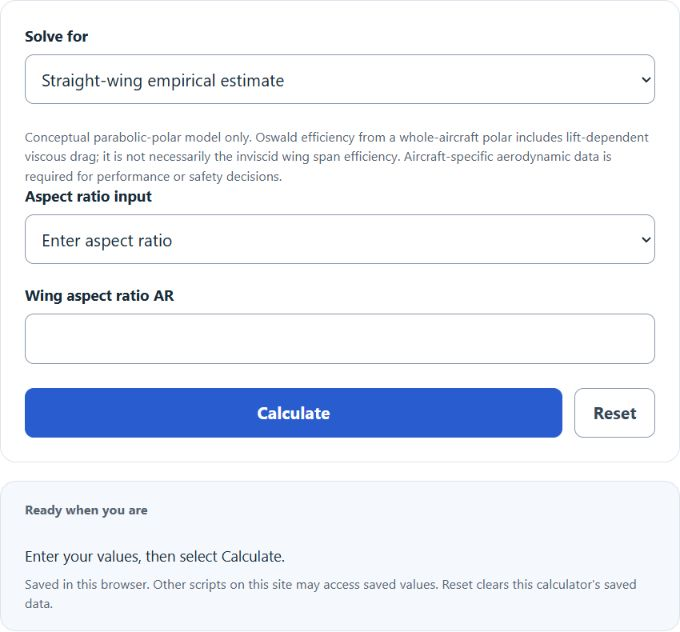
Estimate Oswald efficiency from wing aspect ratio and sweep or derive it from a drag polar, with induced drag, coefficient, and lift-to-drag results.
Oswald Efficiency Factor Formula
The Oswald efficiency factor is a dimensionless parameter of a parabolic drag polar. A whole-aircraft fitted factor includes lift-dependent profile drag and is distinct from inviscid wing span efficiency. This calculator separates empirical geometry estimates from e0 =1/(π AR k) derived from your polar data.
Primary Equations
If you need to calculate aspect ratio before using the efficiency formulas, use:
For an inviscid span-efficiency model the lift-squared term is induced drag. For a fitted whole-aircraft Oswald factor, k CL² can also include lift-dependent viscous drag. Use the same reference area and flight condition in these relationships:
Variable Definitions
- e0 = estimated Oswald efficiency number from aspect ratio alone
- e = fitted Oswald efficiency factor calculated from the specified parabolic drag polar, not necessarily inviscid span efficiency
- AR = aspect ratio of the wing
- b = wingspan
- S = wing planform area
- k = coefficient on the lift-squared term in the drag polar
- CL = lift coefficient
- CD = total drag coefficient
- CD_0 = zero-lift drag coefficient
- CD_i = induced drag coefficient
The efficiency result is dimensionless. If you compute aspect ratio from span and area, keep the geometry units consistent before forming the ratio.
When to Use Each Method
| Known Inputs | Formula to Use | Best For |
|---|---|---|
| Aspect ratio only | e₀ = 1.78(1 - 0.045AR0.68) - 0.64 |
Quick estimates, preliminary design, concept comparison, early sizing studies |
| Aspect ratio and drag-polar coefficient | e = (1) / (π AR k) |
More detailed analysis when aerodynamic polar data already exists |
How to Calculate the Oswald Efficiency Factor
- Determine the wing aspect ratio, either directly or from span and area.
- If you only need a fast estimate, enter the aspect ratio to calculate e0.
- If you know the drag-polar coefficient k, enter both AR and k to calculate e.
- Use the result only within the stated empirical or parabolic-polar assumptions; obtain aircraft-specific validated data for flight-performance and design decisions.
What the Result Means
Within the same parabolic-polar convention, a larger Oswald factor means a smaller lift-squared drag coefficient k for a given aspect ratio. It does not by itself establish the spanwise lift distribution. Fitted Oswald factors can exceed one; they should not be interpreted as a universal percentage of an ideal wing.
e vs. e0
Notation varies between sources. Here both reported factors describe the specified parabolic-polar model: the geometry methods are empirical screening estimates, while the polar method algebraically derives the factor from your k. Neither should automatically be equated with inviscid span efficiency. The straight correlation is for zero sweep; the swept correlation is used only above 30° leading-edge sweep, with AR no greater than 10. No low-sweep interpolation is assumed. The screening methods reject AR below 2.27 and nonpositive outputs. These numerical guards do not establish a certified design envelope.
Example Calculations
For a wing with an aspect ratio of 13, the aspect-ratio estimator gives:
If the same wing has a drag-polar coefficient of 0.03, the polar-derived Oswald-efficiency calculation is:
The two answers differ because one value comes from a quick estimate and the other comes from an explicit drag-polar input.
Common Input Mistakes
- Mixing units while computing aspect ratio: span and area must be handled consistently before forming the ratio.
- Using the wrong coefficient for k: the direct method needs the multiplier on the lift-squared term in the drag polar.
- Confusing estimated efficiency with measured or fitted efficiency: the quick estimator is useful for screening, while the drag-polar method is more specific.
- Forgetting that the output has no units: efficiency factors are pure ratios.
Why Aspect Ratio Matters
Aspect ratio has a strong effect on induced drag. Wings with larger aspect ratio generally spread lift more effectively across the span, which reduces the strength of the trailing vortex system and lowers induced-drag losses. That is why aspect ratio appears directly in induced-drag equations and also shows up in simplified efficiency-estimation fits.
Practical Uses
- Estimating induced drag during early aircraft design
- Comparing wing concepts with different aspect ratios
- Checking the aerodynamic impact of a drag-polar fit
- Improving glide, cruise, and range calculations
- Deriving Oswald efficiency from a specified parabolic performance polar