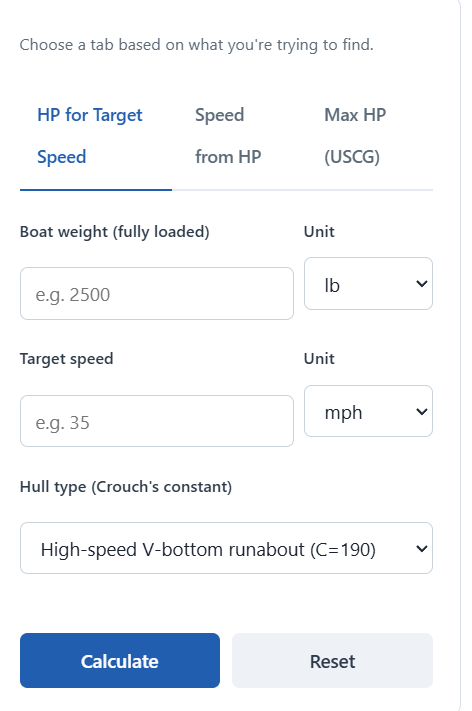
Enter your boat’s fully-loaded weight and either a target speed, an existing engine’s horsepower, or the hull’s length and transom width to size an outboard, predict top speed, or find the USCG maximum legal rating.
Related Calculators
- All Automotive Calculators
- Fuel Pump Horsepower Calculator
- Corrected Horsepower Calculator
- Taxable Horsepower Calculator
Formula
HP for a target speed (Crouch's formula):
HP = W × (S ÷ C)2
where W = boat weight in pounds (fully loaded), S = speed in mph, C = Crouch's hull constant.
Speed from a known HP (Crouch's formula, rearranged):
S = C × √(HP ÷ W)
where S = speed in mph, HP = shaft horsepower, W = weight in pounds, C = hull constant.
USCG maximum HP for monohulls under 20 ft:
Max HP = 2 × (L × W) − 90
where L = centerline length in feet, W = transom width in feet. For factors ≤ 52, a lookup table applies.
Crouch's Constant by Hull Type
| Hull type | C value | Typical use |
|---|---|---|
| Average runabout / cruiser | 150 | Heavy fiberglass cruisers, pontoon hybrids |
| High-speed V-bottom runabout | 190 | Most modern bass boats, bay boats, bowriders |
| Race boat / stepped hull | 210 | Performance offshore, stepped-hull center consoles |
| Catamaran / sea sled | 220 | Power cats, tunnel hulls |
| Hydroplane | 230 | Dedicated race hydroplanes |
Interpretation
The HP result tells you roughly how much shaft horsepower it takes to push your boat at the speed you entered, on flat water, with a properly pitched prop. Real-world output drifts 10–20% from the theoretical number depending on prop, trim, load distribution, hull condition, and sea state. Use these bands as a sanity check:
- Under 25 hp: tiller-steer and small skiff range.
- 25–115 hp: most aluminum fishing boats, small runabouts, and jon boats.
- 115–300 hp: typical single-engine bay boats, bass boats, and bowriders — confirm the transom is rated for it.
- Over 300 hp: usually twin- or triple-engine installations.
For the USCG max HP tab, the result is the highest rating the Coast Guard allows for a new-build boat of that size. It is a legal ceiling, not a recommendation — the manufacturer's capacity plate on your transom always takes precedence.
FAQ
Should I use dry weight or loaded weight?
Use fully loaded weight: boat, fuel, gear, and passengers. Dry weight will under-predict required HP by 15–30%.
Which Crouch constant should I pick if I'm not sure?
Pick 190 for almost any modern recreational V-bottom under 25 ft. Drop to 150 only for heavy cruisers or displacement-style hulls, and go above 210 only for genuinely performance-built hulls.
Why doesn't my actual top speed match the calculator?
Crouch's formula assumes ideal conditions and a correctly pitched prop. Wrong prop pitch alone can cost 5–10 mph, and hull fouling, chop, or extra passengers will pull the number down further.
Can I exceed the USCG maximum horsepower?
Not legally on boats built after 1972 that fall under the rule. Overpowering voids the capacity plate, can invalidate insurance, and is cited as a violation in most states.