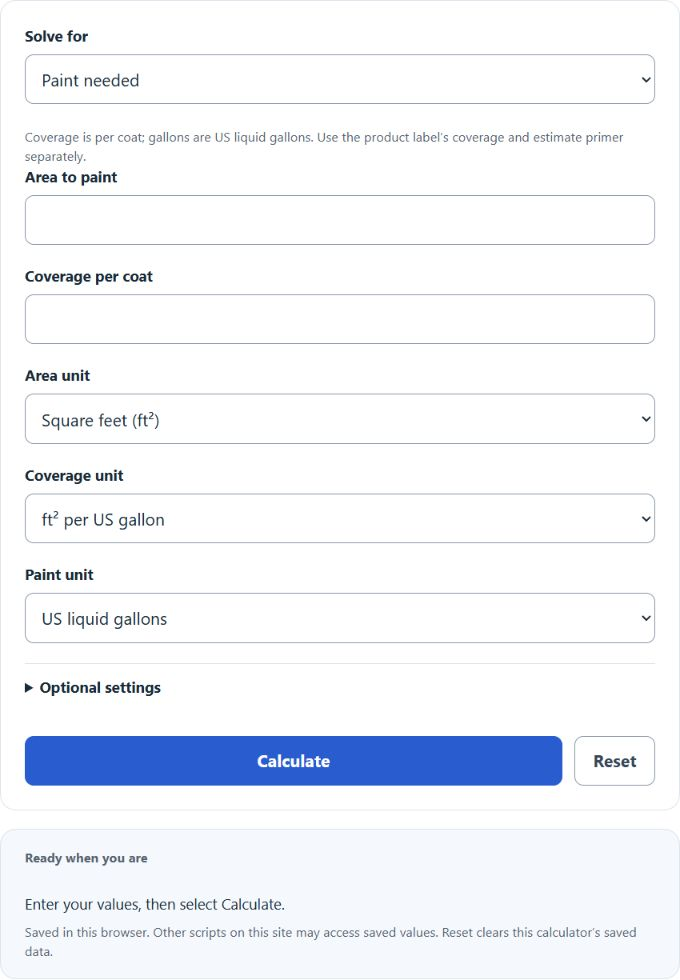
Choose paint needed, coverage or area, then enter the two required values and their units. Gallons mean US liquid gallons. Optional settings add coats and an extra-paint allowance; blank settings mean one coat and no allowance.
Related Calculators
- Siding Calculator
- Paint Ratio Calculator
- Coverage Area Calculator
- Wall Area Calculator
- Exterior Square Footage Calculator
- Automotive Paint Coverage Calculator
- All Construction Calculators
Paint Usage Formula
The basic paint usage calculation divides the total paintable area by the listed coverage of the paint. This gives the amount of paint needed for one coat under ideal conditions.
Where:
- PN = paint needed
- A = total area to be painted
- C = paint coverage rate
For a more realistic estimate, include the number of coats and a small allowance for waste, touch-ups, roller absorption, overspray, and surface texture.
Additional variables:
- N = number of coats
- W = waste factor as a decimal
How to Estimate Paint More Accurately
- Measure each paintable surface and calculate its area.
- Add all wall, ceiling, trim, or siding areas that will receive paint.
- Subtract large doors, windows, and built-ins if precision matters.
- Use the coverage printed on the paint label for the exact product you are buying.
- Multiply by the number of coats you plan to apply.
- Add a buffer if the surface is porous, rough, dark, or being sprayed.
Inputs That Matter Most
| Input | What it Represents | Why it Matters |
|---|---|---|
| Area | Total square footage or square meters to be coated | Under-measuring is the fastest way to run short on paint |
| Coverage | How much area one gallon or liter can cover | Different paints, sheens, and brands spread differently |
| Coats | Number of full paint applications | Most finish-quality jobs need more than one coat |
| Waste Factor | Extra paint for losses and touch-up reserve | Helpful for textured walls, rough siding, and spray application |
Example
If you need to paint 500 square feet and the paint covers 350 square feet per gallon, the one-coat estimate is:
That means you need about 1.43 gallons for one coat before rounding. In practice, paint is usually purchased in standard container sizes, so you would typically round up.
If the same space needs two coats and you want a 10% buffer:
That estimate suggests buying enough paint to cover a little over 3.14 gallons.
What Changes Paint Usage?
- Surface texture: Stucco, brick, popcorn ceilings, and rough wood use more paint than smooth drywall.
- Porosity: New drywall, repaired patches, and bare wood absorb more paint unless properly primed.
- Color change: Going from dark to light, light to dark, or using bold colors may require extra coats.
- Application method: Sprayers are fast but usually create more loss than rollers or brushes.
- Paint type: Primer, stain-blocking products, masonry coatings, and elastomeric paints often have different spread rates.
Quick Measuring Tips
- For a wall, multiply width by height.
- For multiple walls, calculate each wall separately and add them together.
- For ceilings, multiply room length by room width.
- For doors and windows, subtract only if they are large or numerous enough to materially affect the estimate.
- Select the units that match each input. The calculator converts square feet, square meters or square yards, coverage per US gallon or liter, and paint amounts in US liquid gallons or liters.
When to Round Up
Rounding up is usually the safer choice when:
- you are between container sizes,
- the surface is textured or unprimed,
- you need two or more coats,
- you want matching paint available later for touch-ups, or
- you are painting a hard-to-match custom color.
Common Planning Mistakes
- Using a generic coverage rate instead of the product label
- Forgetting ceilings, closets, trim, or accent walls
- Ignoring the second coat in the estimate
- Not accounting for primer on new or repaired surfaces
- Buying exactly the minimum amount with no reserve
Frequently Asked Questions
Do I calculate primer and paint together?
It is better to calculate them separately because primer and finish paint often have different coverage rates.
Should doors and windows always be subtracted?
Not always. For quick estimates, many people leave them in. For larger projects, subtracting large openings can improve accuracy.
How much extra paint should I keep?
A small reserve is useful for future touch-ups, especially in high-traffic rooms or for custom-mixed colors.
Can I use this calculator for liters and square meters?
Yes. Select liters and square meters, or mix the supported units; the calculator converts them consistently. Coverage is per coat, with optional coats and extra allowance applied separately.