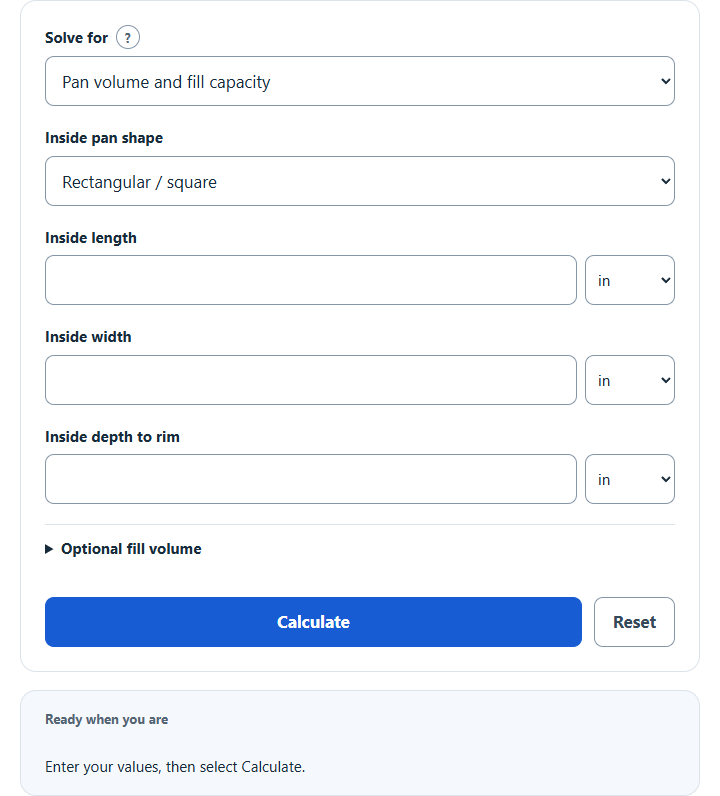
Calculate baking pan volume and usable fill capacity for round, rectangular, oval, tube, and tapered loaf pans, or solve for depth in metric and US units.
- Every Day Life And Education Calculators
- Half Cylinder Volume Calculator
- Hexagonal Volume Calculator
Calculator Functions
| Function | What it does | What it requires |
|---|---|---|
| Pan volume and fill capacity | Finds how much a pan holds when filled to the rim, in US cups, milliliters, liters, cubic inches and US fluid ounces | Requires the pan shape, its inside dimensions and its inside depth to the rim |
| Depth for a target capacity | Finds how deep a pan of a given shape and size must be to hold a set volume | Requires the pan shape, its inside length and width or diameter, and the target capacity |
The shape can be rectangular or square, round, oval, a tube or ring pan, or a tapered loaf pan. Dimensions can be entered in inches, centimeters or millimeters, and a target capacity in US cups, mL, L, US fl oz, in³ or cm³. An optional fill percentage shows the volume of a pan filled only part of the way.
Pan Volume Formula
| V | Volume of the pan filled to the rim |
| A | Inside area of the pan seen from above |
| h | Inside depth to the rim |
With dimensions in inches the volume is in cubic inches, and with centimeters it is in milliliters. One cubic inch is 16.387 mL and one US cup is 236.59 mL [2], so cubic inches divided by 14.44 gives US cups.
Pan volume and fill capacity
The area depends on the shape of the pan, and all measurements are taken inside the pan.
| Pan shape | Area |
|---|---|
| Rectangular or square | length × width |
| Round, straight sides | π × diameter² ÷ 4 |
| Oval (an ellipse), straight sides | π × length × width ÷ 4 |
| Tube or ring, straight sides | π × (outer diameter² − hole diameter²) ÷ 4 |
| Tapered loaf | (bottom area + 4 × mid-depth area + top area) ÷ 6 |
A 9 × 13 inch pan that is 2 inches deep holds 9 × 13 × 2 = 234 in³, which is 16.21 US cups or 3.83 L. The tapered loaf line is the prismoidal formula, the same one used to estimate the volume of an excavation with sloping sides [1]. Its mid-depth area uses the average of the top and bottom lengths and widths, so a loaf pan measuring 9 × 5 inches at the top, 8 × 4 inches at the bottom and 3 inches deep holds 115 in³, or 7.97 US cups.
The fill volume is the brimful volume times the fill percentage, so the 9 × 13 inch pan filled to 50% holds 8.1 US cups. The table gives the brimful volume of common straight-sided pans.
| Inside size (inches) | Cubic inches | US cups | US quarts | Liters |
|---|---|---|---|---|
| 8 × 8 × 2 | 128 | 8.87 | 2.22 | 2.10 |
| 9 × 9 × 2 | 162 | 11.22 | 2.81 | 2.65 |
| 9 × 13 × 2 | 234 | 16.21 | 4.05 | 3.83 |
| 10 × 15 × 2 | 300 | 20.78 | 5.19 | 4.92 |
| 9 × 5 × 3 loaf | 135 | 9.35 | 2.34 | 2.21 |
| 8 round × 2 | 100.5 | 6.96 | 1.74 | 1.65 |
| 9 round × 2 | 127.2 | 8.81 | 2.20 | 2.08 |
One US quart is 4 US cups. The calculator does not show quarts, so divide its US cups by 4.
Depth for a target capacity
The target volume is divided by the area for the chosen shape. A 9 inch round pan has to be 1.82 inches deep to hold 8 US cups to the rim. For a tapered loaf pan, the top and bottom sizes entered are taken to be those of the finished pan at that depth.
Limits of This Estimate
- The result is the volume of an ideal shape filled to the rim. Rounded corners, sloped sides and fluted edges make a real pan hold less, and filling a contoured pan with measured water gives its true capacity.
- Brimful capacity is not how much batter to use. Recipes leave room for rising, so follow the fill level the recipe gives.
- Pans are often sold by their outside or rim-to-rim size. Measure inside, and measure a tapered pan at both the top and the bottom.
- The cup is the US customary cup of 236.59 mL [2], not the 240 mL cup on nutrition labels or the 250 mL metric cup.
Sources
- USDA Natural Resources Conservation Service, Agriculture Handbook 590, Ponds: Planning, Design, Construction, Appendix A: the prismoidal formula for a volume with sloping sides, and the area of an ellipse
- NIST, Guide for the Use of the International System of Units (SP 811), Appendix B.8: the cubic inch, US cup and US fluid ounce in milliliters