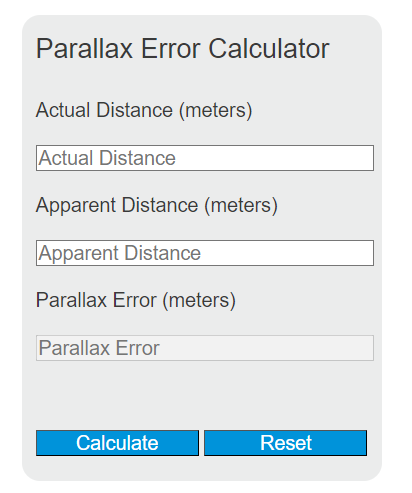
Calculate parallax error, actual distance, or apparent distance by entering any two values and choosing meters, feet, inches, and more.
Related Calculators
- Beacon Distance Calculator
- Dawes Limit Calculator
- Horizontal Shadow Angle Calculator
- Angle Of Projection Calculator
- All Physics Calculators
Parallax Error Formula
Parallax error is the difference between a true value and the value that appears to be read when the observer’s eye is not perfectly aligned with the object, pointer, or scale. In this calculator, parallax error is expressed as a linear reading difference, so the answer is reported in the same units as the entered distances.
The signed error tells you the direction of the reading difference, while the absolute error tells you only the size of the mismatch.
Variable Definitions
| Symbol | Meaning | Units |
|---|---|---|
PE |
Signed parallax error | Same units as the distances entered |
|PE| |
Magnitude of the parallax error | Same units as the distances entered |
AD |
Actual or true distance | Meters, feet, inches, centimeters, kilometers, miles, or any consistent unit |
ApD |
Apparent or measured distance | Must match the unit used for AD |
How to Calculate Parallax Error
- Determine the actual distance,
AD. - Determine the apparent or measured distance,
ApD. - Subtract the apparent distance from the actual distance.
- If you only need the size of the error, take the absolute value of the result.
Always use the same unit for both distance inputs before calculating. If the values are in different units, convert them first.
Solving for Any Missing Value
If you know any two of the three variables, you can solve for the third.
How to Interpret the Result
| Result | Meaning |
|---|---|
Positive PE |
The apparent reading is smaller than the true distance. |
Negative PE |
The apparent reading is larger than the true distance. |
Zero PE |
The apparent and true distances match exactly. |
This sign convention is useful when direction matters. In many quality-control or reporting situations, the absolute error is preferred because it shows how far off the reading is without regard to sign.
Example
If the actual distance is 50 meters and the apparent distance is 48 meters, then the signed parallax error is 2 meters. That means the reading is 2 meters lower than the true value. The magnitude of the error is also 2 meters.
If you want to compare the error to the true value, percent error can also be useful when AD is not zero.
Using the same example:
- Actual distance: 50 m
- Apparent distance: 48 m
- Absolute error: 2 m
- Percent error: 4%
Common Causes of Parallax Error
- Viewing a ruler, dial, or gauge from the side instead of straight on
- Pointer separation from the scale face
- Poor eye positioning during manual measurements
- Optical distortion in sighting or alignment setups
- Low contrast between the pointer and scale markings
How to Reduce Parallax Error
- Place your eye directly in line with the measurement mark or pointer.
- Use mirrored scales when available and align the pointer with its reflection.
- Keep the pointer close to the scale to reduce apparent offset.
- Use digital instruments when precise manual reading is difficult.
- Repeat measurements and compare readings to identify consistent bias.
Practical Notes
- The calculator is most useful when the true value and measured value are already known or estimated.
- The result keeps the same unit as the distance values entered.
- A larger absolute error indicates a larger reading mismatch.
- A negative result is not wrong; it simply means the apparent value exceeded the true value under this formula.
Frequently Asked Questions
Is parallax error always a distance?
Not always. In some fields, especially astronomy and optics, parallax may be discussed as an angle. This calculator uses a distance-based reading difference.
Why is my parallax error negative?
A negative result means the apparent or measured distance is greater than the actual distance when using the formula shown above.
Can I use any unit?
Yes. The key requirement is consistency. Both distance inputs must use the same unit before calculating.