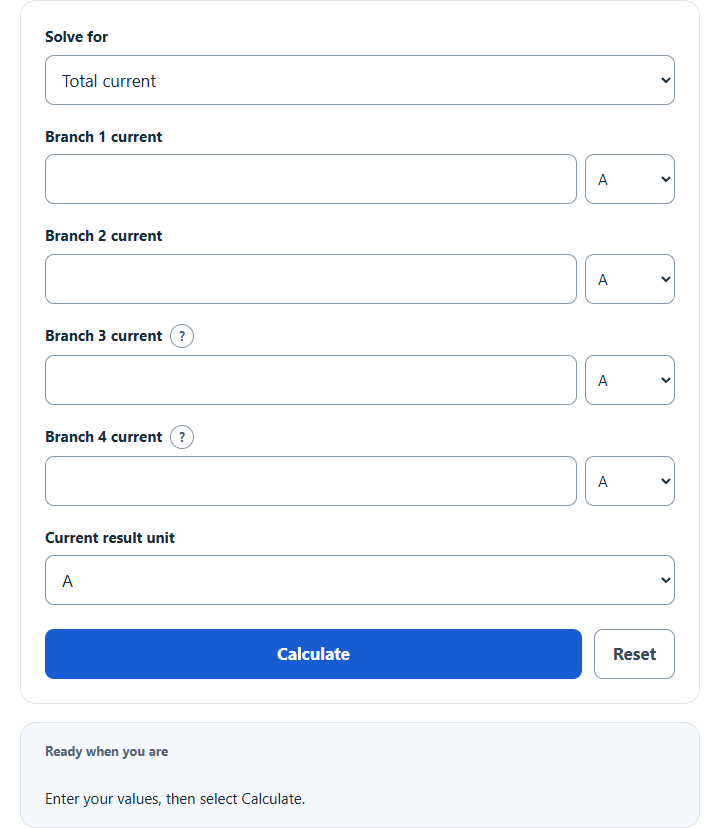
Calculate parallel circuit current by finding a missing branch or total current, or deriving branch and total currents from voltage and resistors.
- All Physics Calculators
- All Electrical Calculators
- Series Current Calculator
- Parallel Voltage Calculator
Total Parallel Current Formula
The following formula is used to calculate the Total Parallel Current.
- Where Ip is the Total Parallel Current (amps)
- Ix represents up to four branch currents (amps) modeled by this calculator.
To calculate the total DC parallel current, add the branch currents with consistent reference directions. AC currents with different phases require phasor addition rather than adding their RMS magnitudes.
How to Calculate Total Parallel Current?
The following two example problems outline how to calculate the Total Parallel Current.
Example Problem #1:
- First, determine the four branch currents. In this example they are 12, 6, 2 and 6 amps.
- Finally, calculate the Total Parallel Current using the formula above:
Ip = SUM ( Ix)
Inserting the values from above and solving the equation with the imputed values gives:
Ip = 12 + 6 + 2 + 6 = 26 amps
Example Problem #2:
Using the same process as example problem 1, we first define the variables outlined by the formula. In this case, the values are:
Four branch currents (amps) = 50, 1, 5, 3
Entering these values into the formula above gives :
Ip = SUM ( Ix) = 59 (amps)