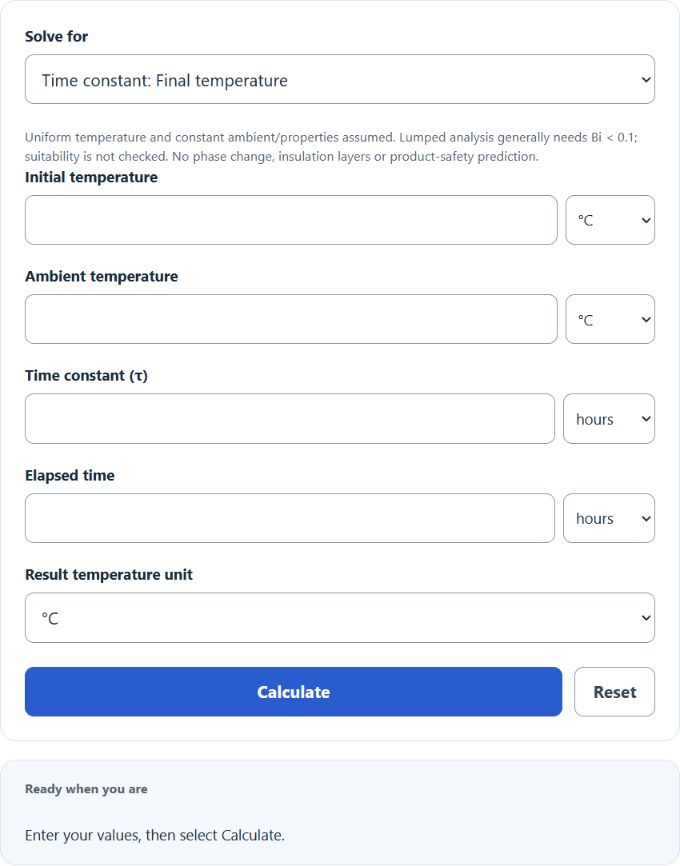
Calculate parcel temperature over time from initial and ambient temperatures, time constant, or lumped heat transfer properties.
Related Calculators
- Dehumidifier Capacity Calculator
- Pool Chlorine Calculator
- F-Stop Calculator
- Exposure Value Calculator
- All Everyday Life and Education Calculators
Parcel Temperature Formula
The following formulas are commonly used to estimate the temperature of a parcel over time using a lumped-capacitance (Newton’s law of cooling/heating) approximation.
Variables:
- T_final is the final temperature of the parcel (°C, K, or °F)
- T_initial is the initial temperature of the parcel (°C, K, or °F)
- T_ambient is the ambient temperature (°C, K, or °F)
- h is the convective heat transfer coefficient (W/m²·K or Btu/(h·ft²·°F))
- A is the surface area of the parcel (m², cm², or ft²)
- m is the parcel mass (kg, g, or lb)
- c_p (c) is the specific heat capacity (J/(kg·K) or Btu/(lb·°F))
- t is the elapsed time (seconds, minutes, or hours; use consistent units in the exponent)
- τ is the time constant τ = m c_p / (hA) (same time unit as t)
To calculate the final temperature of a parcel, you can either (1) use the full lumped-capacitance model with h, A, m, and c_p, or (2) use the equivalent time-constant form if you already know τ (for example, from measurement). These models assume a uniform internal temperature and constant ambient conditions and properties, with no phase change. Lumped analysis generally requires Bi < 0.1; the calculator does not check this or establish product safety. Use measured or modelled h rather than a universal environment preset.
What is Parcel Temperature?
Parcel temperature refers to the temperature of a package or container, which can change over time due to heat transfer with its surroundings. This is particularly important in the context of shipping temperature-sensitive goods, where maintaining a specific temperature range is crucial. In a simple lumped-capacitance model, the rate at which a parcel’s temperature approaches ambient depends on both the external heat transfer (h and surface area A) and the parcel’s thermal mass (m·c_p).
How to Calculate Parcel Temperature?
The following steps outline how to calculate the final temperature of a parcel.
- Determine the initial temperature of the parcel (T_initial).
- Determine the ambient temperature (T_ambient).
- If using the time-constant method, determine the time constant τ (for example, from measurement). If using the lumped method, determine h, surface area A, mass m, and specific heat capacity c_p.
- Determine the elapsed time t (use seconds, minutes, or hours, but keep units consistent with τ or within the exponent).
- Choose a model and the value to solve for, enter the required values, then select Calculate.
Example Problem :
Use the following variables as an example problem to test your knowledge.
Initial temperature of the parcel (T_initial) = 5°C
Ambient temperature (T_ambient) = 25°C
Heat transfer coefficient (h) = 5 W/m²K
Surface area of the parcel (A) = 0.50 m²
Mass (m) = 5 kg
Specific heat capacity (c_p) = 900 J/kg·K
Time (t) = 3 hours
(For these values, the time constant is τ = m c_p /(hA) = 1800 s = 0.5 hr, giving T_final ≈ 24.95°C after 3 hours.)