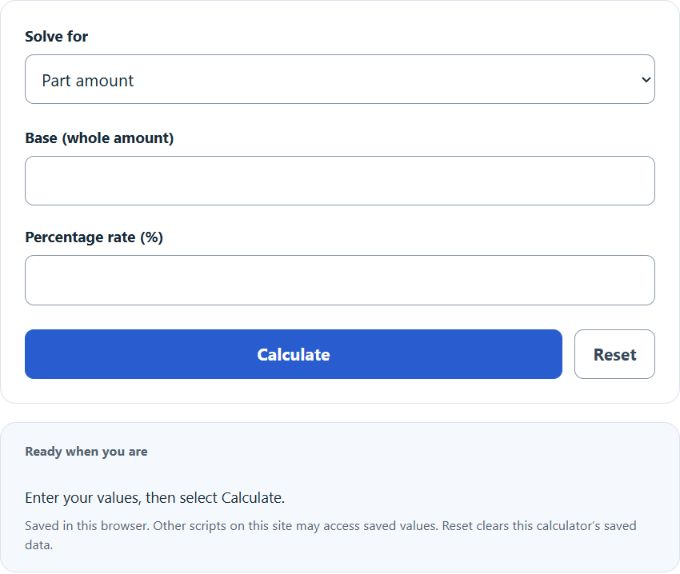
Solve a part amount, base amount, or percentage rate using P = (R / 100) × B. Choose Compare two rates (PBR) for a unitless rate comparison.
- All Math and Numbers Calculators
- All Rate Calculators
- Pass Rate Calculator
- Parts To Percentage Calculator
Part Base Rate Formula
The examples below use Compare two rates (PBR). For part/base/percentage problems, use P = (R / 100) × B, B = P / (R / 100), or R = (P / B) × 100.
- Where PBR is the Part Base Rate (a unitless multiplier or ratio)
- P is the part percentage (or part rate), expressed as a percent (%) or decimal fraction
- R is the base (reference) rate, expressed in the same form as P (percent or fraction)
To calculate the part base rate, divide the part percentage/rate (P) by the base rate (R). If you use percentages, the percent units cancel in the division; if you use fractions, divide the fractions.
How to Calculate Part Base Rate?
The following example problems outline how to calculate Part Base Rate.
Example Problem #1:
- First, determine the part percentage (P).
- The part percentage (P) is given as: 50%.
- Next, determine the base rate (R).
- The base rate (R) is provided as: 2%.
- Finally, calculate the Part Base Rate using the equation above:
PBR = P / R
The values provided above are inserted into the equation below and computed.
PBR = 50% / 2% = 25
Example Problem #2:
For this problem, the variables required are provided below:
part percentage (P) = 60%
base rate (R) = 3%
Test your knowledge using the equation and check your answer with the calculator.
PBR = P / R = 60% / 3% = 20