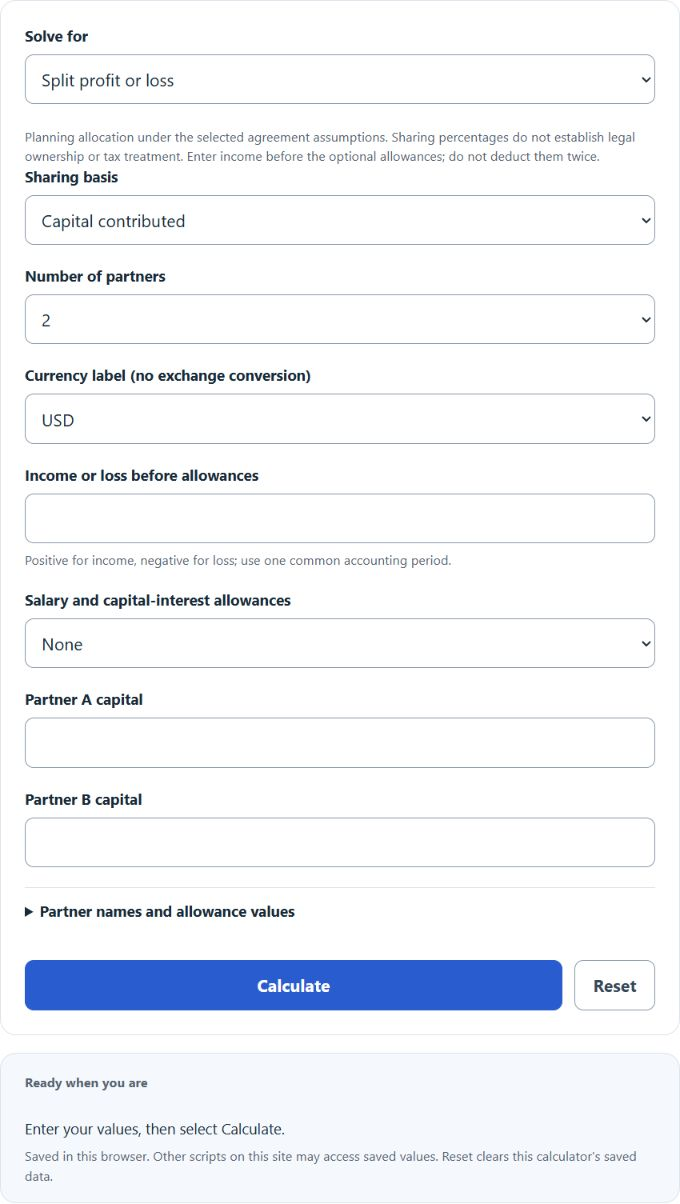
Calculate each partner’s profit or loss share from capital contributions, months invested, or an agreed ratio, plus salary and interest on capital allowances. Income is entered before these allowances; the model does not determine legal ownership or tax treatment.
Related Calculators
- Reverse Commission Calculator
- Finder’s Fee Calculator
- Prorated Charges Calculator
- Consignment Percentage Calculator
- All Business Calculators
Partnership Ratio Formula
A partnership ratio compares each partner’s capital contribution in proportional form. If Partner A contributes A and Partner B contributes B, the starting ratio is:
To reduce the ratio to its smallest whole-number form, first find the greatest common divisor of the two investments:
Then divide both sides of the ratio by that value:
The simplified ratio keeps the same proportion. For a split, allocation i = allowance i + share i × (total income − all allowances). Target mode inverts that relation while keeping allowances and shares fixed. A zero-share partner cannot uniquely determine the total; fractional-cent target totals are marked approximate in the display.
Variables
- A = investment made by Partner A
- B = investment made by Partner B
- R = original partnership ratio
- g = greatest common divisor of the two investments
- Rs = simplified partnership ratio
How to Calculate a Partnership Ratio
- Write both partners’ contributions using the same currency and unit basis.
- Form the raw ratio from the two investment amounts.
- Find the greatest common divisor of the two values.
- Divide each amount by that divisor.
- Read the result as the relative share of contributed capital.
If both contributions are already in lowest terms, the original ratio is already simplified.
Convert the Ratio to Sharing Percentages
Many users want more than a ratio—they also want to know each partner’s share of the total investment. The percentage form is:
These percentages describe the chosen sharing basis. They do not establish legal ownership, voting rights or tax allocation. The selected partnership agreement may use a different basis; see IRS Publication 541.
Example
If Partner A invests $50,000 and Partner B invests $100,000, the ratio begins as:
The greatest common divisor is:
After simplification:
This means Partner B contributed twice as much capital as Partner A. If profits and losses follow invested capital exactly, Partner A holds 33.33% of the total capital base and Partner B holds 66.67%.
How to Interpret the Result
- A larger simplified value means that partner contributed a larger portion of total capital.
- Equal simplified values mean the partners contributed equal amounts.
- The ratio shows relative contribution, not automatically legal ownership, voting rights, or management authority.
- If the partnership agreement uses capital contributions as the basis for profit sharing, the ratio can be used directly for allocation.
When This Calculator Is Useful
- Comparing startup contributions from two business partners
- Checking whether a proposed ownership split matches invested capital
- Creating a simple profit-sharing framework
- Reviewing whether one partner is contributing proportionally more cash
- Translating contribution amounts into an easy-to-read ratio before drafting an agreement
Important Assumptions and Limitations
- The calculator supports two to six partners and capital, capital × months, agreed ratio, normalized percentage weights, or equal shares. The two-partner example above illustrates only the capital basis.
- The time-weighted option uses one capital amount multiplied by its invested months for each partner. It does not model changing balances or a sequence of deposits and withdrawals.
- Optional salary and capital-interest allowances are credited first; the remaining income or loss is allocated by the selected ratio. Enter the total before these allowances so they are not deducted twice. Capital-interest uses one year for the capital basis, or months/12 for the time-weighted basis. This planning convention is distinct from determining deductible guaranteed payments, tax basis, sweat equity, debt guarantees or special allocations. See the OpenStax partnership allocation discussion and IRS Publication 541.
- It does not replace a written partnership or operating agreement.
- Individual weights may be zero, but at least one must be positive. Percentage weights are normalized even when their sum is not 100%. Exact entered decimals are used to reduce the ratio. Salary allowances may produce a negative residual even when total income is positive. Display rounding can leave a cent difference; no penny-balancing convention is imposed.
Quick Checks
- Multiplying both investments by the same number does not change the ratio.
- Dividing both investments by the same number does not change the ratio.
- The ownership percentages derived from the contributions should always add to 100%.
- A simplified ratio is easier to interpret, but it represents the exact same proportion as the unsimplified ratio.
Frequently Asked Questions
- Why should a partnership ratio be simplified?
- Simplifying removes unnecessary scale and shows the clearest whole-number relationship between the two contributions.
- Does the partnership ratio always determine profit sharing?
- No. It only determines profit sharing when the partners agree that profits and losses follow capital contributions.
- Is a ratio the same as a percentage?
- They express the same relationship in different forms. A ratio compares parts to parts, while a percentage compares each part to the whole.
- What if one partner contributes later than the other?
- Select capital × months if that is the agreed allocation basis. Use the same accounting period for every partner. For changing contributions, model the capital-time segments separately; this tool accepts one constant amount and duration per partner.