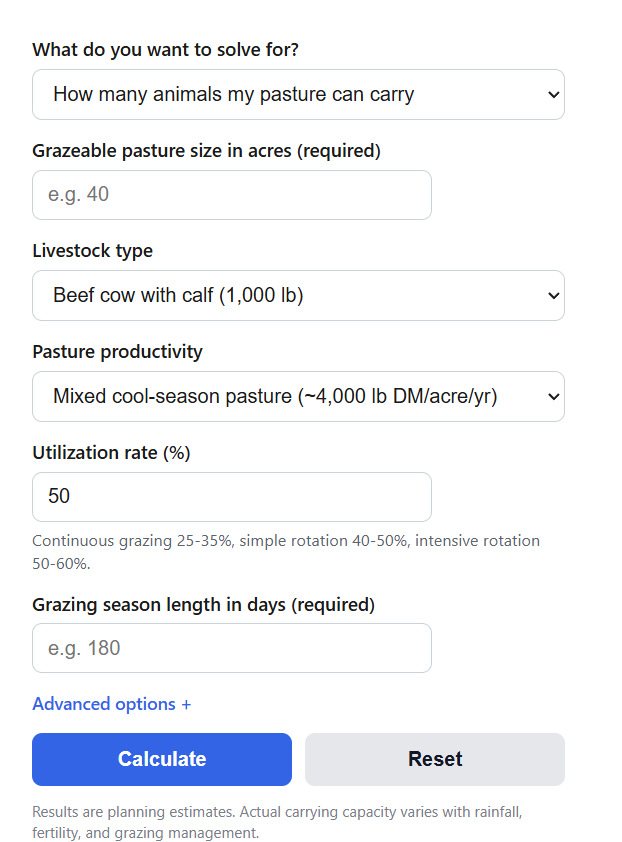
Calculate how many animals your pasture can carry, the acres your herd needs, or how long grazing will last from forage production and utilization.
Pasture Stocking Rate Formula
UF = A * FP * (U/100)
H = UF / (AUE * I * D)
- UF is the usable forage for the grazing season (lb of dry matter)
- A is the grazeable pasture size (acres)
- FP is the annual forage production (lb of dry matter per acre)
- U is the utilization rate (%)
- H is the number of animals the pasture can carry (head)
- AUE is the animal unit equivalent of one animal (1.0 for a 1,000 lb cow with calf)
- I is the daily dry matter intake per animal unit (26 lb DM/day is the standard planning value)
- D is the length of the grazing season (days)
The calculator applies this same relationship in three directions. In carrying capacity mode it solves for H, the number of head your acreage can support for the season. In acreage mode it rearranges the formula to solve for A, the acres required to feed a herd you already own: A = (H * AUE * I * D) / (FP * U/100). In grazing days mode it solves for D, telling you how long the pasture will last before the usable forage runs out: D = UF / (H * AUE * I). Every mode also reports animal unit months (AUM), found by dividing usable forage by 790 lb, the forage one animal unit consumes in a month.
Animal Unit Equivalents and Typical Forage Yields
Stocking rate math only works when different animals are converted to a common unit. The table below lists the animal unit equivalents the calculator uses. For animals not listed, divide the average body weight in pounds by 1,000 to estimate the AUE.
| Livestock type | Animal unit equivalent (AUE) | Daily intake (lb DM) |
|---|---|---|
| Beef cow with calf (1,000 lb) | 1.0 | 26 |
| Beef cow with calf (1,200 lb) | 1.2 | 31 |
| Beef cow with calf (1,400 lb) | 1.4 | 36 |
| Mature bull | 1.35 | 35 |
| Weaned calf / stocker (500 lb) | 0.5 | 13 |
| Yearling (700 lb) | 0.7 | 18 |
| Lactating dairy cow | 1.4 | 36 |
| Mature horse | 1.25 | 33 |
| Ewe with lamb | 0.2 | 5 |
| Goat (doe) | 0.15 | 4 |
Forage production and utilization are the two inputs people guess at most. Use the benchmarks below as starting points, then replace them with clipped samples or local extension yield data when you can.
| Pasture condition | Typical yield (lb DM/acre/yr) | Suggested utilization |
|---|---|---|
| Semi-arid native range | 500 – 2,000 | 25% |
| Unimproved humid-region pasture | 2,000 – 4,000 | 30 – 35% |
| Improved pasture with fertility | 4,000 – 6,000 | 40 – 50% |
| Intensive rotational grazing | 6,000 – 10,000 | 50 – 60% |
Pasture Stocking Rate Example Problems
Example 1: How many cows can 40 acres carry?
A 40 acre pasture produces 4,000 lb of dry matter per acre per year, grazed at 50% utilization over a 180 day season with 1,200 lb cow-calf pairs (AUE 1.2).
Usable forage: UF = 40 * 4,000 * 0.50 = 80,000 lb DM.
Head supported: H = 80,000 / (1.2 * 26 * 180) = 14.2 head. Rounding down, this pasture carries about 14 pairs for the season, or roughly 101 AUM of grazing.
Example 2: How many acres do 25 cows need?
You run 25 head of 1,000 lb cow-calf pairs (AUE 1.0) for 180 days on pasture producing 4,000 lb DM/acre at 50% utilization.
Forage demand: 25 * 1.0 * 26 * 180 = 117,000 lb DM.
Acres required: 117,000 / (4,000 * 0.50) = 58.5 acres, or about 2.3 acres per pair.
FAQ
What is the difference between stocking rate and carrying capacity?
Carrying capacity is what the land can support: the number of animals a pasture can feed for a season without damaging the forage stand. Stocking rate is what you actually put on it: the number of animals per acre you choose to graze. When your stocking rate exceeds carrying capacity, forage is removed faster than it regrows, which leads to overgrazing, weed pressure, and lower yields in following years. The goal of this calculation is to set a stocking rate at or below carrying capacity.
Why does the utilization rate matter so much?
Utilization is the share of total forage growth you plan to harvest with livestock. The rest stays behind for regrowth, ground cover, wildlife, and trampling losses. Doubling utilization from 25% to 50% doubles the calculated carrying capacity, so it is the single most sensitive input in the formula. Continuous grazing typically justifies only 25 to 35% because animals trample and foul much of what they do not eat, while well-managed rotational systems can reach 50 to 60% because paddocks get rest periods to recover.
What should I do if my herd exceeds the calculated capacity?
You have four levers: reduce head count, shorten the grazing season and feed hay for the remainder, add acres, or raise forage production through fertility, interseeding, and rotational management. To size a hay budget, multiply the shortfall in animal unit months by 790 lb; that is roughly the amount of hay dry matter needed to cover the gap. Running the calculator in grazing days mode shows exactly when the pasture is projected to run out, which makes hay planning much easier.