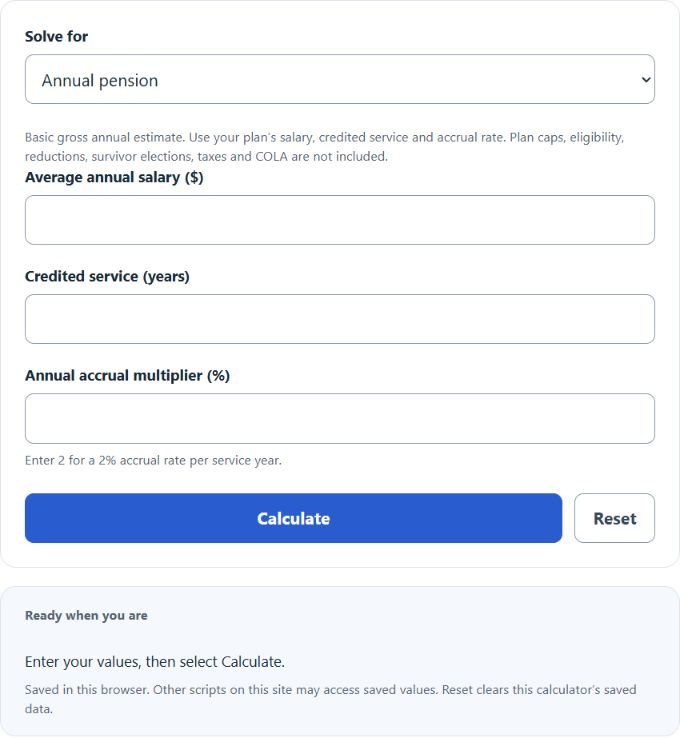
Calculate annual pension, average salary, years of service, or multiplier with a pension formula calculator that solves any missing value.
Pension Multiplier Formula
The pension multiplier calculator estimates annual retirement income for a traditional defined benefit pension plan. It combines three core inputs: your average salary, your credited years of service, and the plan’s pension multiplier.
| Variable | Meaning | What to Enter |
|---|---|---|
| P | Annual pension amount | Your estimated yearly pension benefit |
| AS | Average salary | Usually a final average salary, such as the highest 3 or 5 earning years, depending on the plan |
| YS | Years of service | Your credited service under the pension plan |
| M | Pension multiplier | The plan accrual rate stated as a percent for each year of service |
How the Pension Multiplier Works
The multiplier determines how much of your average salary is earned as a pension benefit for each year you work. A higher multiplier or more years of service increases the final pension estimate.
For example, 30 years of service with a 2% multiplier produces a pension rate of 60% of average salary.
Rearranged Pension Formulas
If you know any three values, you can solve for the fourth. That is why this calculator can estimate a missing input as well as the final pension amount.
| Find | Formula |
|---|---|
| Annual pension |
P = AS × YS × (M) / (100) |
| Average salary |
AS = (P) / (YS × (M) / (100)) |
| Years of service |
YS = (P) / (AS × (M) / (100)) |
| Multiplier |
M = (P) / (AS × YS) × 100 |
How to Use the Calculator
- Enter your average salary for the period used by your pension plan.
- Enter your total credited years of service.
- Enter the pension multiplier as a percent, not a decimal.
- Select the value to solve for, enter the three required inputs, then select Calculate.
- Review the output as an annual benefit estimate and compare it with your plan documents.
Example
If your average salary is $50,000, you have 30 years of service, and your pension multiplier is 2%, the estimate is:
That means the projected annual pension is $30,000. To view it as a monthly gross benefit:
In this scenario, the estimated pension is about $2,500 per month before taxes, survivor elections, insurance deductions, or other plan adjustments.
What Can Change the Actual Pension Amount?
The calculator provides a clean estimate, but many pension plans include additional rules that can raise or lower the final payment. Common factors include:
- Final average salary definition: Some plans use the highest 3 years, highest 5 years, or another averaging period.
- Credited service rules: Leaves of absence, part-time work, purchased service, or military service credits may affect years of service.
- Early retirement reductions: Retiring before the normal retirement age often lowers the monthly benefit.
- Benefit caps: Some plans limit the salary counted or the maximum payable benefit.
- Survivor options: Choosing a joint-and-survivor payout can reduce the monthly amount.
- Cost-of-living adjustments: Some pensions increase after retirement, while others remain level.
Common Input Mistakes
- Entering the multiplier as 0.02 instead of 2.
- Using current salary instead of the plan’s official average salary method.
- Using calendar years worked instead of credited service years.
- Ignoring reductions for early retirement or optional survivor benefits.
- Assuming the estimate is a lump sum rather than an annual pension payment.
Frequently Asked Questions
Is the multiplier always the same for every employee?
No. Pension multipliers vary by employer, plan design, bargaining agreement, job classification, and retirement tier.
Does this calculator estimate monthly or annual pension income?
The primary result is annual pension income. If you want a monthly estimate, divide the annual amount by 12.
Is a higher pension multiplier better?
With salary and credited service held constant, a higher multiplier increases the result of this basic formula. Plan caps and other adjustments may change the actual benefit.
Can I use this calculator for retirement planning?
Use it to compare the basic formula under different inputs, then verify eligibility, credited service, reductions and other plan rules with your pension administrator before making retirement decisions.