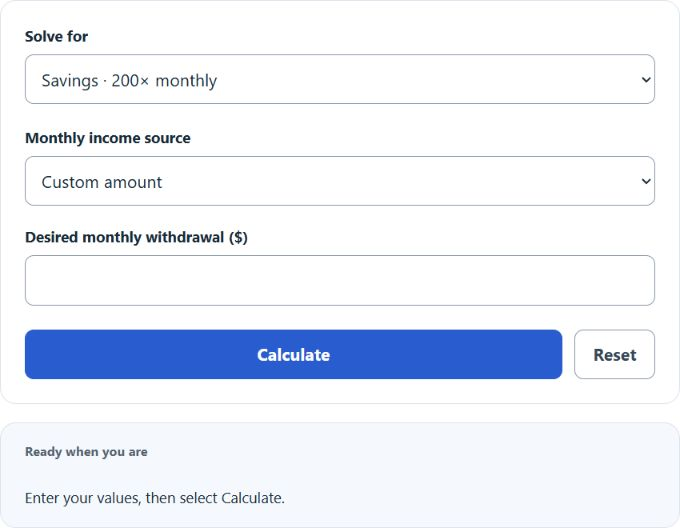
Compare illustrative first-year portfolio and withdrawal amounts with the Rule of 200, Rule of 300, or Rule of 25. These shortcuts do not establish a sustainable retirement plan.
Rule Of 200 Formula
The following formula is used to estimate the amount of money needed to save for retirement using the Rule of 200. (This rule of thumb is mathematically equivalent to assuming roughly a 6% annual withdrawal rate, because 12/200 = 0.06.)
Variables:
- S is the total savings needed for retirement ($)
- I is the desired monthly income during retirement ($)
To estimate the total savings needed for retirement, multiply the desired monthly income during retirement by 200. This gives an estimated portfolio size intended to support that monthly income under the Rule of 200 assumption.
What is a Rule Of 200?
The Rule of 200 is a simplified retirement planning guideline that estimates how much you may need saved based on a target monthly retirement income. It suggests that for every $1 of monthly income you want to withdraw in retirement, you would need about $200 saved. For example, if you want $1,000 per month during retirement, this guideline estimates about $200,000 saved.
This rule is effectively the same as assuming you can withdraw about 6% of your portfolio per year (since annual income = 12·I and savings = 200·I, so 12/200 = 6%). That withdrawal rate is generally considered more aggressive (less conservative) than the commonly cited 4% rule (often expressed as the Rule of 25 for annual income or the Rule of 300 for monthly income). These multipliers calculate only the first-year amount, not sustainability. The usual 4% rule adjusts the initial dollar withdrawal for inflation in later years. This calculator does not project inflation, taxes, fees, investment returns, longevity, or other income such as Social Security or pensions.
How to Calculate Rule Of 200?
The following steps outline how to calculate the Rule Of 200.
- First, determine the desired monthly income during retirement ($).
- Next, use the formula from above: S = I * 200.
- Finally, calculate the total savings needed for retirement by multiplying I by 200.
- After inserting the variables and calculating the result, check your answer with the calculator above.
Example Problem :
Use the following variables as an example problem to test your knowledge.
desired monthly income during retirement ($) = 5000
Total savings needed, S = 5000 * 200 = $1,000,000