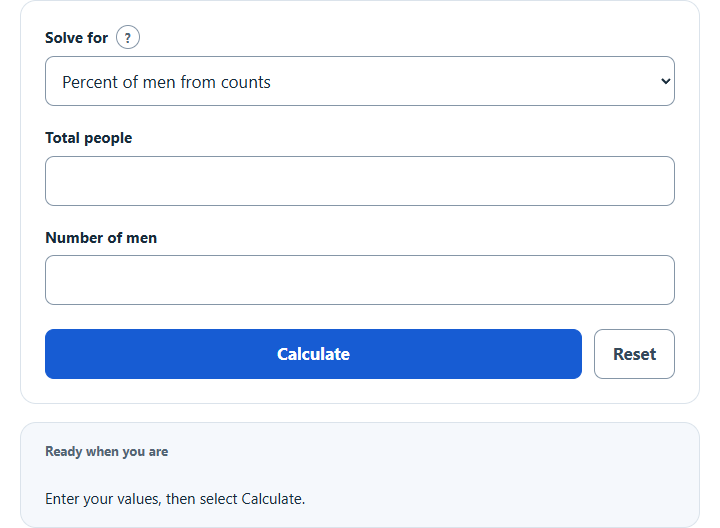
Calculate the percentage of men in a group from the number of men and total people, or find the number of men or the total from a known percentage.
- All Statistics Calculators
- Population Proportion Calculator
- Population Density Calculator
- Population Growth Calculator
- Adult Height Percentile Calculator
Calculator Functions
| Function | What it does | What it requires |
|---|---|---|
| Percent of men from counts | Finds the share of a group who are men, as a percentage | Requires the total number of people and the number of men, both as whole numbers |
| Implied number of men | Finds the number of men a percentage implies for a group of known size | Requires the total number of people and the percentage of men |
| Implied total population | Finds the group size implied by a count of men and the percentage they make up | Requires the number of men and the percentage of men, both above zero |
Every result also shows the number and percentage of people who are not counted as men, and the number of men per 100 people.
Percent of Men Formulas
| PM | Percent of men (%) |
| M | Number of men in the group |
| T | Total number of people in the group |
Percent of men from counts
The count of men is divided by the total and multiplied by 100, the standard way to state one number as a percentage of another [1]. A group of 1,000 people with 500 men is 500 ÷ 1,000 × 100 = 50% men. A count of men larger than the total is rejected.
Implied number of men
The total is multiplied by the percentage. A workforce of 1,200 that is 48.5% men has 1,200 × 48.5 ÷ 100 = 582 men. The answer is not rounded to a whole person, so a result such as 582.4 is an estimate from the percentage and not a head count.
Implied total population
The count of men is divided by the percentage written as a decimal. If 300 men are 40% of a group, the group has 300 ÷ 0.40 = 750 people.
Limits of This Estimate
- Both counts must describe the same group, place and time, and use the same definition of who is counted as a man. Gender and sex classifications are not interchangeable.
- The people not counted as men are the remainder of the group. That remainder is not automatically a count of women.
- A rounded percentage fits more than one pair of whole counts, so the two implied functions give approximate figures.
Sources
- Statistics Canada, Finding and Using Statistics: Using basic statistical techniques, Percentages (archived): one number as a percentage of another