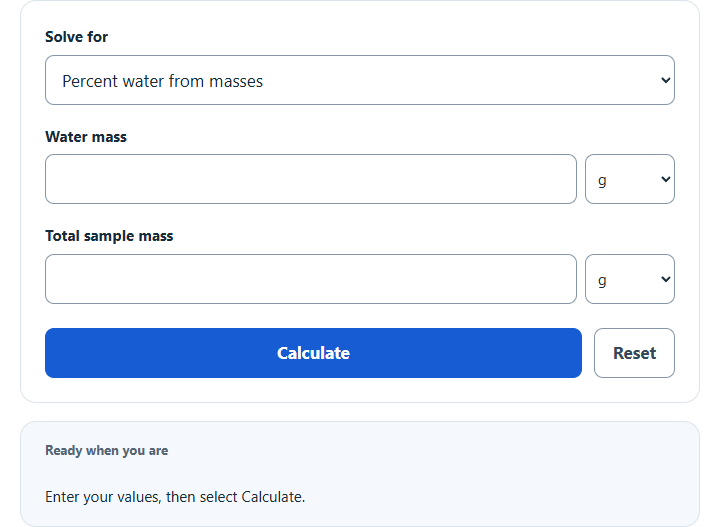
Calculate the mass percent of water in a sample from water and total mass, wet and dry weighings, or hydrate crucible measurements in grams.
Related Calculators
- Weight Volume Percent Calculator
- Percent Solution Calculator
- Water Dilution Calculator
- Mass Balance Calculator
- All Chemistry Calculators
Calculator Functions
| Function | What it does | What it requires |
|---|---|---|
| Percent water from masses | Finds the percent of a sample that is water by mass | Requires the water mass and the total sample mass |
| Water mass from percent | Finds the mass of water in a sample of known water content | Requires the water percent and the total sample mass |
| Total mass from percent | Finds the total sample mass that holds a known mass of water at a known water content | Requires the water mass and the water percent |
| Wet / dry mass | Finds percent water from weighings before and after drying | Requires the wet mass and the dry mass, with an optional container mass |
| Hydrate / crucible | Finds the percent water in a hydrate from a crucible heating experiment | Requires the empty crucible mass and the crucible mass with the sample before and after heating |
| Theoretical hydrate water | Finds the percent water in a hydrate from its formula, with no weighing | Requires the molar mass of the anhydrous compound and the number of waters in the formula |
Masses can be entered in grams, kilograms, pounds or ounces. Every function except Theoretical hydrate water also lists the water mass, the wet sample mass and the dry sample mass.
Percent Water Formula
| %W | Percent water by mass, on a wet basis |
| mw | Mass of water in the sample |
| mt | Total mass of the sample, water included |
This is water content on a wet basis: the mass of water divided by the total mass of the material, as a percent [1]. The two masses must be in the same unit.
Percent water from masses
The main formula is applied directly. A 150 g sample that holds 30 g of water is 30 ÷ 150 × 100 = 20% water. A water mass larger than the total mass is rejected.
Water mass from percent
A 250 g sample at 12% water holds 250 × 12 ÷ 100 = 30 g of water.
Total mass from percent
If 30 g of water makes up 20% of a sample, the sample weighs 30 ÷ 0.20 = 150 g.
Wet / dry mass
(m1 − c) × 100
m1 is the mass before drying, m2 is the mass after drying and c is the container mass, which is 0 when left blank. The mass lost is taken to be water, and the dry matter is taken to stay the same [2]. A sample that goes from 150 g to 120 g has lost 30 g, so it was 30 ÷ 150 × 100 = 20% water.
Hydrate / crucible
The same formula is used with the empty crucible as the container: m1 is the crucible with the hydrate before heating and m2 is the crucible with the residue after heating. A crucible of 20.000 g that weighs 22.500 g before and 21.598 g after gives 0.902 ÷ 2.500 × 100 = 36.08% water. The optional reference compares the measured value with the theoretical water content of a common hydrate.
| Hydrate | Theoretical water |
|---|---|
| Copper(II) sulfate pentahydrate, CuSO₄·5H₂O | 36.08% |
| Magnesium sulfate heptahydrate, MgSO₄·7H₂O | 51.17% |
| Cobalt(II) chloride hexahydrate, CoCl₂·6H₂O | 45.43% |
| Barium chloride dihydrate, BaCl₂·2H₂O | 14.75% |
| Sodium carbonate decahydrate, Na₂CO₃·10H₂O | 62.96% |
| Calcium chloride dihydrate, CaCl₂·2H₂O | 24.51% |
Theoretical hydrate water
(M + n × 18.0153) × 100
n is the number of waters in the hydrate formula, M is the molar mass of the anhydrous compound in g/mol and 18.0153 g/mol is the molar mass of water [3]. For copper(II) sulfate pentahydrate, M = 159.609 and n = 5, so the water is 90.0765 g of a 249.6855 g/mol hydrate, or 36.08%. A hemihydrate uses n = 0.5. The reference values in the table follow from the same formula and the standard atomic weights [4].
Limits of This Estimate
- The result is on a wet basis, with the total mass as the divisor. Moisture content on a dry basis divides by the dry mass and gives a larger number for the same sample [2].
- The drying functions count all of the mass lost as water. Other volatile substances, decomposition on heating or incomplete drying shift the result.
- A measured value near a theoretical one is consistent with that hydrate. It does not identify the compound.
Sources
- Purdue University, ABE 305 Moisture module, Wet Basis Moisture Content: wet basis water content as water mass over total mass
- Purdue University, ABE 305 Moisture module, Methods of Calculating Moisture Content: wet and dry basis, and the assumption that only water is lost on drying
- NIST Chemistry WebBook, Water: molar mass of water
- IUPAC Commission on Isotopic Abundances and Atomic Weights, Abridged Standard Atomic Weights: atomic weights behind the hydrate reference values