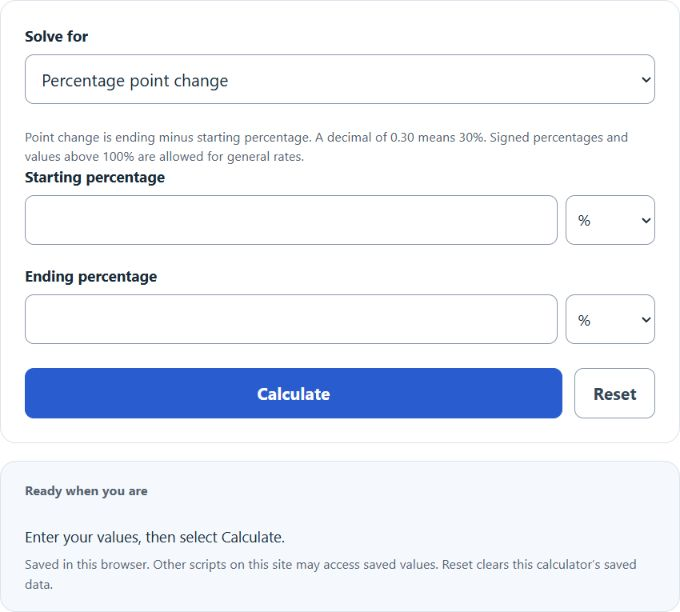
Calculate percentage point differences or percent change from two percentages, and solve for the missing starting, ending, or difference value.
- Basis Points Commission Calculator
- Basis Points Difference Calculator
- All Math and Numbers Calculators
- Reverse Percentage Calculator
Percentage Points Formula
The following equation is used to calculate the Percentage Points.
- Where PP is the difference in percentage points
- P2 is the second percentage (%)
- P1 is the first percentage (%)
To calculate the difference in percentage points, subtract the first percentage from the second percentage.
What Are Percentage Points?
Definition:
Percentage point change is the signed difference between the ending and starting percentages; its magnitude is the absolute gap. For instance, moving from 30% to 35% is a 5 percentage point increase. This is different from a 16.67% relative increase, which calculates how much one percentage changes relative to another in percentage terms.
How to Calculate Percentage Points?
Example Problem:
The following example outlines the steps and information needed to calculate the difference in Percentage Points.
First, determine the initial percentage. In this example, the first percentage is 30%.
Next, determine the second percentage. In this example, the second percentage is 45%.
Finally, calculate the difference in percentage points using the formula above:
PP = P2 – P1
PP = 45% – 30%
PP = 15 percentage points
FAQ
Does a percentage point difference measure the same as a relative percent change?
No. A difference of percentage points is an absolute measure (e.g., from 30% to 35% is a 5 percentage point change), while a relative percent change compares the change with the original value (e.g., 35% is about a 16.67% increase from 30%).
When should I use percentage points instead of relative percent changes?
Use percentage points when you want to describe the direct difference between two percentages without referencing the relative size. It’s particularly useful in fields like finance, economics, or poll results when you need an exact numeric gap rather than a relative comparison.
Can a percentage point difference be negative?
Yes, if the second percentage is lower than the first. For example, going from 40% to 30% is a -10 percentage point change.
Why is it important to distinguish between percentage points and percent changes?
Failing to distinguish between the two can lead to confusion or misinterpretation of data. Using each measure correctly ensures clarity, especially in professional or academic contexts where precise data interpretation is crucial.