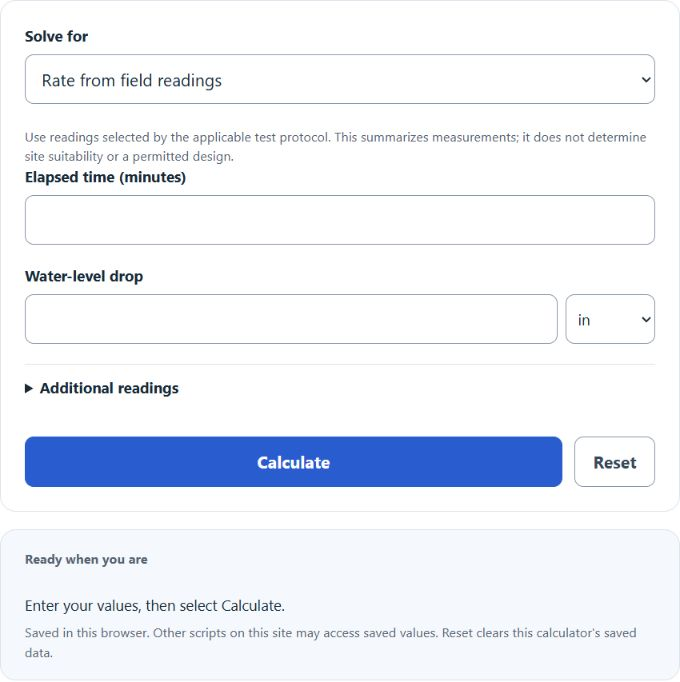
Calculate percolation rate in minutes per inch from perc test readings: enter the elapsed time and water-level drop, or average up to three readings.
- All Construction Calculators
- All Rate Calculators
- Water Vapor Transmission Rate Calculator
- Evaporation Rate (Water) Calculator
- Drain Flow Rate Calculator
Percolation Rate Formula
The calculator finds a percolation rate, an arithmetic mean of up to three entered rates, or a constant-rate time or drop estimate.
Volume flow (volume divided by time) is a different quantity and is not a mode in this calculator.
Perc test mode
- PRp = perc test rate, usually in min/in or min/cm
- T = elapsed time
- d = water level drop distance
A lower min/in value means faster water-level fall. For multiple entries, the calculator takes the unweighted arithmetic mean of the individual T/d ratios, not sum(T)/sum(d). Use comparable, protocol-selected readings. Time = rate × drop; drop = time / rate.
Reciprocal water-level fall speed
- PRp = percolation rate in min/in
- I = reciprocal water-level fall speed in in/hr
- 60 = minutes per hour
For centimeter units, the calculator uses exactly 1 inch = 2.54 cm. Converting the mean min/in rate gives 60 divided by that mean; it does not give the arithmetic mean of individual speeds. Perc-test level fall does not automatically equal areal infiltration or saturated hydraulic conductivity.
Interpretation and Test Limits
Use the preparation, stabilization, reading selection and acceptance criteria required by the applicable local test protocol. A simple average of arbitrary readings does not establish site suitability or an approved design.
There is no universal ideal/fast/slow cutoff assigned here. NRCS hydrologic soil groups depend on soil-profile hydraulic conductivity, restrictive layers and water-table depth; a single fixed infiltration-rate preset cannot identify a group. Consult the applicable soil survey and permitting authority.
How to Check a Percolation Rate Result
Make sure the water level drop and time are both greater than zero. Use the same test method for each hole if you compare multiple locations.
Example: if the water drops 2 inches in 30 minutes, the perc rate is:
15 min/in equals approximately 5.9055 min/cm. Its reciprocal water-level fall speed is 4 in/hr (10.16 cm/hr). These are unit conversions, not a site-approval or hydraulic-conductivity determination.