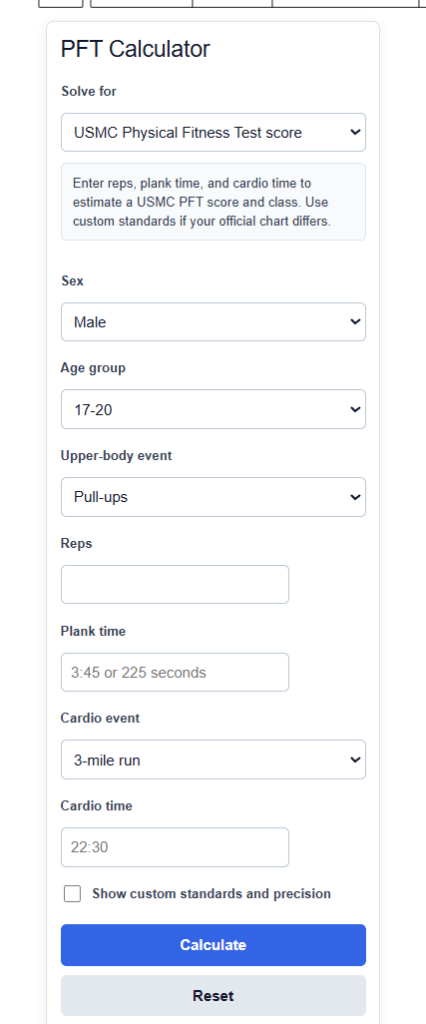
Calculate your PFT result from your raw test inputs. This calculator works in two modes: a USMC Physical Fitness Test score from your upper-body event, plank, and cardio time, and a pulmonary function test ratio from your FEV1 and FVC.
PFT Formula
In USMC mode, each event earns 40 to 100 points on a straight-line scale between the minimum and maximum standard for your sex and age, and the three event scores are added together.
EventScore = 40 + (Value - Min) / (Max - Min) * 60
PFT = UpperScore + PlankScore + CardioScore
For timed events the same scale runs in reverse, so a faster time scores higher and the maximum-point time earns the full 100.
In pulmonary mode, the calculator divides FEV1 by FVC to give the airflow ratio as a percent.
FEV1/FVC = FEV1 / FVC * 100
- EventScore: points for a single USMC event, from 40 at the minimum to 100 at the maximum (pull-ups and plank cap at 100, push-ups cap at 70).
- Value: your raw reps for the upper-body event, or your time for the plank and cardio events.
- Min: the passing standard for the event, set by your sex and age group.
- Max: the perfect-score standard for the event, set by your sex and age group.
- PFT: total Physical Fitness Test score out of 300.
- FEV1: forced expiratory volume in the first second of a hard exhale.
- FVC: forced vital capacity, the total volume you can exhale.
The USMC mode reads your sex and age group to load the correct minimum and maximum for each event, scores the three events, and adds them for a total out of 300 with a class rating. The pulmonary mode reports the FEV1/FVC ratio and flags an obstructive pattern when the ratio falls below your cutoff. If you also enter percent-predicted values, it flags a possible restrictive pattern when FVC is low with a normal ratio, and grades the FEV1 level.
USMC Standards and Pulmonary Cutoffs
The USMC mode uses these reference points for the perfect (100-point) and passing (40-point) marks. Your exact run standard shifts with age group; the values below are the younger-age baseline.
| Event | 100 points | Passing (40) |
|---|---|---|
| Pull-ups (male) | 23 reps | 4 reps |
| Pull-ups (female) | 12 reps | 1 rep |
| Plank (both) | 3:45 | 1:10 |
| 3-mile run (male) | 18:00 | 28:00 |
| 3-mile run (female) | 21:00 | 31:00 |
Choosing push-ups instead of pull-ups caps that event at 70 points, so the highest total then drops from 300 to 270. The total score sorts into a class rating.
| Total score | Class |
|---|---|
| 235 to 300 | 1st class |
| 200 to 234 | 2nd class |
| 150 to 199 | 3rd class |
| Below 150 or any event below 40 | Fail |
For pulmonary mode, the ratio and percent-predicted values are read against these common reference points.
| Measure | Reading | Typical meaning |
|---|---|---|
| FEV1/FVC | At or above 70% | No simple obstruction |
| FEV1/FVC | Below 70% | Obstructive pattern |
| FVC percent predicted | Below 80% with normal ratio | Possible restrictive pattern |
| FEV1 percent predicted | Below 80% | Reduced airflow, graded by severity |
Example Problems
Example 1 (USMC mode). A male Marine in the 21-25 age group does 20 pull-ups, holds a 3:00 plank, and runs 3 miles in 21:00. Pull-ups score 40 + (20 - 4) / (23 - 4) * 60, which is about 91. The 3:00 plank is past the 3:45 max-point mark on the reverse scale and scores below 100, while a strong hold near the top still earns full marks; a clean 3:45 would score 100. The 21:00 run scores 40 + (1680 - 1260) / (1680 - 1080) * 60, which is 82. Adding the three events gives a total in the 1st class range above 235.
Example 2 (pulmonary mode). You enter FEV1 of 2.1 liters and FVC of 3.5 liters with a cutoff of 70. The ratio is 2.1 / 3.5 * 100, which is 60%. Because 60% is below the 70% cutoff, the calculator flags an obstructive pattern. If you also enter an FEV1 of 65% predicted, it reports the airflow as reduced and grades the level.
Frequently Asked Questions
Which PFT does this calculator handle? Two. In USMC mode it scores the Marine Corps Physical Fitness Test from your upper-body event, plank, and cardio time. In pulmonary mode it computes the FEV1/FVC ratio used to read spirometry results. Pick the one you need from the solve-for selector at the top of the form.
Why does choosing push-ups lower my maximum score? The Marine Corps scores push-ups as an alternative to pull-ups and caps that event at 70 points rather than 100. If you choose push-ups, the highest possible total for the test drops from 300 to 270, so pull-ups are the only way to reach a perfect 300.
What FEV1/FVC ratio counts as obstructive? A common adult cutoff is 70%. A ratio below that flags an obstructive pattern, while a normal or high ratio paired with a low FVC suggests a restrictive pattern instead. You can change the cutoff field if your lab uses a lower-limit-of-normal value rather than a fixed 70%. These figures support reading a result and do not replace a clinician's interpretation.