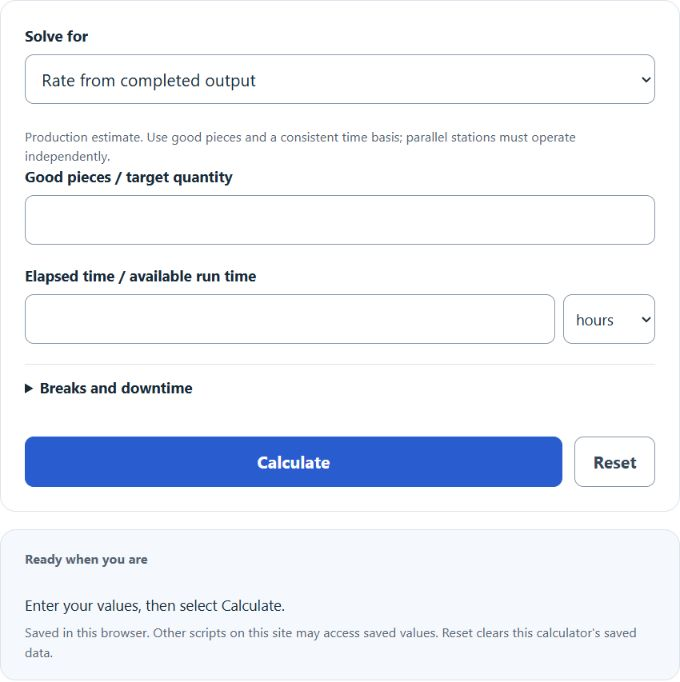
Calculate pieces per hour from good output and net work time or cycle time, then estimate target quantity, run time, cycle speed, and 8-hour output.
Pieces Per Hour Formula
The calculator uses four formulas, one for each solve mode.
Find PPH (from a finished run):
Cycle time (from machine or station data):
Expected output (from total rate and available run time):
Plan target (time needed to hit a target):
- PPH – pieces per hour
- Total Pieces – good pieces produced (scrap excluded)
- Hours Worked – elapsed time minus entered breaks or downtime, expressed in hours
- Pieces per Cycle – good pieces from one cycle of one station
- Cycle Time – measured time for one station to complete a cycle (Lean Enterprise Institute); this differs from the aggregate output interval of parallel stations
- Stations – identical independent stations running at the stated cycle time
- Productive Time – a user-entered percentage greater than zero and up to 100, divided by 100 in the cycle formula; it is not an industry benchmark
- Total Rate – combined good pieces per hour, already including all stations; do not multiply it by station count again
Use good pieces for customer-usable output. Counting scrap gives a gross rate instead. Cycle mode assumes identical stations run independently. Use the same time basis for a total rate and its output or time projection, and count each time loss once.
Reference Tables
Quick conversions for one station making one good piece per cycle at 100% productive time. The eight-hour column assumes eight run hours on the same basis, without added breaks:
| Cycle Time | Pieces / Hour | Pieces / 8-hr Shift |
|---|---|---|
| 2 sec | 1,800 | 14,400 |
| 5 sec | 720 | 5,760 |
| 15 sec | 240 | 1,920 |
| 30 sec | 120 | 960 |
| 1 min | 60 | 480 |
| 2 min | 30 | 240 |
| 5 min | 12 | 96 |
These productive-time percentages are hypothetical planning illustrations, not industry benchmarks or recommended defaults. Use your own observed time basis:
| Illustration | Productive Time |
|---|---|
| Example A | 100% |
| Example B | 90% |
| Example C | 75% |
| Example D | 50% |
Example
A line ran from 7:00 AM to 3:30 PM with a 30-minute lunch and produced 1,920 good units. Worked time is 8 hours.
PPH = 1,920 ÷ 8 = 240 units/hr, or 4 units per minute, or 15 seconds per unit.
To produce 3,000 more units at the same rate: 3,000 ÷ 240 = 12.5 hours. Adding a second identical station cuts that to 6.25 hours.
FAQ
Should I use good pieces or total pieces? Use good pieces if you care about throughput that customers actually receive. Use total pieces if you are measuring raw machine output.
Do I subtract breaks from time worked? Yes, if the line is stopped during breaks. The clock-time mode handles this with the break field.
Why does my cycle-time PPH look higher than my actual PPH? At 100% productive time, cycle mode assumes continuous production. Changeovers and stops may reduce actual output. Apply an observed productive-time percentage only for losses not already included in the cycle time or run-time basis; do not subtract the same loss twice.